
Before You Hire Your First Team, You Need to Answer This:-)
Why Should Someone Work For You? When you want to scale from solopreneur → your first team, there’s one question you must answer honestly: Why should someone…

Why Should Someone Work For You?
When you want to scale from solopreneur → your first team, there’s one question you must answer honestly:
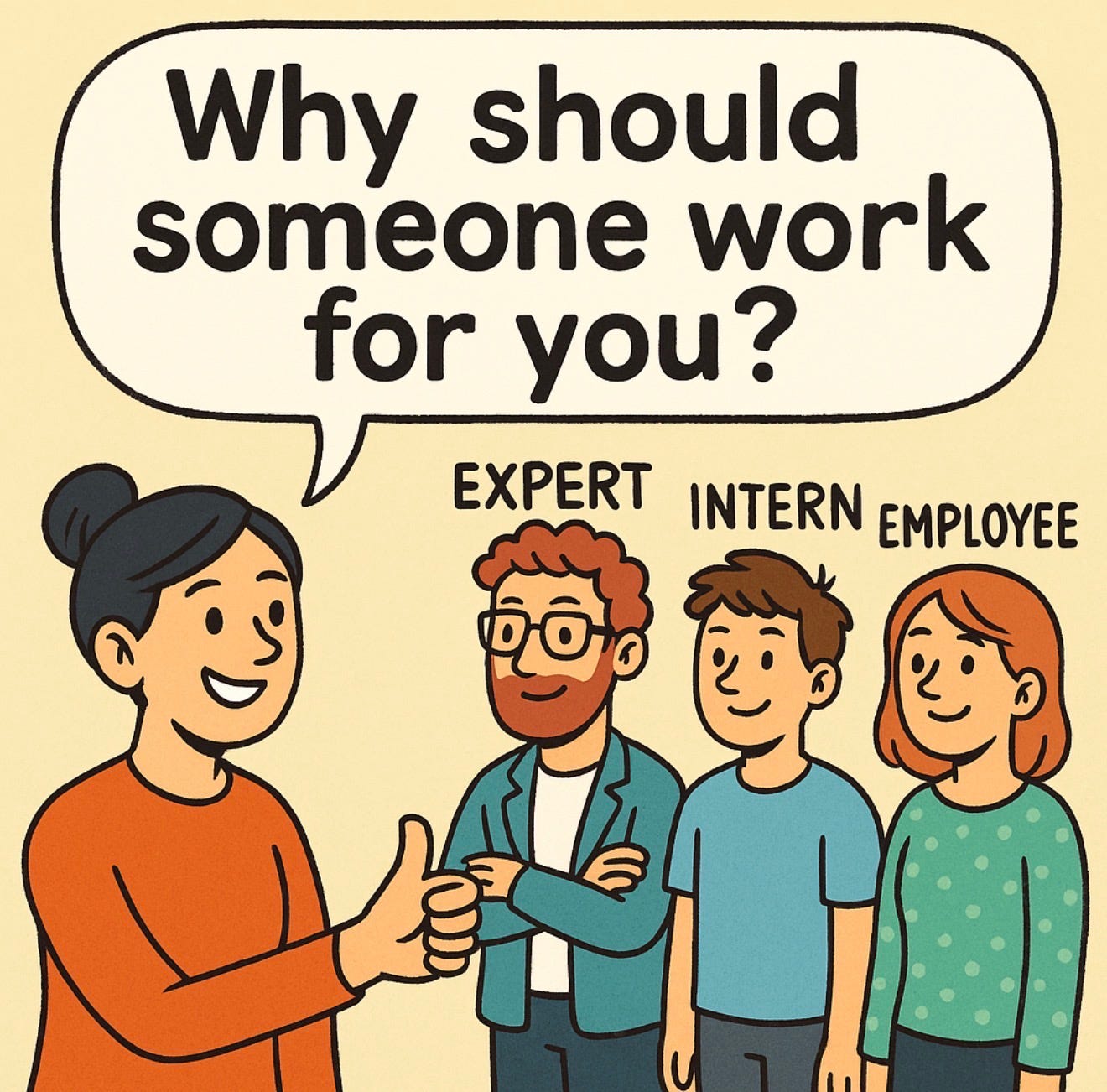
Why should someone work for you?
Not “why should they buy from you.”
Not “why should they follow you.”
Very specifically:
Why should a smart, capable person choose to give their time, energy, and reputation to your company?
Because the moment you decide to hire- even one intern, one contractor, one expert- you’re crossing a line:
You’re no longer just selling your own time.
You’re buying other people’s time.
And that’s the real entry point into entrepreneurship.
If our writing helps you grow even 1% each week ( that’s what we call Incremental Growth ) , becoming a Paid Subscriber is the best way to support this journey. It costs less than a coffee ☕️, but it directly fuels the hours i and my team invest in creating these founder-tested frameworks for you.
🔁 From Selling Your Time → Buying Other People’s Time
As a solopreneur, the model is simple:
You do the work
You deliver the work
You get paid
Even if you have a job + side business, you’re still in a “time for money” equation- just split across multiple buckets.
Then something happens:
You crack a niche.
You start getting more clients.
Your calendar fills up.
You hit your own capacity.
And then comes the friction:
“I have enough work in hand. I don’t have enough time in hand.”
This is where your mindset must shift from:
“How can I do more?”
to
“Whose time can I buy so the work still gets done at my standard?”
That’s your first real step into entrepreneurship.
But before you buy anyone’s time-
you must know why they would choose to work under your umbrella in the first place.
🚦First Filter: Who
Not
to Work With
Let’s start with a big red flag from my own experience:
If someone is working only to “get your client”, that is not a person you need to associate with.
If their intention is:
to own the client
to have their name in front
to build their brand on top of your system
…then they’re not your team. They’re a parallel business waiting to separate.
You can collaborate tactically with such people on clear, one-off deals.
But they are not the foundation of your first team.
Your team should plug into your system, not build a separate branch from your roots.
If this article helped you think differently, you’ll love what’s coming next. Become a Paid Subscriber to support the work and access deeper, actionable founder-level insights — all for the price of a coffee ☕️.
👑 Case 1: Working With an Expert (Who You Pay More)
Sometimes, you genuinely need an expert.
Maybe:
a senior trainer,
a specialised consultant,
a developer for a complex build,
or someone with credibility in a niche.
You may have to pay them more than anyone else on your team. That’s fine.
But then the question is:
How do you set up the system so that this expert works under you, respects your authority, and doesn’t run away with your business?
Here’s what I’ve learned:
1️⃣ Payments Flow Through
You
, Not Around You
The client should always:
receive invoices from your company
pay into your company account
From there, you pay the expert.
If the expert wants the client to pay them directly “for convenience” – that’s your first warning.
2️⃣ Contracts Are Boring… Until They Save Your Business
For experts, you should have at minimum:
Service Agreement
NDA (Non-Disclosure Agreement)
Non-solicit clause (they can’t directly pitch your client behind your back)
You don’t need 20-page legal drama.
You just need clear, written expectations.
3️⃣ Identity Matters: Company Email, Not Personal
Your expert should work through:
a company email ID (e.g. expert@yourcompany.com)
your Teams / Slack / official channels
The client should experience them as a part of your company, not as an outside agency.
This subtly establishes:
authority
branding
and belonging.
If you want more posts like this and want to stay ahead of the curve, consider becoming a Paid Subscriber.It supports this work — and costs less than a cup of coffee ☕️.
🌱 Case 2: Working With Interns (Your Future Powerhouse)
Interns are a completely different game.
You’re not buying pure expertise here.
You’re buying:
time
energy
and potential
Which means your responsibility increases.
“People are coming to you for your company level work. The intern is an extension, not a replacement.”
Here’s how to do this right:
1️⃣ Attach Them to
You
(or Your Expert), Not to the Client
Interns can:
prepare drafts
do research
create first versions
handle repetitive tasks
But validation must come from you or an expert.
They shouldn’t be left alone to represent your final quality.
2️⃣ Sell Them the Story, Not Just the Stipend
Great interns join you because:
they see your journey
they believe in your growth
they sense they’ll learn things they’d never see in a big company
Share your vision.
Show them the system you’re building.
Make them feel part of something being built, not just “cheap help”.
3️⃣ Start With Control-Friendly Tasks
Initially, give them:
structured tasks
SOP-backed work
things where mistakes won’t break the client relationship
You’re testing:
reliability
consistency
attitude
From there, you slowly move them into more critical work.
4️⃣ Don’t Promote Too Fast - Intern Success ≠ Long-Term Stability
And yes - if an intern performs really well, handles tasks end-to-end, or even manages a client beautifully… don’t get over-excited and convert them into a full-time employee overnight.
Why? Because early success is not the same as long-term consistency.
Founders make this mistake all the time:
Intern does great for 2–3 months
Founder feels relieved (“Finally someone who gets it!”)
Founder offers a full-time role + big salary + perks
One client project ends → workload drops → regret begins
Interns join at a very minimal stipend, so their expectations rise sharply the moment you talk “full-time.”
If you jump too fast, you lock yourself into cost commitments before you even know if the work pipeline is stable.
Here’s the smarter way to scale:
✔ Put them on a 6–12 month Contract-to-Hire model
✔ Increase pay moderately (never drastically)
✔ Track consistency, reliability, attitude, and ownership
✔ Watch how they behave when pressure increases or when work slows down
✔ Evaluate whether they can handle multiple clients, not just one
This way:
You protect your company’s finances
You protect your control
You protect your system from emotional decisions
And most importantly, you give them a clear growth path without breaking your structure
Intern → Contract (higher stipend) → 1-year contract → Full-time (only after long-term proof)
This is the real founder-safe progression.
Go slow here.
Your system should grow steadily, not emotionally.
If you’d like to keep learning insights like this and stay ahead of the curve, consider becoming a paid subscriber. It supports my work — and costs less than a cup of coffee ☕️.
🧩 Case 3: Full-Time Team Members (Your Core System)
Then there are full-time employees - or long-term contract equivalents.
These people form the spine of your company.
They’re not just here for a project.
They’re here for the journey.
Why should they work for you instead of a big brand?
Because you can offer them things big brands rarely can:
Direct exposure to real decisions
Faster growth in scope
Closer proximity to impact
Flexibility + learning
Ownership over outcomes
But to make that true, your side must be solid:
1️⃣ Role & Growth Must Be Clear
Even if small, you can say:
“For the next 6 months, you’ll handle X and Y.
If we hit A, B, C milestones, your role expands into Z.”
People don’t just join for “now”.
They join because they can imagine their later.
2️⃣ Payroll & Payout Needs to Be Predictable
Use systems like:
Zoho Payroll / Zoho Books (India & UAE)
Gusto / QuickBooks (US)
Your team should never wonder:
“Will I be paid on time?”
If they feel safe, they will give extra.
If they feel insecure, they will keep one foot out.
3️⃣ Communication Must Be Centralized
Everything should be on:
Microsoft Teams or Slack
Company email
Shared drives / folders
No random WhatsApp chaos as your primary channel.
You can’t scale trust on scattered screenshots.
🎯 The Real Question Behind “Why Should Someone Work For You?”
It all boils down to this:
Can I give people a safe, clear, growth-oriented system to work inside?
Because:
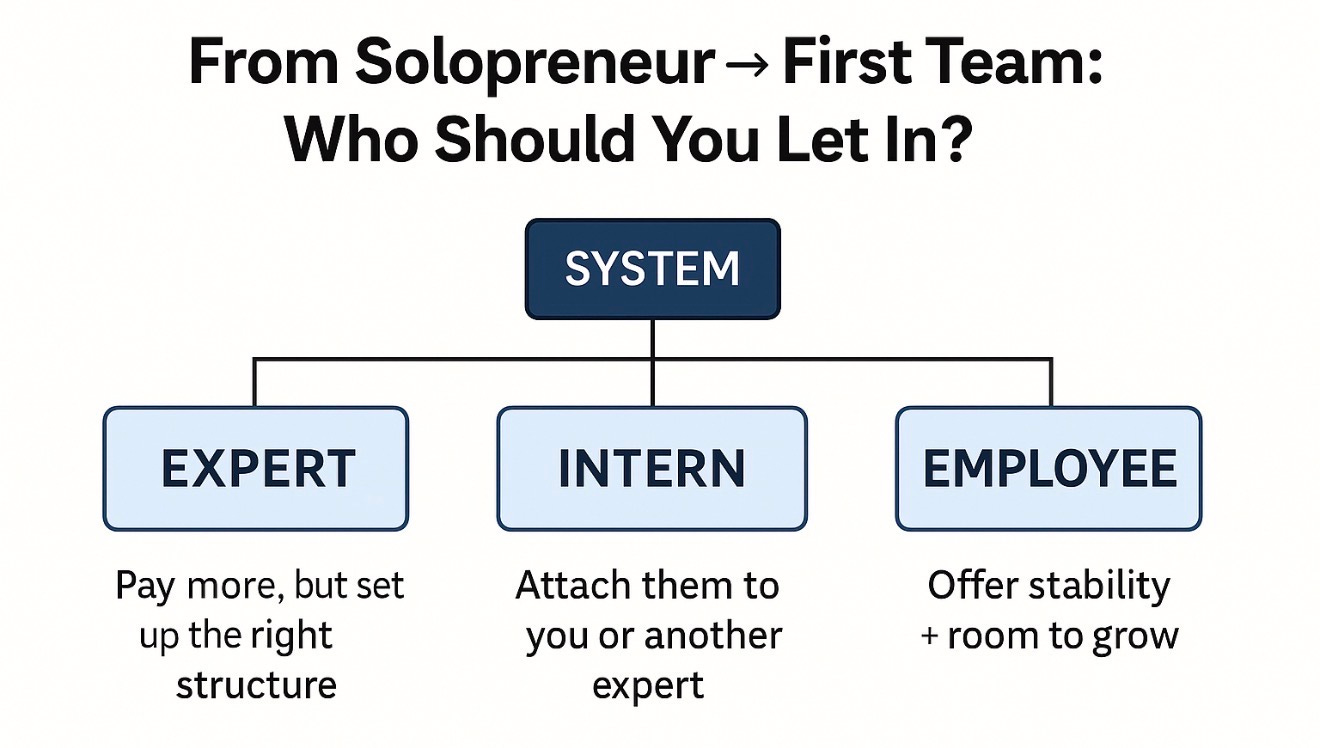
Experts work with you when they see structure + respect + timely payouts.
Interns work with you when they see learning + exposure + possibility.
Employees work with you when they see stability + growth + clarity.
So before asking:
“Where do I find good people?”
Start with:
“If a good person showed up today, would my system make them want to stay?”
That’s the founder’s real work.
If these posts are helping you think and build better, consider joining as a paid subscriber. It’s a small gesture — a coffee-sized one ☕️ — that fuels big work.
🧱 This Is Why We’ve Been Building the System Step-by-Step
All the earlier posts in this series are actually building towards this point:
You get:
your company structure in place
your email & access control in place
your money pipeline in place
your AI & delegation systems in place
…so when you finally add people, they’re not walking into chaos.
They’re walking into a designed environment where:
they know who’s in charge
they know how work flows
they know how money flows
they know how they grow
That’s why someone will choose to work for you.
📌 Previous Posts in This AI Solopreneur → System Founder Series
If you’re new or want to revisit the flow, here are the earlier posts that connect into this one:
1️⃣ Who owns the code and access?
https://open.substack.com/pub/instrovate/p/who-owns-the-code-in-the-age-of-ai
2️⃣ How to manage a tech team when you’re not technical
https://open.substack.com/pub/instrovate/p/how-to-manage-a-tech-team-when-youre
3️⃣ From Solopreneur → Micro-Team: How to scale while staying in control
https://open.substack.com/pub/instrovate/p/from-solopreneur-to-micro-team-how
4️⃣ The Revenue Share Trap — Why founders lose control in % deals
https://open.substack.com/pub/instrovate/p/the-revenue-share-trap-why-founders
5️⃣ Push vs Pull — The Founder’s Revenue System
https://open.substack.com/pub/instrovate/p/push-vs-pull-the-founders-revenue-system
6️⃣ How to Build an AI-Run Business Without Being an AI Engineer
https://open.substack.com/pub/instrovate/p/how-to-build-an-ai-run-business-without
7️⃣ The Invisible Founder — How to run your AI company without losing control
https://open.substack.com/pub/instrovate/p/the-invisible-founder-how-to-run
8️⃣ How to Set Up Your AI Company Before You Scale It
https://open.substack.com/pub/instrovate/p/how-to-set-up-your-ai-company-before
9️⃣ How to Build a Solopreneur Business While Working a Full-Time Job
https://open.substack.com/pub/instrovate/p/how-to-build-a-solopreneur-business
🔟 How I Bought My First BMW While Working a Full-Time Job
https://open.substack.com/pub/instrovate/p/how-i-bought-my-first-bmw-while-working
Originally published on Substack