Forward Deployed Engineers (FDEs): The Missing Link Between Data & AI Investments and Business Value
Why organisations need engineers who don’t just understand technology, but know how to make it work in the real world.
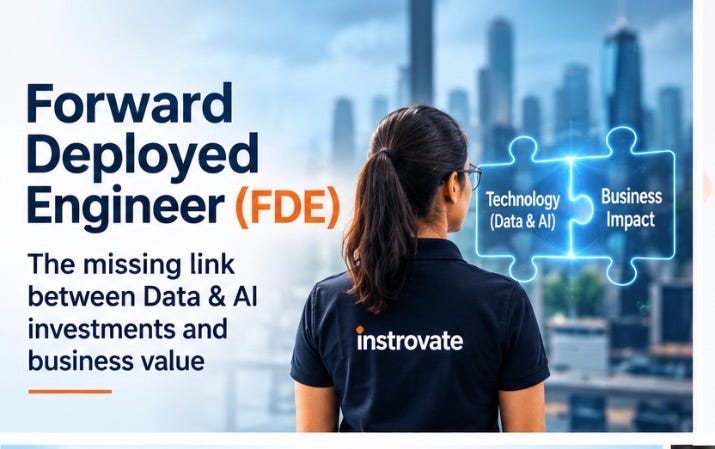
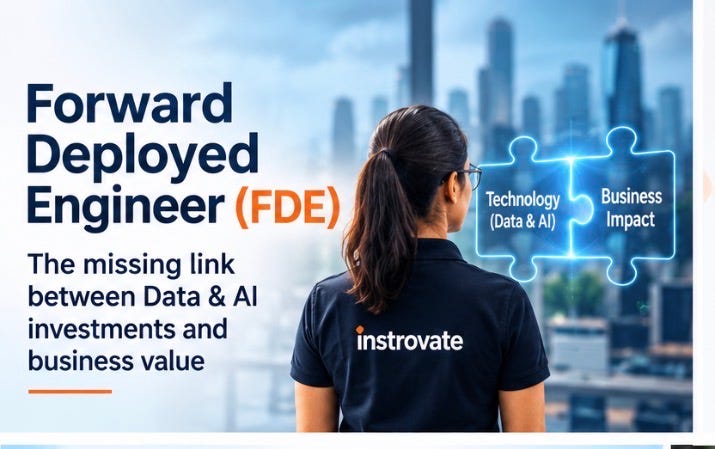
Introduction: The Technology Is Ready. Is the Business?
Companies are investing heavily in data platforms, cloud infrastructure, artificial intelligence, and business automation. Platforms such as Databricks, Microsoft Fabric, Microsoft Power Platform, Microsoft Dynamics 365, and Microsoft Copilot are opening up possibilities that would have seemed ambitious just a few years ago.
Organisations can now unify data from multiple systems, automate complex workflows, build intelligent applications, introduce AI-powered assistants, and enable employees to make faster, more informed decisions.
Yet a familiar problem continues to emerge.
A proof of concept looks promising. A demonstration impresses stakeholders. The technology performs exactly as expected in a controlled environment. But when the solution is introduced into the actual business, progress slows down.
The data is inconsistent. Existing systems do not integrate as expected. Security requirements introduce additional complexity. Users continue following their old processes. Business requirements evolve. And a promising pilot struggles to become a production-ready solution.
Why does this happen?
Because implementing technology and making it work inside a real business are two very different things.
This is where the role of the Forward Deployed Engineer (FDE) becomes particularly important.
1. What Is a Forward Deployed Engineer?
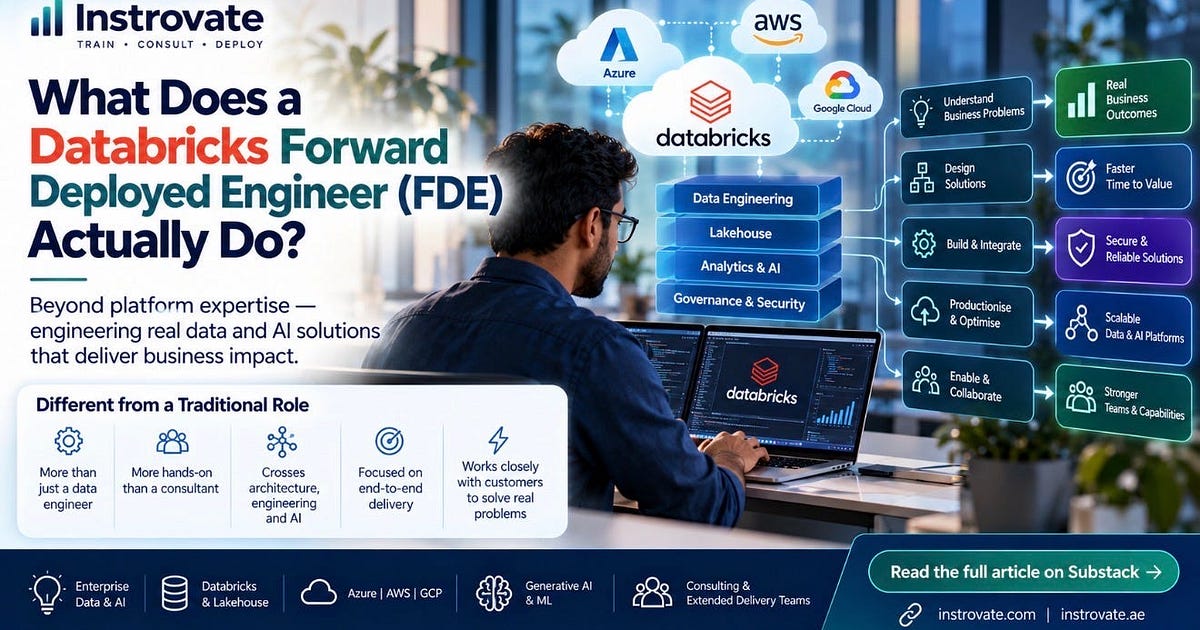
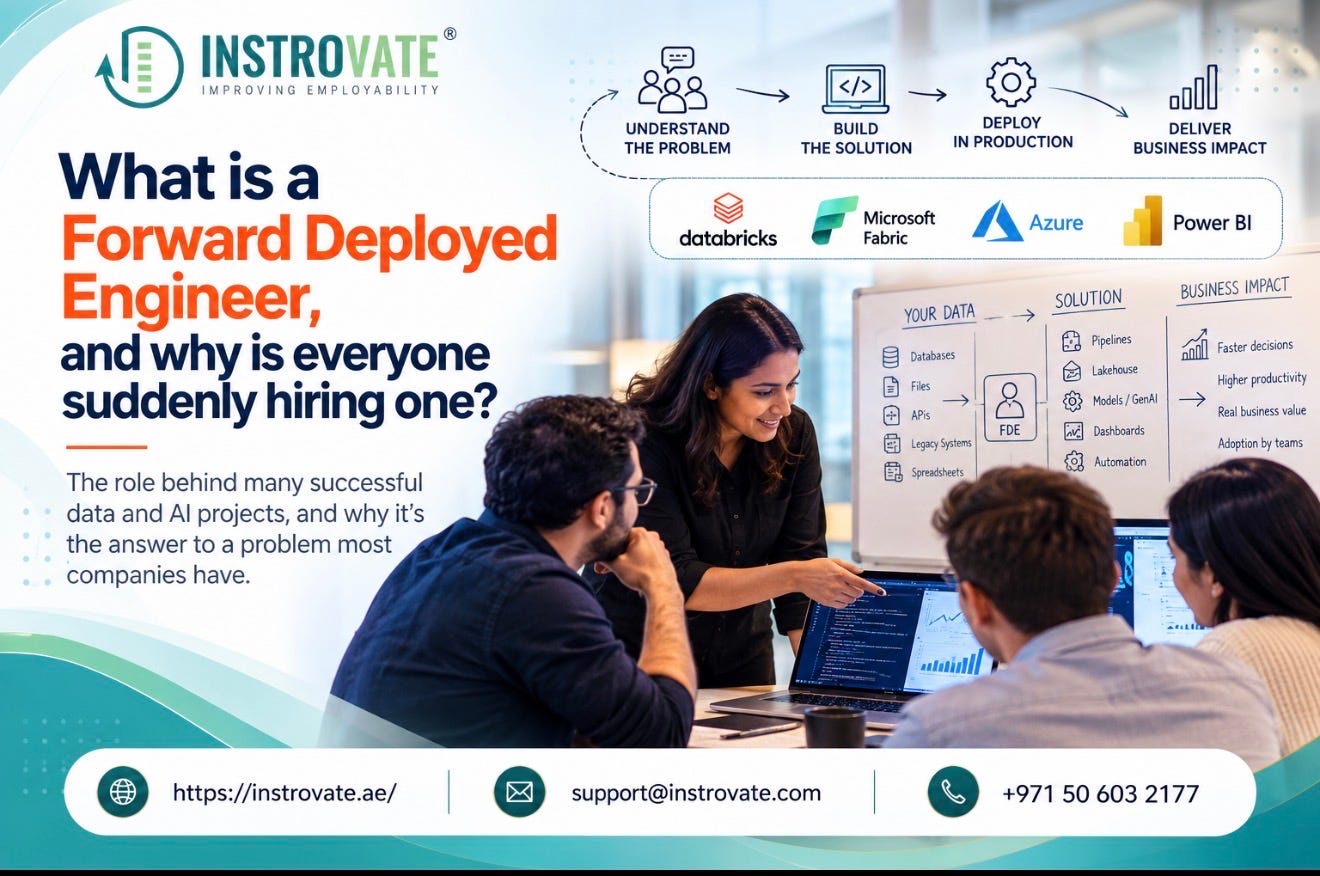
A Forward Deployed Engineer is a technically strong, hands-on professional who works closely with a customer or business team to understand a problem, build a solution, deploy it in the customer’s environment, and help ensure that it delivers the intended outcome.
Rather than working exclusively from a product team’s roadmap or receiving requirements through several layers of handovers, an FDE operates close to the people experiencing the problem.
They might spend time with a finance team struggling with manual reporting, a supply chain team dealing with fragmented data, a sales organisation looking to improve forecasting, or an IT team trying to introduce generative AI securely.
The FDE learns how the business actually works, identifies the technical and operational constraints, and translates that understanding into a working solution.
The role is commonly associated with Palantir’s approach to embedding engineers with customers. As enterprise AI adoption accelerates, the same general model is becoming relevant across data platforms, AI companies, cloud services, and enterprise software.
The important distinction is that an FDE is not simply a consultant who makes recommendations or an engineer who works through a predefined backlog.
An FDE combines technical execution with customer engagement and outcome ownership.
In simple terms, the role brings together three responsibilities:
Understand the problem: Work directly with stakeholders to discover the real business need, not just the initial request.
Build the solution: Write code, develop integrations, create data pipelines, configure platforms, and implement applications.
Make it work in practice: Deploy, test, refine, document, and support adoption so that the solution becomes part of the business workflow.
The work is not complete merely because the code runs. The solution must also be reliable, secure, maintainable, and useful to the people who depend on it.
2. Why Are Forward Deployed Engineers Becoming More Relevant Now?
The growing interest in FDEs is closely connected to a shift in enterprise technology.
For years, organisations invested considerable time in acquiring infrastructure, implementing platforms, and building technical capabilities. Today, many of these capabilities are readily available through cloud services, managed data platforms, low-code tools, and AI models.
The challenge is increasingly about applying those capabilities to specific business problems.
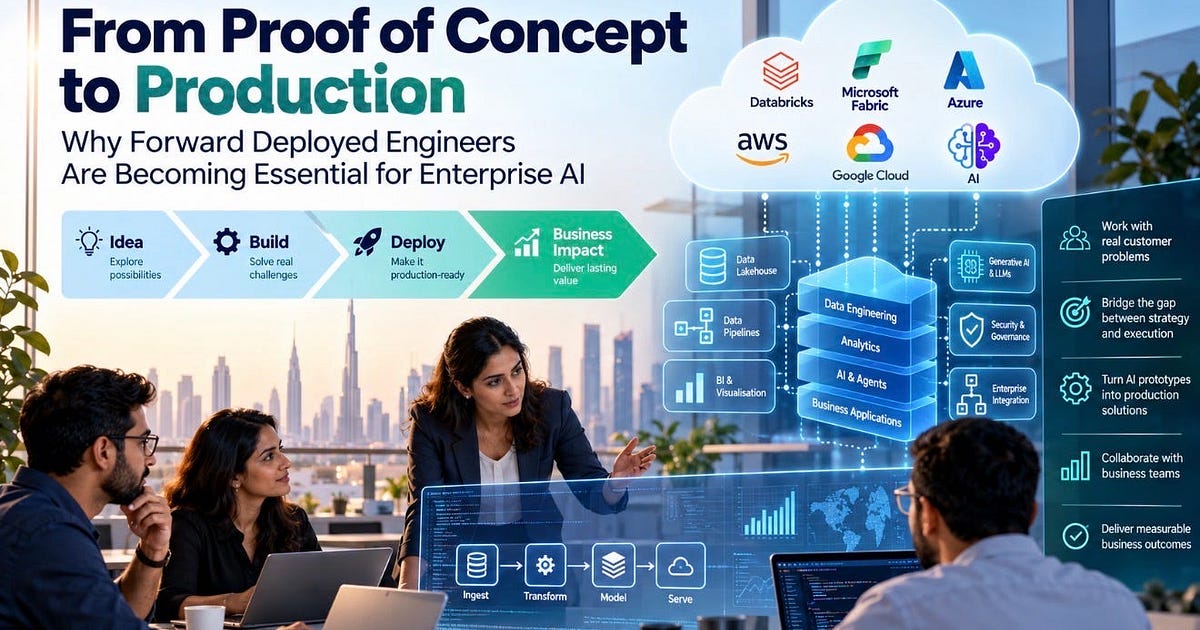
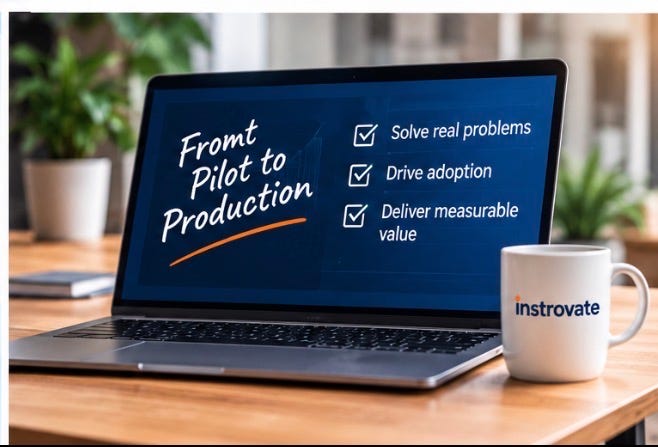
The gap between a demo and production
A GenAI application may answer questions accurately using a small collection of sample documents. In production, however, the same application may need to handle thousands of documents, different permission levels, constantly changing information, unpredictable questions, and strict requirements around data privacy.
A data pipeline may work perfectly with clean sample data but fail when it encounters missing values, unexpected schema changes, duplicate records, or delayed source-system updates.
An automation may successfully demonstrate a workflow but require additional handling for exceptions, approvals, audit trails, and failed transactions before it can be trusted by the business.
These are not necessarily failures of the underlying technology. They are implementation challenges that emerge when technology meets operational reality.
An FDE works directly with these challenges rather than treating them as issues to be addressed after the initial implementation.
The cost of disconnected teams
In traditional delivery models, business analysts gather requirements, architects design solutions, developers build components, infrastructure teams manage environments, and support teams take over after deployment.
This model can work well, particularly for large programmes with stable requirements. However, when requirements are evolving rapidly, every handover introduces the possibility of misunderstanding, delay, or rework.
An FDE can shorten this feedback loop by understanding the business context, making technical decisions, building the solution, and validating the results directly with users.
The growing complexity of enterprise AI
AI solutions often depend on several interconnected capabilities: data engineering, identity and access management, application development, APIs, model integration, evaluation, monitoring, and governance.
A successful implementation requires these pieces to work together.
The challenge is no longer just selecting an AI model. It is building a complete solution around it.
This is one of the reasons the FDE model is particularly relevant to organisations implementing enterprise data and AI platforms.
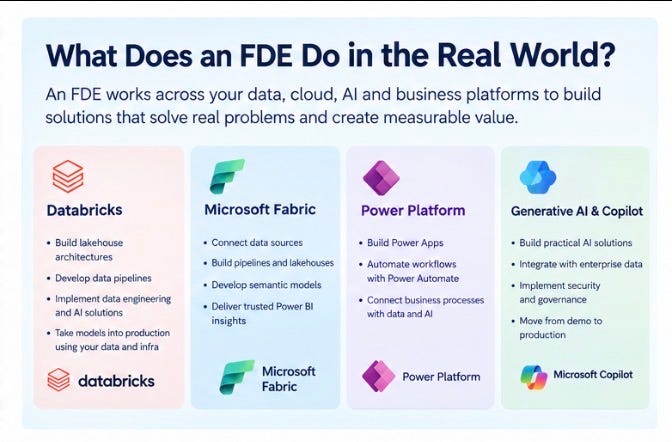
3. What Does an FDE Actually Do With Databricks?
Consider an organisation that wants to use its operational data to improve business decisions.
Its information is scattered across ERP systems, CRM applications, databases, spreadsheets, and external sources. Different departments maintain different versions of important metrics, and analysts spend considerable time reconciling numbers before they can produce reports.
The organisation has invested in Databricks, but the expected business value has not yet materialised.
An FDE can help bridge this gap.
Building a reliable lakehouse foundation
The engineer works with the business and data teams to understand the source systems, the quality of the data, the reporting requirements, and the security constraints.
They then build the necessary ingestion and transformation pipelines, organise data into appropriate layers, implement data quality checks, and establish reliable structures for downstream analytics.
Using Databricks capabilities such as Delta Lake and Spark, the FDE can develop pipelines that process data at scale while supporting reliability and maintainability.
Where appropriate, Unity Catalog can help establish data governance, permissions, and discoverability across the data environment.
The objective is not simply to create a lakehouse. It is to create a dependable data foundation that supports actual business use cases.
Turning data into decisions
Once reliable data is available, the FDE can work with analysts and business stakeholders to develop curated datasets, analytical models, and reporting integrations.
They may also help implement machine learning or generative AI capabilities where those technologies solve a genuine business problem.
For example, a supply chain team might need better visibility into inventory movements and delayed shipments. The engineer could bring together the relevant data, develop the required transformations, and enable a reporting or predictive solution that helps the team act earlier.
The value comes from the entire process, from understanding the operational problem to delivering a usable outcome.
Moving AI from experimentation to production
A Databricks-based AI proof of concept may need additional work before it can support real users.
An FDE might develop retrieval-augmented generation (RAG) pipelines, integrate enterprise documents, implement access controls, evaluate response quality, and establish monitoring.
Depending on the architecture, the implementation might use Databricks Vector Search, model-serving capabilities, or other relevant platform services.
The engineer must also consider what happens when information is missing, a model produces an unreliable answer, or a user’s permissions restrict access to particular content.
These details determine whether an AI demonstration becomes a dependable business application.
4. What Does an FDE Do With Microsoft Fabric and Power BI?
The same principle applies to Microsoft Fabric.
Imagine a company using several business systems for finance, sales, operations, and customer management. Leadership wants a unified view of performance, but each department reports different numbers.
The organisation may already have Microsoft Fabric and Power BI licences. However, the platform alone cannot resolve inconsistent business definitions or poorly designed data processes.
An FDE can work with stakeholders to establish what the organisation needs to measure and then build the technical solution.
Implementing Microsoft Fabric
Depending on the requirements, the work could include connecting source systems, building Data Factory pipelines, using Dataflow Gen2 for appropriate transformation scenarios, creating a lakehouse or warehouse, and implementing the necessary data models.
The engineer may also develop a semantic model that defines measures, relationships, and business metrics consistently.
This is important because a dashboard is only as trustworthy as the data and definitions behind it.
If revenue, margin, customer retention, or operational efficiency is calculated differently across departments, simply connecting more data sources will not solve the underlying problem.
The FDE helps translate those business definitions into a consistent technical implementation.
Delivering trusted Power BI insights
Once the data foundation is established, the engineer can work with report users to create dashboards that answer practical questions.
Instead of asking only what charts should be displayed, the FDE asks what decisions the dashboard should support.
Does the sales manager need to identify underperforming regions? Does the finance team need to investigate unexpected cost movements? Does the operations team need to identify bottlenecks before they affect delivery?
These questions shape the data model, calculations, report design, and refresh strategy.
The result is not merely another dashboard. It is a reporting capability designed around how the business operates.
5. What About Power Platform, Dynamics 365, and Copilot?
Forward deployment is not limited to data engineering or AI infrastructure. It is equally relevant to business applications and workflow automation.
Microsoft’s ecosystem illustrates this particularly well because it connects data, applications, automation, customer processes, and AI.
Power Apps: Building applications around real workflows
Suppose an operations team tracks inspections, approvals, or service requests through spreadsheets and email.
A conventional approach might begin with a detailed requirements document and a long application development cycle.
An FDE can work directly with the users to understand how the process functions today, identify the essential requirements, and develop an appropriate Power Apps solution.
The engineer may use Dataverse to store business data, configure security roles, and connect the application to existing systems.
The application can then be tested with the people who will use it, allowing feedback to shape the implementation before the solution is rolled out more widely.
The focus is on solving the operational problem, not simply building an application because the platform makes it possible.
Power Automate: Removing manual work
Consider an approval process involving multiple departments, email notifications, document checks, and status updates.
An FDE can map the existing process, identify repetitive activities, and build an automation using Power Automate.
The implementation must account for more than the happy path. It may need approval escalation, error handling, permissions, retry logic, and visibility into failed transactions.
By working directly with the business, the engineer can validate whether the automated process reflects how decisions are actually made.
Dynamics 365: Connecting technology to customer-facing operations
Dynamics 365 applications support business processes such as sales, customer service, and field service.
An FDE working in this environment might help configure business processes, integrate external data, implement extensions, automate activities, or build reporting capabilities that improve the user experience.
For example, a sales organisation might want to reduce the time representatives spend updating records and preparing for customer meetings.
The engineer could investigate the existing workflow, identify integration opportunities, and implement an appropriate combination of Dynamics 365 configuration, automation, data integration, and AI-assisted capabilities.
The objective is to improve the business process while respecting the organisation’s security, governance, and operational requirements.
Microsoft Copilot and Copilot Studio: Making AI useful at work
AI assistants are most valuable when they help people complete meaningful tasks using relevant information and appropriate permissions.
An FDE might work with a business team to identify a suitable use case, connect an agent to approved knowledge sources, configure instructions and actions, and test its behaviour against realistic scenarios.
With Copilot Studio, this could involve building an agent that answers policy questions, retrieves information, or initiates an approved workflow.
The engineer must consider grounding, access controls, response quality, exception handling, and the limits of what the agent should be allowed to do.
A successful agent is not defined by how impressive its demonstration looks. It is defined by whether it helps users accomplish their work reliably and responsibly.
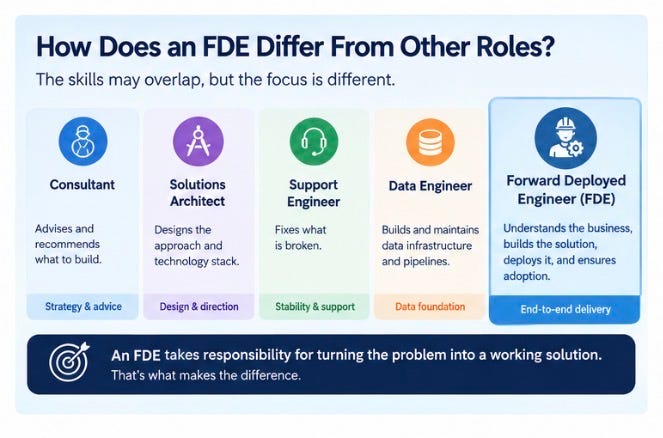
6. How Is an FDE Different From a Consultant, Architect, or Data Engineer?
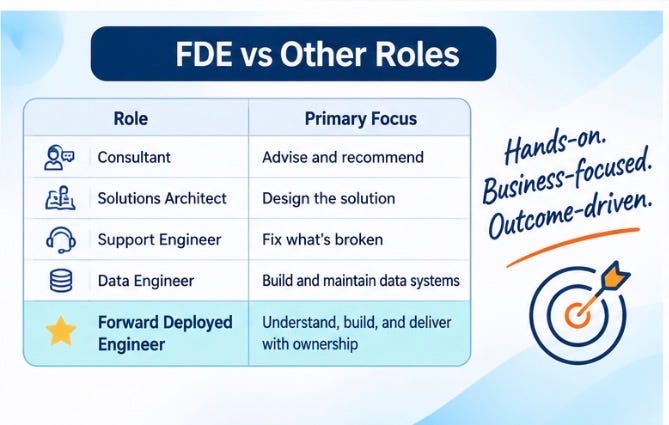
These roles can overlap, and organisations may define them differently. The distinction is primarily about the combination of responsibilities rather than a completely separate set of technical skills.
Role
Primary focus
Typical contribution
Consultant
Business problems and recommendations
Analyses requirements, recommends an approach, and may support implementation
Solutions Architect
Solution design and technical direction
Defines architecture, technology choices, and integration patterns
Support Engineer
Reliability and issue resolution
Diagnoses incidents, resolves defects, and maintains existing systems
Data Engineer
Data infrastructure and pipelines
Builds and maintains systems for data ingestion, transformation, and delivery
Forward Deployed Engineer
Customer problem-solving and hands-on delivery
Works directly with the customer to build, deploy, and refine a solution around a real business need
A consultant can be deeply involved in implementation. An architect can write production code. A data engineer can work closely with business stakeholders.
Therefore, the FDE is not necessarily a replacement for these roles.
What distinguishes the FDE model is the expectation that one role combines customer proximity, technical execution, rapid feedback, and responsibility for delivering a practical outcome.
In some organisations, FDEs complement existing engineering teams. In others, they act as the technical bridge between a platform provider and its customers.
7. What Makes a Good Forward Deployed Engineer?
FDEs require a combination of skills that can be difficult to find in a single individual.
Technical depth
The engineer needs enough hands-on expertise to build solutions that are reliable and maintainable. Depending on the assignment, this could include software development, data engineering, cloud infrastructure, APIs, AI integration, security, or enterprise application development.
Business understanding
The ability to understand why a problem matters is just as important as knowing how to solve it technically.
An FDE should be able to ask which business decision will improve, which process will become more efficient, or which operational risk the solution will reduce.
Communication
FDEs frequently work with people who have very different levels of technical knowledge.
They must be able to explain trade-offs, ask the right questions, challenge assumptions constructively, and translate business requirements into technical decisions.
Comfort with ambiguity
Customer requirements are rarely perfect at the beginning of a project.
The engineer must be able to identify what is known, clarify what remains uncertain, make reasonable decisions, and deliver progress without creating unnecessary complexity.
Ownership and collaboration
An FDE needs to take responsibility for the quality of the implementation while working effectively with the customer’s internal teams.
That includes documentation, knowledge transfer, security considerations, and planning for the solution to be maintained after the initial engagement.
Ultimately, the strongest FDEs combine the mindset of an engineer with the curiosity of a consultant and the accountability of someone responsible for making the solution work.
8. How Should Organisations Hire and Work With FDEs?
Hiring an FDE should begin with a clear business problem, not simply a technology requirement.
Before looking for candidates, organisations should identify the outcome they want to achieve.
For example, a brief such as “deliver a trusted sales performance dashboard using our existing data sources within eight weeks” provides a much clearer starting point than “we need a Microsoft Fabric engineer.”
The organisation should also provide access to the right systems, data, stakeholders, and internal technical owners. Even an excellent engineer cannot make meaningful progress if essential information and permissions remain unavailable.
It is equally important to establish the boundaries of the engagement.
Which components will the FDE build? Who will approve business decisions? Who is responsible for production operations? How will security and governance be handled? Who will maintain the solution once it is delivered?
These questions should be addressed early.
Finally, knowledge transfer must be part of the plan from the beginning. Documentation, code reviews, technical walkthroughs, and training help ensure that the organisation retains the capability to maintain and extend the solution.
An FDE should not create unnecessary dependency on one individual. The objective is to help the business move forward and strengthen its ability to operate the solution over time.
9. When Should You Consider Hiring an FDE?
An FDE may be particularly valuable when an organisation has already invested in technology but is struggling to turn that investment into production outcomes.
You might consider this model if:
Your data platform is implemented, but meaningful business use cases remain stuck in the pilot stage.
Your AI proof of concept works in a demonstration but struggles with real data, access controls, or daily workflows.
Your internal engineering team understands the platform but lacks the capacity to deliver a specific initiative quickly.
Your business and technical teams are misaligned on what needs to be built.
You need hands-on engineering expertise while your internal team learns and prepares to take over.
You want to accelerate implementation without waiting for a lengthy permanent hiring process.
However, an FDE is not always the right answer.
If your primary challenge is defining a business strategy, establishing enterprise-wide governance, or deciding which investments to make, you may need a strategist, architect, or specialist consultant first.
Similarly, a stable project with well-defined requirements and an established delivery team may not need a dedicated FDE.
The right choice depends on the problem, the urgency, and the capabilities already available within the organisation.
10. The Instrovate Perspective: Bringing Technology Closer to Business
At Instrovate Technologies, we work across data, analytics, cloud, enterprise applications, automation, and AI.
Our work with Microsoft and Databricks technologies reflects a challenge that organisations increasingly face: having access to powerful platforms is only the beginning.
The real value emerges when those platforms are applied to actual business problems.
That may mean implementing a Databricks data engineering solution, developing a Microsoft Fabric analytics platform, automating processes with Power Platform, extending Dynamics 365 capabilities, or taking an enterprise AI initiative from experimentation to production.
These initiatives require people who can understand the business context, work directly with stakeholders, and translate requirements into practical technical solutions.
We provide experienced engineering professionals to support organisations with hands-on implementation, including remote and onsite engagements in Dubai and across global markets.
For organisations that need additional engineering capacity, the FDE model can provide a way to bring technical expertise closer to the problem while enabling internal teams to learn and collaborate throughout delivery.
You can learn more about our work at instrovate.com or, for the UAE and Gulf region, instrovate.com.
If you are exploring an FDE engagement, hiring engineers for a data or AI initiative, or trying to move a promising pilot into production, we welcome a conversation about your requirements.
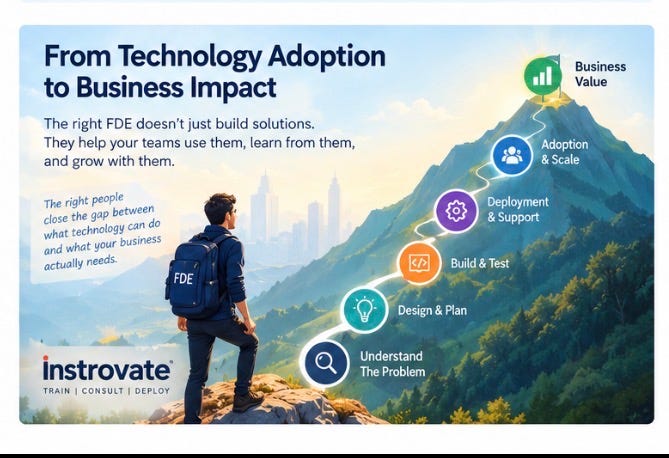
Final Thoughts: From Technology Adoption to Business Impact
Forward Deployed Engineering is not simply another job title. It represents a way of bringing engineering closer to the people, processes, and decisions that technology is intended to support.
As organisations adopt more sophisticated data platforms, AI capabilities, and business automation tools, the challenge increasingly lies in integrating those capabilities into the realities of everyday work.
That requires more than selecting the right platform or building an impressive demonstration. It requires engineers who can understand the problem, develop the solution, navigate real-world constraints, and work with the people responsible for using it.
The most successful implementations will combine strong engineering practices with business understanding, security, governance, and continuous feedback from users.
For some organisations, that means hiring dedicated Forward Deployed Engineers. For others, it means building the same capabilities into their existing consulting and engineering teams.
Either way, the underlying principle remains the same:
The value of technology is not measured by what an organisation buys or deploys. It is measured by what the organisation can actually achieve with it.
Will Forward Deployed Engineers become a standard part of enterprise data and AI teams? As the gap between technological capability and practical implementation continues to challenge organisations, it is a question worth taking seriously.
Originally published on Substack