From Vision to Production: How a Forward Deployed Engineer Built CVFine.com - An AI-Powered Career and Upskilling Platform
One engineer. A business vision. Databricks, Azure Functions, Cosmos DB and AI-assisted development. The story of how Forward Deployed Engineering ( FDE’s) is changing what it takes to turn an idea into a working product.
The problem was never just the CV
Over the years, working across technology training, consulting and professional development, I have seen a recurring problem.
People invest in learning. They earn certifications, gain professional experience, work on projects and develop technical skills. Yet, when they apply for a new role, they often struggle to communicate their value effectively.
Their CV may not reflect what they can actually do. Their experience may not align clearly with the job description. They may not know which skills employers expect them to develop next. And even when they identify a skills gap, they may not know how to gain practical experience that demonstrates their readiness.
Recruiters face the other side of this problem. They receive large volumes of applications, each presented differently, with varying levels of detail and evidence. Identifying candidates who genuinely match a role can be time-consuming.
Meanwhile, the nature of work itself is changing. AI is influencing roles across data, software development, consulting, finance, operations, marketing and many other professional domains.
This led us to think about a bigger question at Instrovate Technologies:
What if we could connect career assessment, CV improvement, practical AI upskilling and job opportunities in one platform?
Not just another CV formatter. Not just another job board. And not just another AI chatbot giving generic career advice.
We wanted to build something that could help professionals understand where they stand today, identify what they need to improve, demonstrate their skills through practical work and connect with relevant opportunities.
That vision became CVFine.com an AI-powered career and job platform built by Instrovate Technologies.
Explore the platform: https://cvfine.com/
The vision needed an engineer who could do more than code
A product vision is only the starting point.
Turning that vision into a working platform requires someone who can understand the business problem, translate it into a technical architecture, make decisions about services and data, develop the application, integrate its components, test the complete workflow and keep refining the product as the requirements evolve.
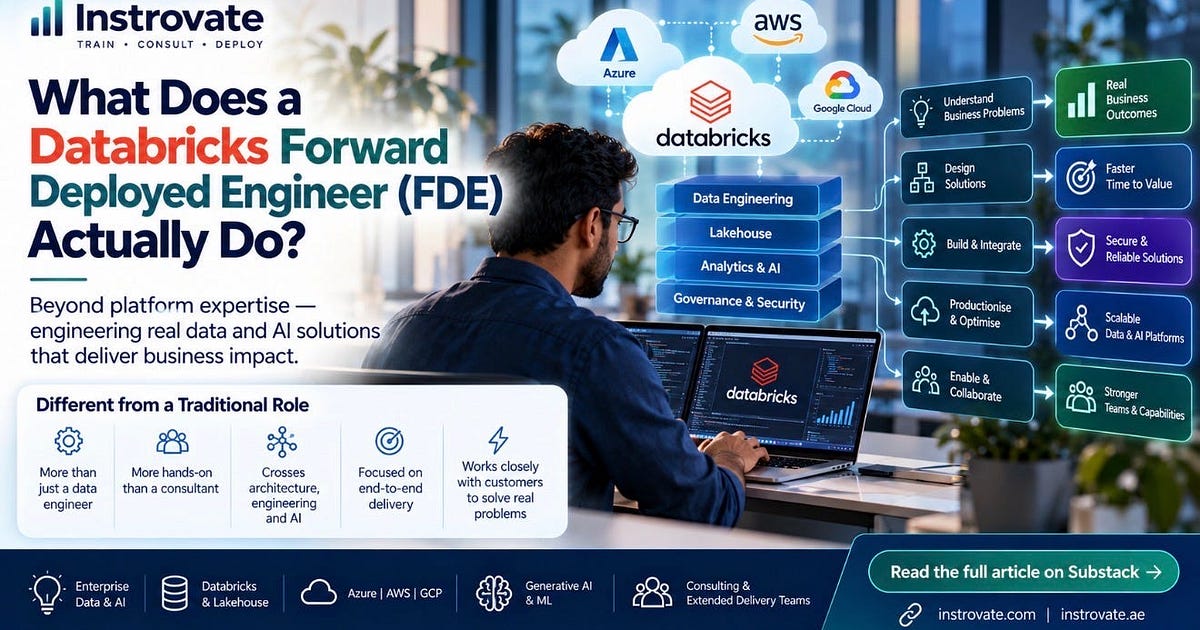
This is where the role of a Forward Deployed Engineer, or FDE, becomes particularly interesting.
One of our FDEs took on the challenge of translating the CVFine vision into an end-to-end technical solution.
The work extended beyond implementing individual features. It involved thinking about the complete user journey, designing how the components would work together, developing the backend logic, integrating cloud services and bringing the application towards a usable product.
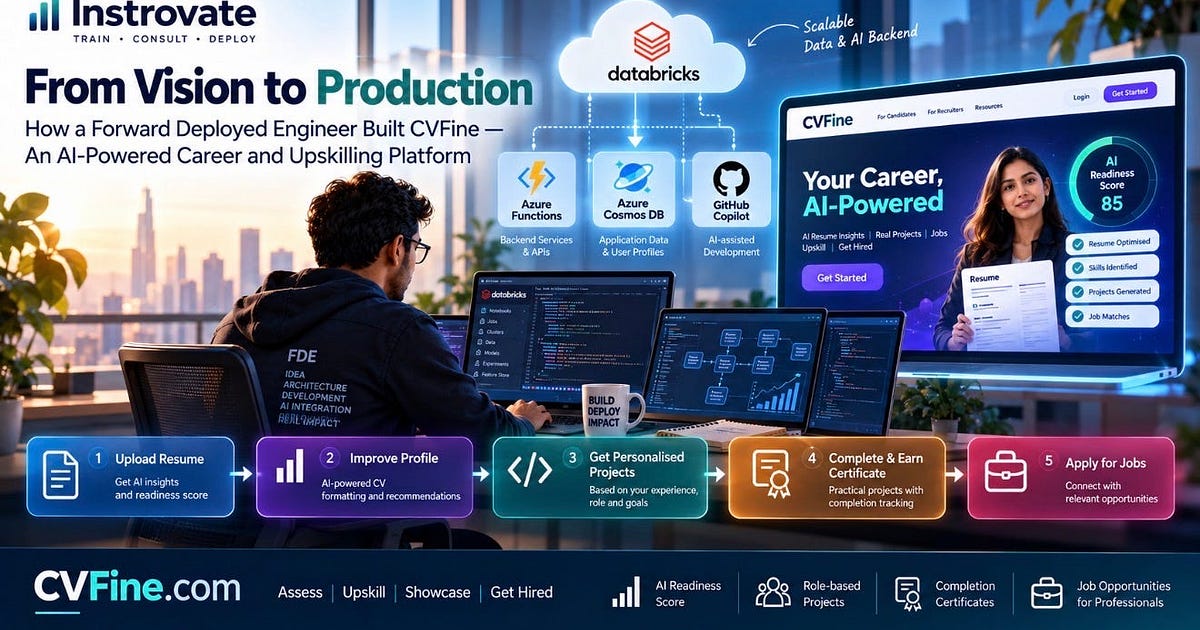
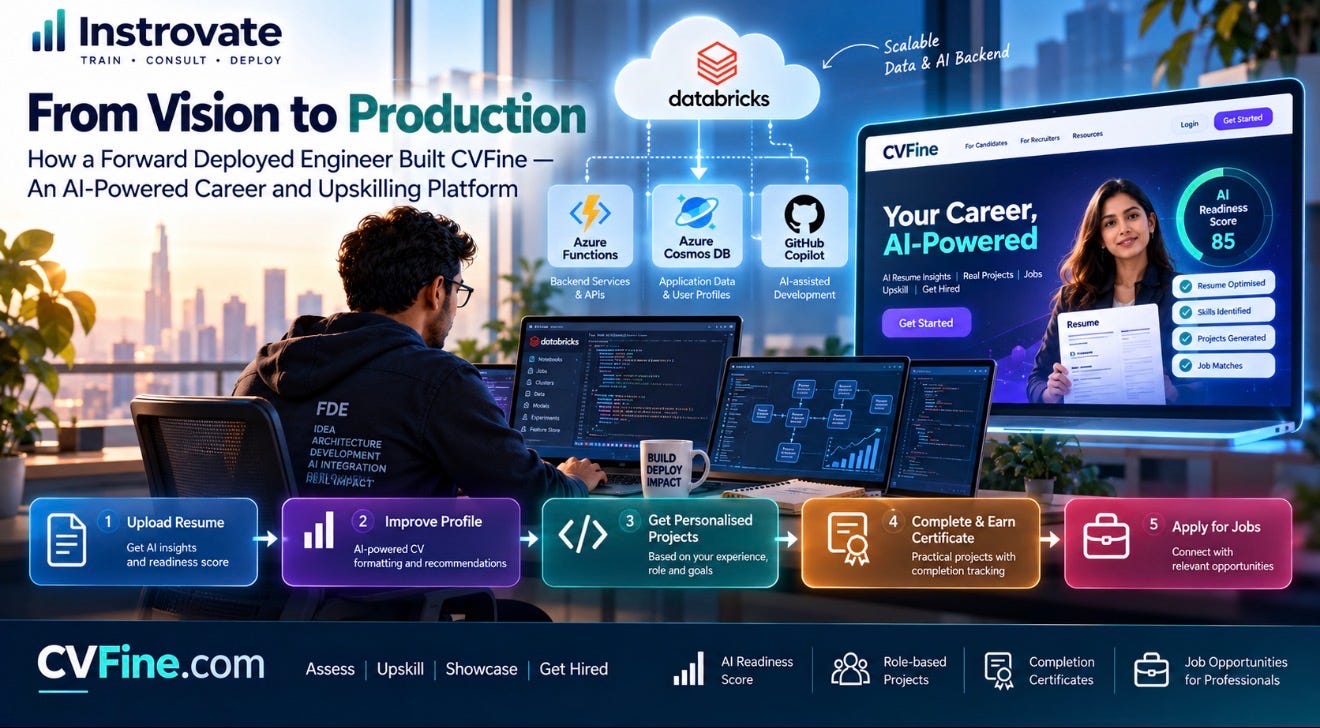
The technology stack included Databricks, Azure Functions, Azure Cosmos DB, GitHub Copilot and Microsoft Visual Studio Code. But the story is not simply about the tools.
The real achievement lies in how these technologies were brought together to solve a business problem.
The engineer had to think about architecture, data flows, backend processing, application behaviour, integrations and the logic behind the user experience. He needed to move between the perspectives of a software developer, data engineer, cloud engineer, solution architect and product problem-solver.
That combination is what makes this a compelling example of Forward Deployed Engineering.
An FDE does not stop at understanding the problem or recommending a solution. The role is about getting close enough to the problem to build something that works.
What does CVFine actually do?
CVFine brings together several parts of the career journey that are often handled by separate tools.
1. Understand your AI readiness
A professional can upload a CV and receive an AI Readiness Score and insights into their profile.
The objective is to make career readiness more concrete. Instead of relying only on a job title or a list of qualifications, a candidate can begin exploring how their experience, skills and profile align with the demands of AI-enabled roles.
This matters because AI readiness is not limited to knowing how to use a chatbot. Depending on the profession, it could involve applying AI to existing workflows, understanding data, automating processes, building AI-powered applications, evaluating AI outputs or governing AI responsibly.
A readiness assessment can help people identify potential gaps and decide what to work on next.
The score is a starting point for improvement, not a guarantee of employability or a substitute for a recruiter’s assessment.
2. Turn an existing CV into a stronger professional profile
Many professionals have valuable experience but struggle to present it clearly.
CVFine helps users format their CVs into professional layouts and improve how their experience, skills and achievements are communicated. Its capabilities also include tailoring a CV to a specific job description.
The goal is not to invent experience or add skills a candidate does not possess. It is to make relevant experience easier to understand and evaluate.
A well-presented CV cannot replace real capability, but it can help ensure that genuine capability is communicated more effectively.
3. Generate projects based on experience, role and career direction
This is where the platform’s upskilling vision becomes particularly important.
Traditional learning pathways often begin with a course catalogue. A professional chooses a subject, completes a course and then tries to figure out how to apply the knowledge.
But what if the starting point were the professional’s actual role, experience and goals?
CVFine can generate personalised project ideas based on a person’s profile, experience and target direction. Rather than giving every learner the same generic exercise, the intention is to connect learning with practical, role-relevant work.
For example, an experienced data professional might explore a project involving data quality, analytics or AI-assisted data engineering. A business operations professional might work on workflow automation or an AI-supported decision process. A marketing professional might build a project around content operations, customer insights or campaign analysis.
The project should reflect the professional’s context and provide an opportunity to demonstrate how they approach a real problem.
This changes the conversation from:
“Which course have you completed?”
to:
“What can you demonstrate that you know how to do?”
4. Connect project completion with evidence of achievement
Learning becomes more meaningful when there is a tangible outcome.
CVFine’s project and fellowship journey is designed to help professionals work towards completing relevant projects, with completion monitoring and certificate issuance as part of the workflow.
This creates a path from identifying a skills gap to working on a practical assignment and demonstrating completion.
A certificate should never be confused with a guarantee of expertise or employment. Its value is strongest when it is supported by genuine project work and can be considered alongside a candidate’s experience, skills and interview performance.
The broader idea is to make upskilling more outcome-oriented: learn something, apply it, complete the work and have evidence of the effort.
5. Connect professionals with job opportunities
The final part of the journey is connecting candidates with relevant opportunities.
CVFine brings career profiles, AI-focused job opportunities and recruiter-facing workflows into the same platform. Candidates can explore roles and apply, while recruiters can post jobs and discover profiles aligned with their requirements.
The long-term value of this model comes from connecting the different stages of career development.
A candidate identifies a gap, works on relevant skills, builds project evidence, improves their profile and applies for suitable roles. Recruiters, in turn, can use structured profile information to support their search and assessment process.
The ambition is not simply to help people apply to more jobs. It is to help them become better prepared for the jobs they choose to pursue.
Explore CVFine: https://cvfine.com/
Behind the experience: the engineering that makes it possible
A user may see a score, a formatted CV, a project recommendation or a job listing. Behind each of those experiences sits a chain of technical decisions.
This is where the FDE’s contribution deserves attention.
Databricks: the intelligence and data foundation
Databricks is a core part of CVFine’s backend intelligence and data architecture.
A platform that analyses professional profiles, generates insights, works with role requirements and supports personalised recommendations needs more than a collection of screens. It needs backend logic capable of processing information and supporting the workflows that make those features useful.
Databricks provides an environment for building data and AI capabilities as part of that solution.
The important architectural point is that Databricks is not being used merely because it is a popular technology. It is part of a broader system designed around the product’s requirements.
Azure Functions: connecting the application to backend workflows
Azure Functions supports event-driven and serverless application logic. It can be used to execute backend operations when particular requests or events occur, without requiring every operation to run inside a continuously managed application server.
In a platform such as CVFine, services of this kind can help connect application requests with the appropriate processing, integrations and backend operations.
The value lies in designing those interactions carefully: defining responsibilities, handling failures, managing dependencies and ensuring that the user experience remains coherent across the complete workflow.
Azure Cosmos DB: supporting application data
Azure Cosmos DB provides a managed database service for applications that need flexible data storage and access patterns.
For an AI career platform, application data can include profile information, workflow states, project progress and other information required to support the product’s user journeys.
The challenge is not simply choosing a database. It is modelling the information appropriately, deciding how components access it, and designing for reliability, performance and security as the product evolves.
GitHub Copilot and Visual Studio Code: AI-assisted development
The development environment also matters.
GitHub Copilot can assist with coding, explaining unfamiliar code, generating implementation suggestions and speeding up parts of the development process. Visual Studio Code provides the working environment in which the engineer can build, inspect, debug and refine the application.
These tools can reduce friction in software development. They do not eliminate the need to understand the system.
An engineer still needs to evaluate generated code, make architectural decisions, investigate unexpected behaviour, validate assumptions, test integrations and take responsibility for the final implementation.
AI-assisted development is most powerful when the engineer knows what needs to be built, why it needs to be built and how to verify that it works.
The tools can accelerate execution, but engineering judgement determines whether the result is dependable.
Why this is an FDE use case, not just a software development story
Traditional software projects often divide responsibilities across multiple roles: a business analyst captures requirements, an architect designs the solution, developers implement components, data engineers build processing logic, cloud engineers manage infrastructure and QA specialists validate the result.
Those roles remain important, especially in large and regulated environments.
Forward Deployed Engineering offers a different emphasis. The engineer works close to the real problem and connects business understanding with hands-on implementation. The role often spans multiple disciplines, with a focus on delivering a working outcome rather than handing off a design and stopping there.
In the CVFine example, the engineer had to think across the product lifecycle:
Understand the career and recruitment problem.
Translate the vision into product workflows.
Design the technical architecture and service interactions.
Develop backend logic and application capabilities.
Integrate Databricks and Azure services.
Use AI-assisted development tools productively.
Test the end-to-end experience and refine the solution.
This is the essence of the FDE mindset: own the problem, work across the stack and stay focused on the outcome.
The title alone does not make someone an FDE. What matters is the ability to connect the customer’s or business’s needs with practical engineering, navigate ambiguity and deliver a solution that works in context.
CVFine gives us a concrete way to discuss that combination.
Why this kind of product development was harder a few years ago
Building a platform like CVFine was possible before today’s generation of AI-assisted development tools. But the effort, iteration speed and skills required could look very different.
A team might have needed to coordinate more specialised resources across application development, backend services, cloud infrastructure, data engineering, AI integration and testing.
Today, managed cloud services, mature data and AI platforms, developer tooling and AI coding assistants can make it easier for a capable engineer to work across those boundaries.
An engineer can use AI assistance to explore implementation options, generate an initial version of code, understand unfamiliar APIs and accelerate repetitive development tasks. Cloud services can reduce the operational burden of managing underlying infrastructure. Data and AI platforms provide building blocks that would otherwise take significant effort to create from scratch.
This does not mean that one engineer can replace every specialist on every project. Large-scale, security-sensitive or highly regulated systems still demand appropriate expertise, independent review, rigorous testing and strong operational controls.
Nor does AI automatically produce good architecture.
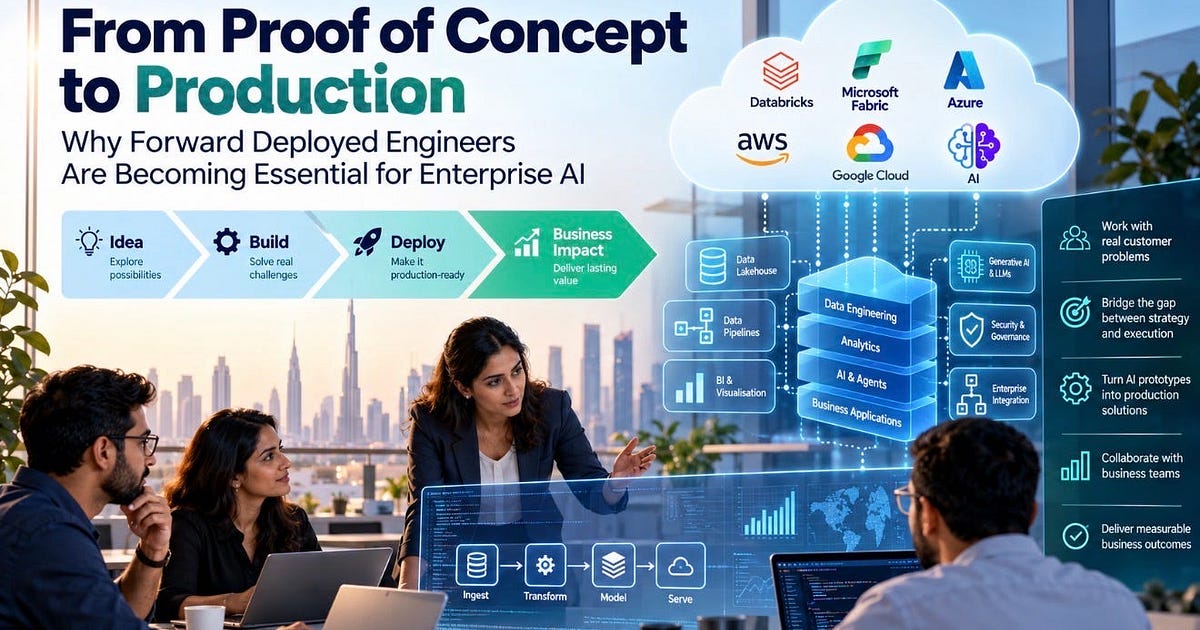
The shift is that a strong engineer can now potentially take a broader idea from concept to working implementation with fewer hand-offs and faster iteration.
That is an important reason why the FDE profile is becoming increasingly relevant to organisations building data and AI products.
The differentiator is not simply coding faster. It is combining technical breadth, business understanding, product thinking and the judgement to decide what should be built.
The next phase of upskilling: from learning content to demonstrating capability
CVFine also reflects a broader belief we hold at Instrovate.
For years, professional development has largely been organised around courses, learning paths and certifications. These remain valuable. A well-designed course can provide structure, and a recognised certification can validate knowledge against a defined standard.
But the AI economy increasingly demands the ability to apply knowledge in context.
A professional may understand the fundamentals of generative AI but still need to learn how to apply it safely to their own work. A data engineer may know the principles of a lakehouse but need experience building a production-oriented pipeline. A business analyst may understand process mapping but need to demonstrate how AI can improve a real workflow.
This is why we see value in connecting training with practical projects, evidence of completion and career opportunities.
At Instrovate, our wider work spans technology training, consulting and engineering delivery. CVFine extends that thinking into a career platform: help people understand their starting point, identify a relevant next step and work towards demonstrating what they can do.
Our ambition is to make the path between learning and opportunity more connected.
That means moving beyond a model where the learning experience ends when a course finishes. Instead, we want professionals to have a clearer way to connect what they learn with what they can build and the roles they want to pursue.
Learn more about our work at https://instrovate.com/.
What this means for consulting firms and technology leaders
The CVFine case study also has implications for organisations delivering technology projects.
Consulting firms are increasingly expected to deliver data and AI solutions quickly, demonstrate tangible outcomes and work across a growing set of platforms. They may have excellent client relationships and domain expertise but need additional engineering capacity to turn a requirement into a working implementation.
This is where experienced FDEs can help.
An FDE can work alongside a client’s or consulting firm’s team to explore a problem, build integrations, develop data and AI capabilities, validate assumptions and move an implementation towards production.
Depending on the project, that might mean building a data application on Databricks, implementing a Microsoft Fabric solution, integrating AI into an existing workflow or developing a proof of concept that needs to become a dependable product.
For consulting firms, the value is not merely adding another developer. It is bringing in an engineer who can work through ambiguity and contribute across the delivery lifecycle.
At Instrovate, we are building our consulting and engineering offering around this need, including specialist data and AI expertise, Forward Deployed Engineers and flexible delivery support for consulting partners.
Our focus is on helping teams access the right expertise for the work they need to deliver.
For organisations looking for that kind of support, learn more at Instrovate Consulting & FDEs.
The lesson from CVFine
For me, the most important part of this story is not the number of technologies involved or the list of features delivered.
It is the connection between a clear business vision and the ability to execute it.
We started with a problem: professionals need a better way to understand their readiness for AI-related work, improve their profiles, develop relevant skills and connect with opportunities.
One of our FDEs took that vision and worked across architecture, development, backend services and integration to build the platform.
Databricks, Azure Functions, Cosmos DB, GitHub Copilot and Visual Studio Code were important parts of the technical journey. But the real value came from how they were applied to the problem.
That is why I believe we will see more demand for engineers who can operate at this intersection of software development, data engineering, AI, cloud architecture and business outcomes.
The next generation of technology professionals will still need depth in their chosen disciplines. But the ability to work across boundaries, make sound decisions and deliver a complete solution will become increasingly valuable.
And the next generation of technology products will need more than AI features. They will need people who can turn AI capabilities into experiences that solve meaningful problems.
CVFine is one step in our journey towards that goal.
Explore CVFine. Build your next capability.
If you are a professional exploring how AI may affect your career, CVFine can help you begin with your profile, an AI Readiness Score and relevant opportunities for development.
If you are a recruiter, you can explore the platform’s job-posting and candidate-discovery capabilities.
And if you are a technology leader or consulting partner looking for engineers who can work across data, cloud and AI delivery, we would be happy to discuss how Instrovate can help.
For professionals: Explore CVFine
For recruiters: Visit CVFine and explore hiring options
For consulting and engineering partnerships: Connect with Instrovate
The future belongs not only to people who understand AI, but to those who can use it to solve real problems.
At Instrovate, that is the kind of capability we want to help build — in our products, in our people and in the organisations we work with.
Train. Consult. Build. Deliver.
— Akriti Lal
linkedin.com/company/instrovate
Director, Instrovate Technologies
Microsoft Certified Trainer | Data, Cloud & AI
Originally published on Substack