Databricks Forward Deployed Engineer: The Role Connecting Data Engineering, AI and Business Impact
Why organisations need more than platform specialists and how Forward Deployed Engineers help turn Databricks investments into production-ready solutions.
The next evolution of data engineering
For years, organisations have hired data engineers to build pipelines, data architects to design platforms, consultants to recommend solutions, and data scientists to develop machine learning models.
Each role remains important. But enterprise data and AI projects are becoming more complex.
Organisations are no longer simply asking, “Can we build a data pipeline?” They are asking:
Can we transform our data into reliable, business-ready products?
Can we move our AI proof of concept into production?
Can we integrate Databricks with our existing applications, cloud infrastructure and business workflows?
Can we demonstrate measurable business value from our investment?
These questions require technical depth, business understanding and the ability to execute in real-world environments.
This is where the Forward Deployed Engineer (FDE) comes in.
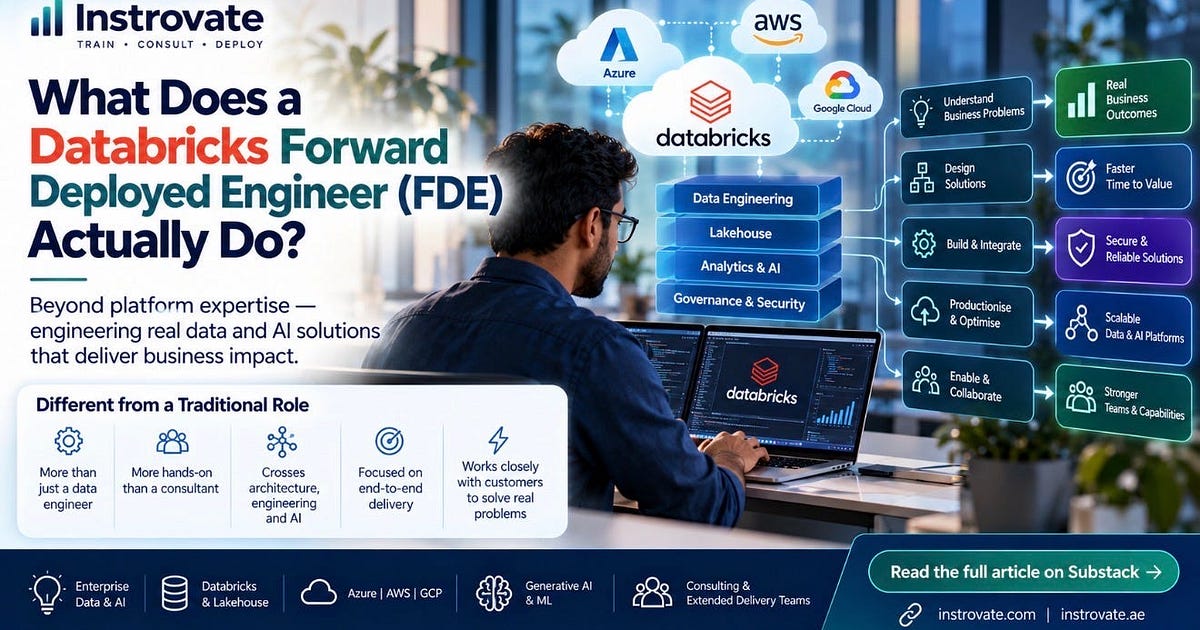
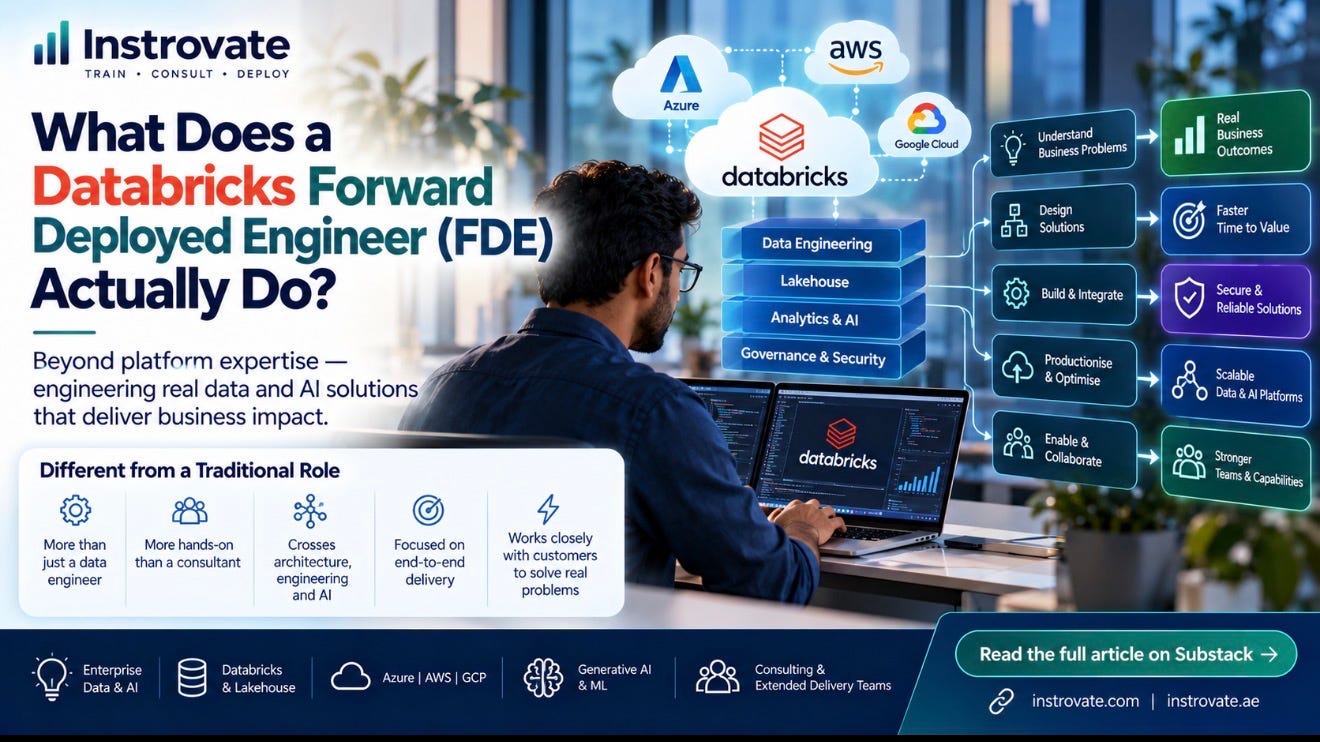
Databricks has established a dedicated FDE function focused on helping customers design, build and productionise complex data and AI solutions using its Data Intelligence Platform. The role combines hands-on engineering with close customer collaboration and end-to-end solution delivery.
1. What exactly is a Databricks FDE?
A Databricks Forward Deployed Engineer is a hands-on engineer who works closely with a customer to solve a real business or technical problem using Databricks and the surrounding technology ecosystem.
The engineer does not simply recommend an architecture or demonstrate a feature. They help understand the problem, make design decisions, write code, integrate systems, test the solution and move it towards production.
Imagine a retail organisation that wants to predict product demand across its stores.
A conventional project might assign different teams to build ingestion pipelines, prepare data, develop forecasting models and create dashboards. Each team may complete its own deliverables, but integration, performance, data quality and operational readiness can still become challenges.
An FDE works across these boundaries. They collaborate with the business and engineering teams to understand the forecasting requirements, build the data pipelines, implement transformations in Databricks, integrate the appropriate analytical or machine learning components, and help deliver a solution that can be used reliably.
The objective is not merely to complete a technical task. It is to help the organisation solve the problem that motivated the project in the first place.
2. What does a Databricks FDE actually do?
The work varies by customer and engagement, but typically spans several areas.
Understand the business problem
Before choosing a technical solution, an FDE works with stakeholders to understand the business objective, existing systems, constraints and desired outcomes.
For example, a company may say it needs a modern lakehouse. The deeper problem might be that financial reports take three days to reconcile, customer information is fragmented, or analytics workloads are too expensive.
Understanding the underlying problem helps determine what should actually be built.
Design the solution architecture
The FDE translates requirements into a technical design that fits the customer’s environment.
This may involve Databricks architecture, cloud storage, identity and access management, data governance, integrations, security, scalability and cost considerations.
The solution might use Azure, AWS or Google Cloud, alongside Databricks and other enterprise technologies.
Build and integrate the solution
This is where hands-on engineering becomes essential.
Depending on the engagement, the FDE may work with:
Python, SQL, PySpark and Apache Spark.
Delta Lake, lakehouse architecture and data transformation pipelines.
Batch and streaming ingestion.
Unity Catalog, access controls and data governance.
Machine learning, generative AI, retrieval-augmented generation (RAG) and AI application integration.
APIs, application interfaces, CI/CD and deployment automation.
An FDE does not necessarily need to be an expert in every one of these areas. The required depth depends on the particular project. However, the role requires enough engineering capability to take meaningful ownership of implementation rather than stopping at high-level recommendations.
Move from prototype to production
A solution that works in a notebook is not automatically ready for enterprise use.
Production readiness may require testing, monitoring, performance optimisation, access controls, error handling, deployment pipelines, documentation and operational support arrangements.
The FDE helps address these concerns so the solution can function within the organisation’s real environment.
Collaborate, enable and improve
FDEs work alongside customer engineers, architects, business stakeholders and other specialists. They share knowledge, help teams understand the solution and identify improvements based on implementation experience.
In some engagements, reusable engineering assets and feedback from customer projects may also help improve future solutions and inform product development.
3. How is an FDE different from traditional technology roles?
The distinction is not that traditional roles are no longer useful. It is that FDEs combine responsibilities that may otherwise be distributed across several roles.
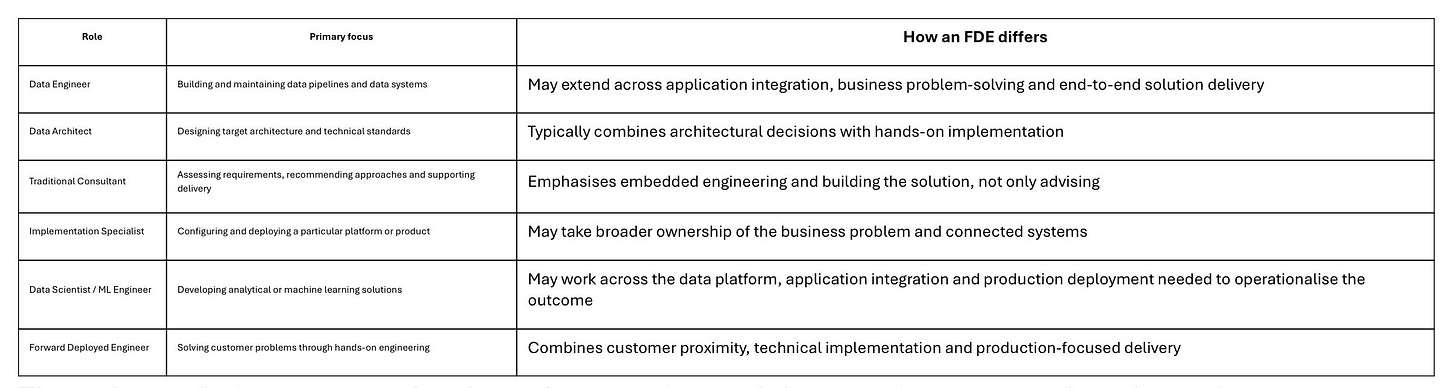
These boundaries are not absolute. An experienced data engineer may already perform many FDE responsibilities, and some consultants are deeply hands-on. The FDE title describes a delivery model and set of expectations rather than a completely separate engineering discipline.
The defining difference is the combination of customer immersion, engineering execution and ownership of an end-to-end outcome.
4. A real-world example: Building an enterprise AI assistant on Databricks
Consider a financial services company that wants employees to ask questions about internal policies, operational documents and business data.
The organisation has already conducted a successful AI demonstration. However, the solution struggles when real users begin testing it.
Documents are inconsistent. Users must only see information they are authorised to access. Answers need to be evaluated. Data sources must be refreshed. The application must integrate with enterprise identity systems and remain reliable as usage increases.
How might a Databricks FDE contribute?
Step 1 — Discovery: Work with business users, security teams and engineers to identify the actual requirements and constraints.
Step 2 — Data preparation: Build ingestion and transformation workflows to make relevant information available and maintainable.
Step 3 — Retrieval and AI: Implement an appropriate RAG architecture, retrieval logic, model integration and evaluation approach using suitable components of the Databricks ecosystem.
Step 4 — Security and integration: Address access controls, identity, application integration and governance requirements.
Step 5 — Production deployment: Introduce testing, monitoring, deployment practices and operational safeguards.
Step 6 — Validation: Work with users to assess answer quality, usefulness, reliability and the business value delivered.
The exact architecture would depend on the organisation’s requirements and the capabilities available in its chosen environment.
The important point is that the FDE helps connect all these components into a working solution. The work is not finished just because the model produces a convincing answer in a demonstration.
5. Why is industry looking for FDE capabilities?
Enterprise AI is moving beyond experimentation
Organisations increasingly need engineers who can integrate AI into existing data platforms, applications and business processes. Building a prototype is only one part of the challenge; production deployment introduces security, governance, integration, evaluation and operational requirements.
Technology stacks are interconnected
A Databricks implementation rarely exists in isolation. It may depend on cloud services, enterprise databases, identity providers, reporting tools, APIs and operational systems.
Engineers who can work across these boundaries can help reduce handoff problems and accelerate implementation.
Business requirements are not always fully defined
In complex projects, important requirements emerge during implementation. Engineers need to investigate, test assumptions and adapt the solution as they learn more about the customer environment.
Customers want outcomes, not just deliverables
A completed pipeline, a deployed model or a configured workspace is a technical deliverable. The ultimate objective may be faster reporting, more reliable data, improved decision-making or a useful AI-enabled workflow.
An FDE-oriented engagement keeps the intended outcome visible throughout the engineering process.
These are reasons the role is gaining attention, not a guarantee that every organisation needs a dedicated FDE. Some projects are well served by conventional engineering and consulting roles. FDE is especially relevant when a problem is complex, the implementation path is uncertain, and close collaboration with the customer is essential.
6. What skills should a Databricks FDE have?
A strong candidate typically combines several capabilities.
Engineering fundamentals: Strong programming and problem-solving skills, particularly in Python, SQL and relevant software engineering practices.
Data platform expertise: Practical understanding of Databricks, Apache Spark, data engineering patterns and distributed processing.
Cloud knowledge: Experience with at least one major cloud platform, and the ability to work with the services and integrations relevant to the engagement.
Production engineering: Testing, version control, CI/CD, monitoring, security and operational readiness.
AI capability: Depending on the role, familiarity with machine learning, AI APIs, RAG, model integration and evaluation.
Customer collaboration: The ability to communicate with technical and non-technical stakeholders, understand business constraints and translate requirements into workable solutions.
Adaptability and ownership: Comfort with ambiguity, a willingness to learn and the discipline to take agreed work through implementation.
Databricks’ published FDE roles reflect this combination of engineering depth, customer-facing collaboration and production solution delivery.
Reference: Databricks FDE Job Opening.
7. Why consulting firms may need FDEs
This shift is relevant not only to end-user organisations but also to consulting companies delivering data and AI projects.
A consulting firm may have strong client relationships and architecture expertise but lack sufficient hands-on capacity for a specialised Databricks implementation. Another may have a growing AI pipeline but need engineers who can work across data engineering, application integration and production deployment.
Hiring every specialist permanently may not always be practical, particularly when project demand fluctuates.
An extended delivery partner can help provide additional engineering capacity for a defined workstream, a project or a longer engagement.
The partner’s engineers can integrate with the existing team, work within agreed delivery processes and take responsibility for clearly defined technical outcomes.
For consulting firms, this model can help address specialist skill gaps, support delivery timelines and expand the work they can undertake without having to build every capability internally before a project begins.
The engagement still needs clear ownership, appropriate customer access, security controls, confidentiality arrangements and agreement on deliverables. Additional capacity is most valuable when it integrates effectively with the existing team.
8. How Instrovate supports this delivery model
At Instrovate Technologies, we see an important opportunity to help organisations and consulting firms bridge the gap between data and AI strategy and practical implementation.
Our focus includes Microsoft and Databricks technologies, data engineering, cloud data platforms, analytics and AI solutions.
Through our consulting and engineering delivery model, we can support engagements that require specialist technical expertise, additional project capacity or engineers who work closely with existing teams.
Depending on the requirement, this may involve:
Databricks and lakehouse engineering.
Data pipelines, PySpark and data transformation.
Microsoft Fabric, Azure data engineering and analytics.
AI solution implementation and integration.
Embedded engineering support for defined project workstreams.
Collaboration with consulting firms through agreed subcontracting or white-label arrangements.
We also provide technical training through our training capabilities, including Microsoft Certified Trainer-led delivery where appropriate.
Our approach is Train • Consult • Deploy: help teams develop skills, solve technical challenges and put practical solutions into use.
For consulting partners, the objective is straightforward. When specialist skills or additional delivery capacity are needed, Instrovate can work as an extension of the existing team rather than competing for the client relationship.
The scope and delivery model are agreed around each engagement’s requirements.
Final thoughts: The value is in what gets built
Forward Deployed Engineering is not simply a new name for a data engineer or consultant. It represents an approach that brings engineering closer to the customer problem and connects technical execution with real-world implementation.
In the Databricks ecosystem, that can mean moving beyond configuring a platform or demonstrating a pipeline to building integrated data and AI solutions that are secure, scalable and ready for practical use.
As organisations move from experimentation to implementation, the ability to combine deep technical skills with customer collaboration becomes increasingly valuable.
For technology leaders, the question is not whether every project needs an FDE. It is whether the project would benefit from an engineer who can work across the technical boundaries, adapt to the real environment and help turn an idea into a working solution.
For consulting firms, it is also worth asking whether additional specialist delivery capacity could help them serve clients more effectively.
At Instrovate Technologies, we are building around this need—supporting organisations and consulting partners with data, AI and engineering delivery expertise.
If you are a consulting firm delivering Databricks or Microsoft data and AI projects and need additional specialist capacity, let’s connect.
Instrovate Technologies
Train • Consult • Deploy
instrovate.com | instrovate.com
Originally published on Substack