Forward Deployed Engineer (FDE): The AI Career You Should Be Preparing For in 2027
AI models are becoming increasingly powerful. But who makes them work with real business data, enterprise systems and actual customer problems? Meet the Forward Deployed Engineer.
The AI industry is evolving rapidly. Over the last few years, we’ve seen an explosion of opportunities around Generative AI, Large Language Models (LLMs), Retrieval-Augmented Generation (RAG), AI agents and intelligent automation.
Thousands of developers are learning how to build AI applications. Organisations are experimenting with copilots, chatbots and AI-powered workflows. But there is a significant challenge.
Building an AI application is one thing. Making it work reliably inside a real organisation is another.
Enterprise data is rarely clean. Business processes are rarely straightforward. Systems don’t always communicate with each other. Security, governance, performance and reliability all become critical once an AI solution moves beyond a demonstration.
This is where a relatively new and increasingly important engineering role comes into the picture: Forward Deployed Engineer (FDE).
As we look towards 2027, this is a role worth understanding, particularly for professionals working in software engineering, data engineering, cloud computing and AI.
Let’s explore what it involves, why companies need it, and how you can start building the skills required.
1. What exactly is a Forward Deployed Engineer?
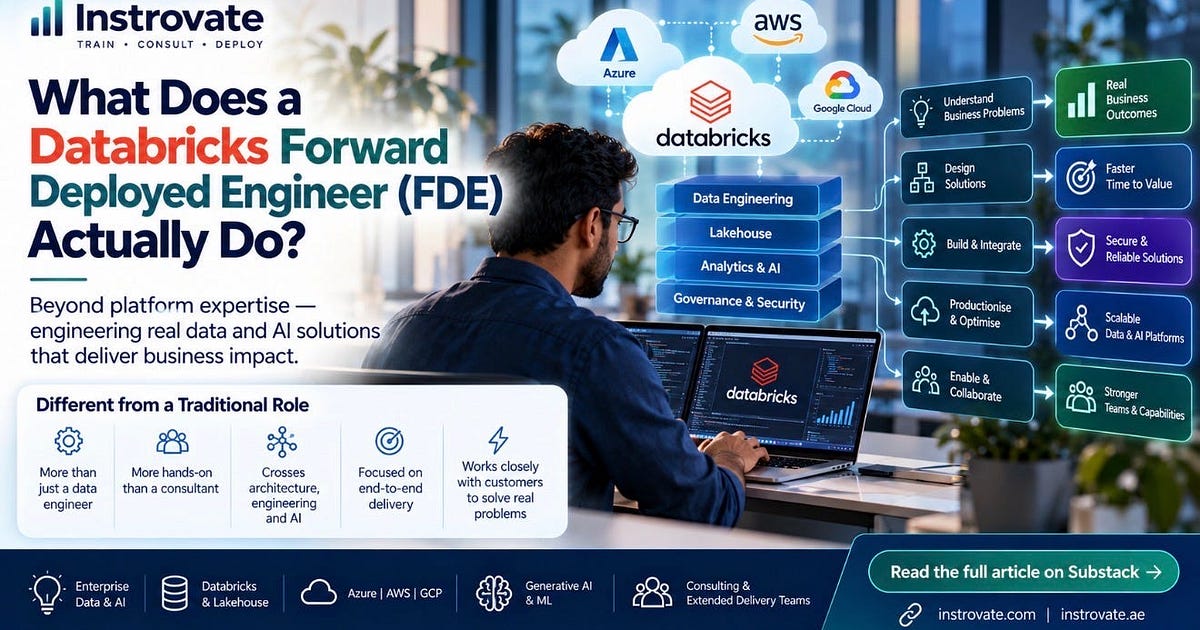
A Forward Deployed Engineer is an engineer who works closely with customers to design, build and implement technology solutions that solve their actual business problems.
Unlike a traditional engineering role that may focus primarily on developing a product centrally, an FDE works much closer to the customer and the environment in which the solution will operate.
Think about a company that wants to introduce an AI-powered analytics assistant.
The company may already have an LLM. It may even have a working chatbot.
But the real questions are:
Can the AI understand the company’s business terminology?
Can it securely access the organisation’s databases?
Can it interpret complex SQL queries correctly?
Can it provide accurate answers based on internal information?
Can it integrate with existing applications?
Can it operate reliably in production?
An FDE takes responsibility for turning that requirement into a working solution.
They understand the problem, work with the customer’s data and systems, build the solution, validate it, deploy it and ensure the business can actually use it.
In simple terms:
An FDE doesn’t just demonstrate what AI can do. They make AI useful in the customer’s real working environment.
2. What does an FDE actually do?
The role is particularly interesting because it combines engineering, problem-solving, customer interaction and deployment.
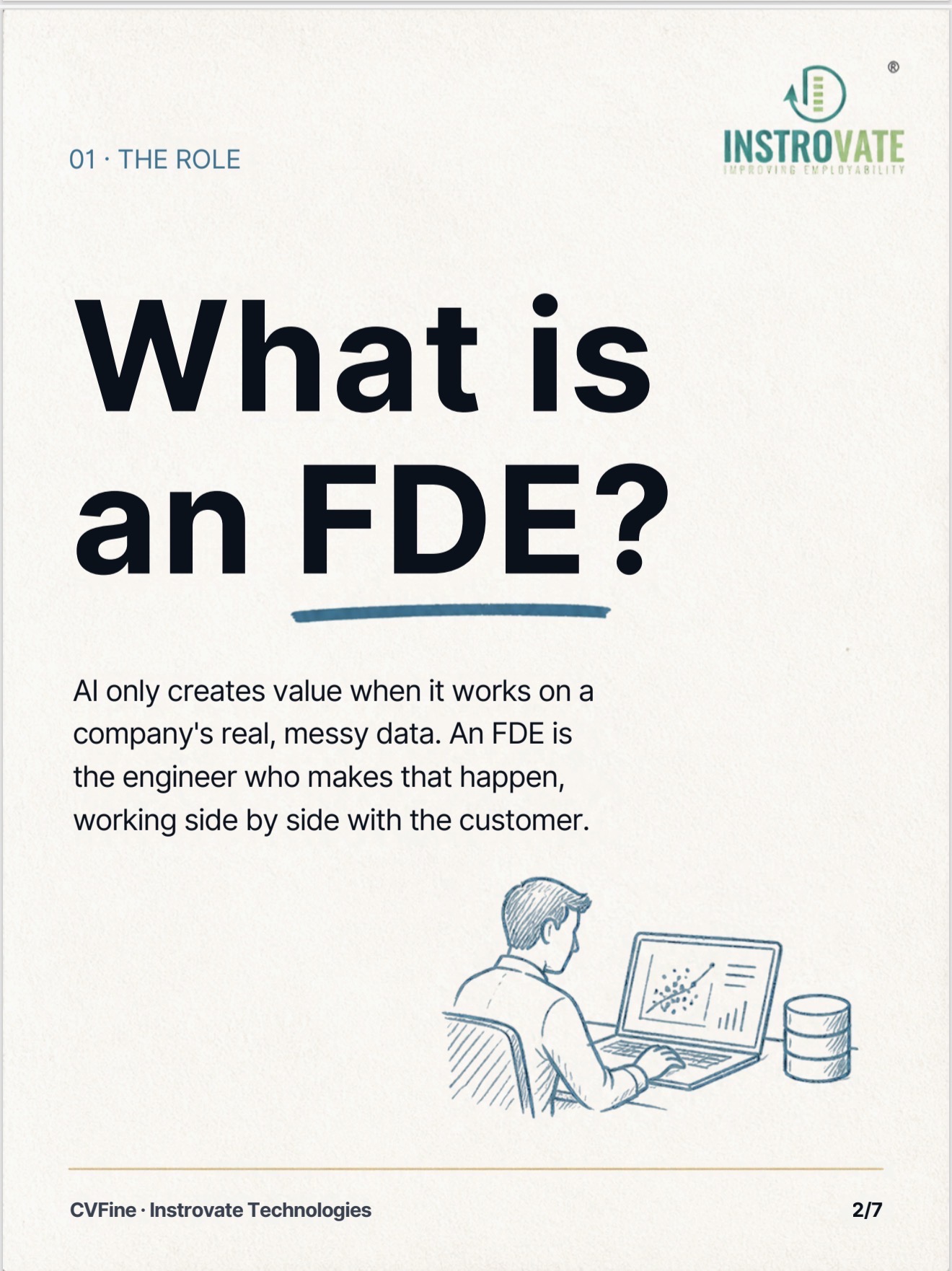
A typical FDE engagement can be understood through five stages.
Stage 1: Discover
Before writing code, the FDE needs to understand the customer’s problem.
This involves working with business stakeholders, understanding existing workflows, identifying pain points and agreeing on what success should look like.
For example, a customer might say they want an AI chatbot. But after discovery, the actual requirement may turn out to be an intelligent assistant that can answer questions across internal documents, retrieve information from enterprise databases and generate business reports.
Understanding that difference is critical.
Stage 2: Build
Once the problem is understood, the engineering work begins. The FDE connects AI models with the customer’s data, applications and existing systems.
This could involve:
Connecting LLMs to enterprise databases.
Building RAG pipelines.
Developing text-to-SQL applications.
Integrating APIs and enterprise services.
Implementing AI agents and tools.
Creating secure data access mechanisms.
The objective is not simply to build a prototype. It is to build something that addresses the actual requirement.
Stage 3: Test
An AI application that works for five demonstration questions may fail when exposed to hundreds of real-world questions.
Testing therefore becomes extremely important. The FDE validates accuracy, reliability, security, performance and edge cases.
For a RAG application, for instance, this could involve checking whether the system retrieves the right information, produces grounded answers and provides appropriate source citations.
Stage 4: Deploy and monitor
A working application needs to move into a production environment. This involves deployment, configuration, monitoring, troubleshooting and continuous improvement.
The FDE must ensure that the solution continues to work as real users interact with it and business requirements evolve.
Stage 5: Handover
The final objective is business adoption. The customer needs to understand how the solution works, how to use it, how to monitor it and what to do when something goes wrong.
A successful FDE engagement doesn’t end with a successful deployment. It ends when the customer can use and operate the solution effectively.
3. Why is the FDE role becoming important?
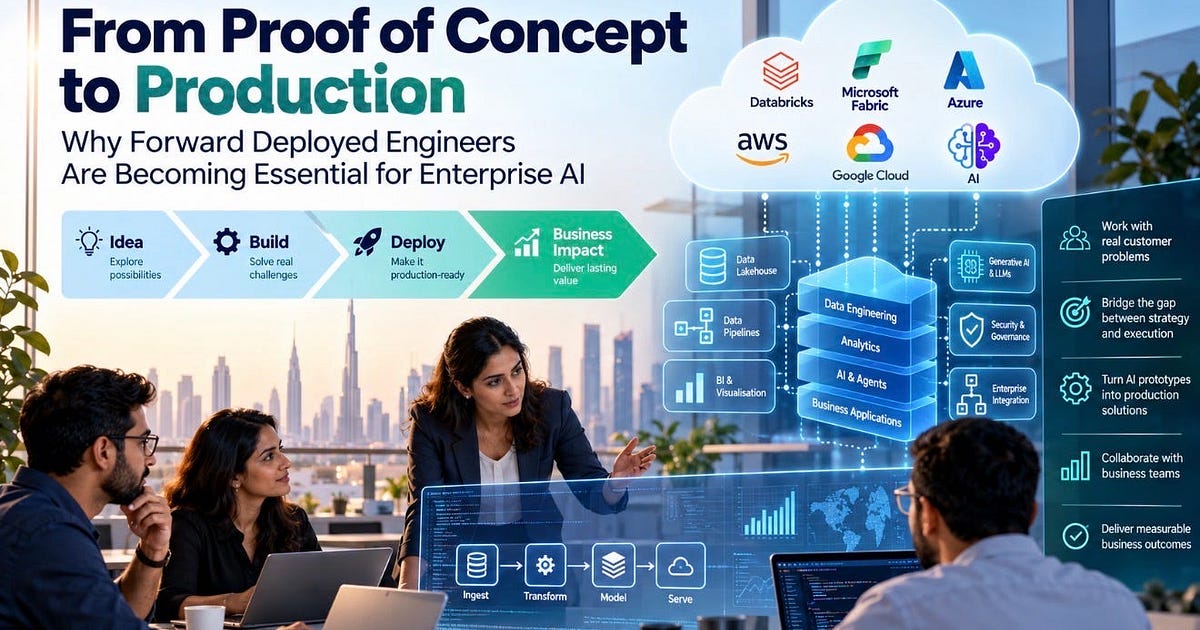
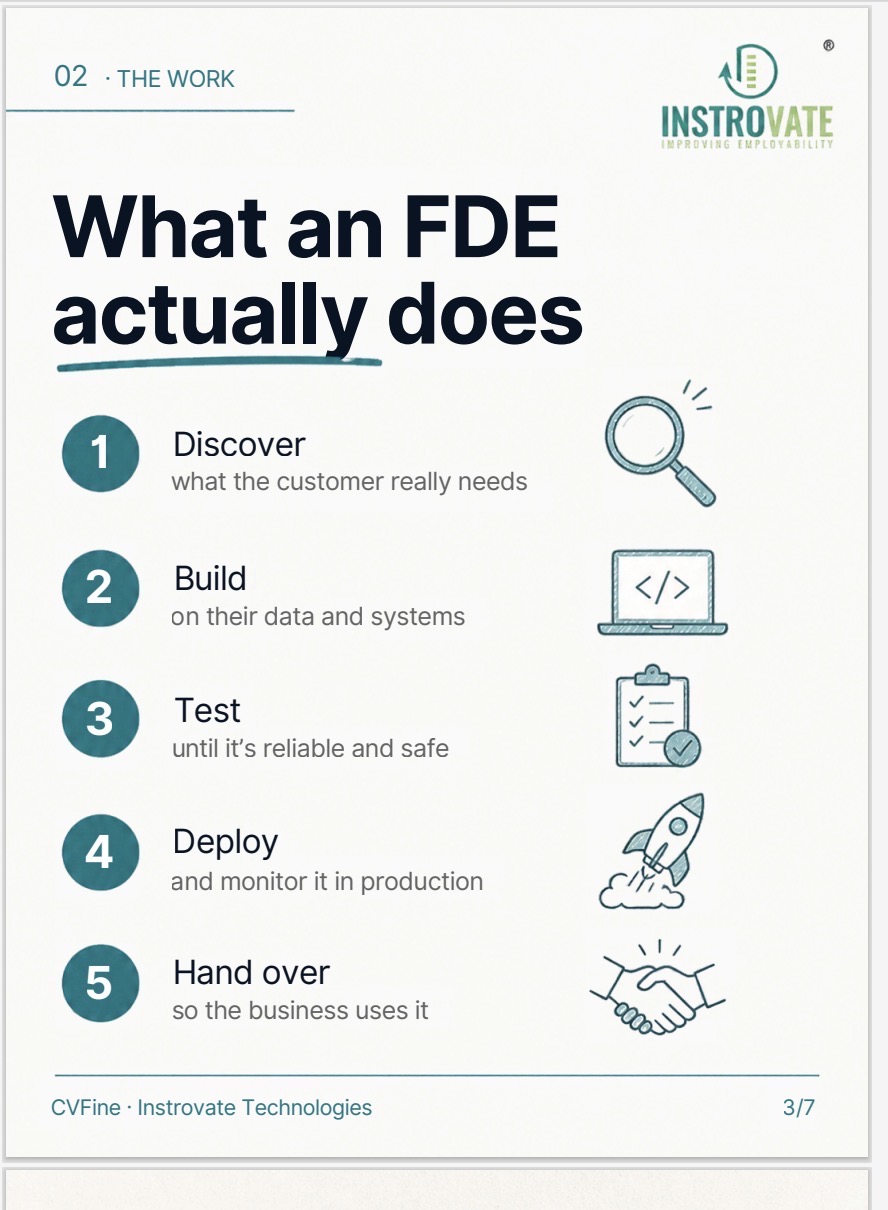
We are moving from the experimentation phase of AI towards practical enterprise adoption. Organisations are no longer satisfied with simply seeing what an LLM can generate.
They want AI solutions that can:
Work with their proprietary business data.
Integrate with existing enterprise applications.
Automate meaningful business processes.
Support employees in making decisions.
Operate securely within organisational boundaries.
Deliver measurable business outcomes.
Consider a few examples.
In banking: An AI assistant that retrieves information from internal policy documents and supports employees in answering customer queries.
In retail: An AI-powered analytics application that allows business managers to ask questions about sales, inventory and customer behaviour using natural language.
In healthcare: A secure knowledge assistant that helps authorised professionals retrieve relevant information from large collections of documents.
In manufacturing: An intelligent assistant that accesses maintenance records, equipment documentation and operational data to support troubleshooting.
These solutions require more than prompt engineering. They require an understanding of data engineering, application development, cloud infrastructure, APIs, security, AI evaluation and business processes.
This is precisely the combination of skills that makes the FDE role interesting.
4. FDE vs AI Engineer vs Data Engineer: What’s the difference?
These roles overlap, but their primary responsibilities are different.
Role
Primary focus
AI Engineer
Building and integrating AI-powered applications, models and intelligent systems
Data Engineer
Designing and maintaining data pipelines, platforms and infrastructure
Forward Deployed Engineer
Implementing solutions in the customer’s environment and ensuring they solve real business problems
An AI Engineer may build a sophisticated RAG application.
A Data Engineer may build the pipelines that make enterprise data available.
An FDE may bring these capabilities together, work directly with the customer, adapt the architecture to the customer’s environment and take the solution through deployment and adoption.
This doesn’t mean FDEs don’t need deep engineering skills. In fact, they often need to work across several technical disciplines. The distinction is primarily about the scope of responsibility and proximity to the customer.
5. What skills should you develop to become an FDE?
There isn’t one fixed technology stack for every FDE role. Requirements vary depending on the organisation, customer and solution being implemented.
However, there are several important skill areas worth developing.
A. Programming and application development
You should be comfortable building working applications.
Useful skills include:
Python
SQL
REST APIs
Application development
Git and GitHub
Debugging and troubleshooting
B. Data engineering
AI applications depend on data, and enterprise data can be complex.
You should understand:
Data ingestion and transformation
Relational databases
Data warehouses and lakehouses
SQL and query optimisation
Data quality
Data access and security
C. Generative AI and LLM engineering
This is one of the most important areas for someone entering AI-focused FDE roles.
Learn how to work with:
Large Language Models
Prompt engineering
Embeddings
Vector databases
Retrieval-Augmented Generation (RAG)
Function calling and tool integration
AI agents
Evaluation and guardrails
D. Cloud and deployment
A solution is only useful when it can operate outside a developer’s local environment.
Develop an understanding of:
Cloud platforms
Application deployment
Containers
APIs and integrations
Monitoring and observability
Authentication and authorisation
CI/CD fundamentals
E. Customer-facing and consulting skills
This is what makes the role particularly different.
You need to be able to:
Ask the right discovery questions.
Translate business requirements into technical solutions.
Explain architectural decisions.
Work with different stakeholders.
Manage changing requirements.
Communicate technical limitations.
Take ownership of outcomes.
An excellent engineer who cannot understand the customer’s problem may struggle in an FDE role.
Similarly, a strong communicator without the ability to build and troubleshoot solutions will find the technical responsibilities challenging.
The real strength of an FDE is the ability to combine both.
6. How do you start preparing for an FDE career?
Reading about RAG, watching tutorials and completing certification courses are useful starting points. But there is a difference between understanding a technology and being able to build something that works.
If you want to move towards AI Engineering or Forward Deployed Engineering, you should start building practical projects.
You don’t need to begin with an enormous enterprise implementation.
Start with smaller engineering challenges that develop the core skills required for real-world AI applications.
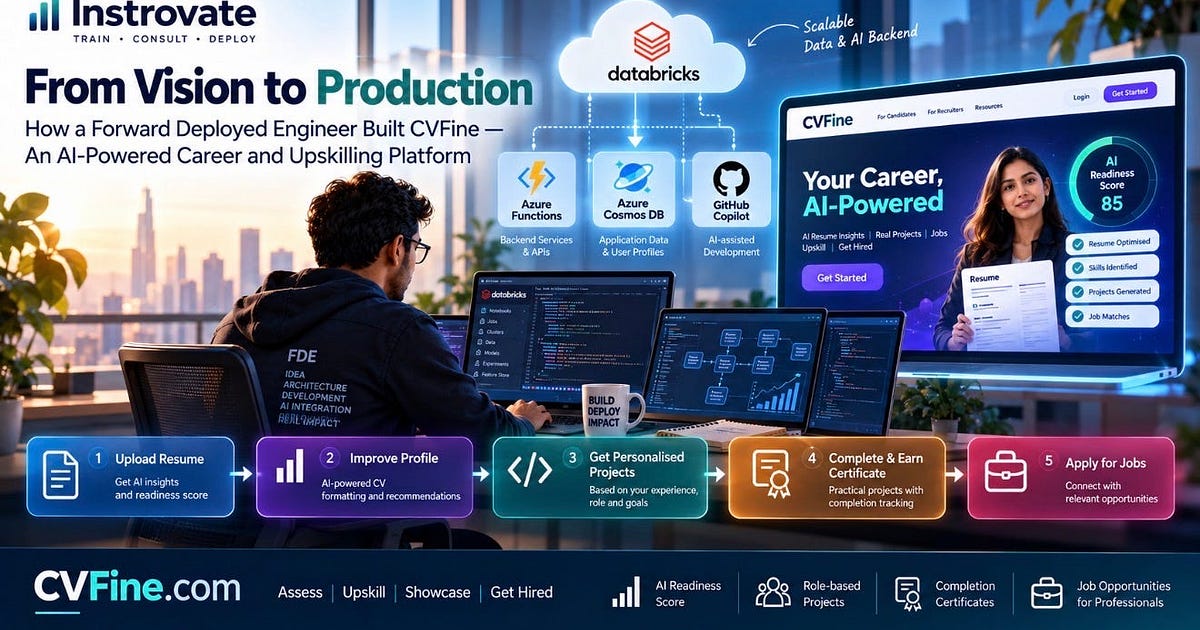
At Instrovate Technologies, we have structured a practical learning journey around this approach, Through our AI Projects at CVfine
Step 1: Foundation : Build the core engineering skills
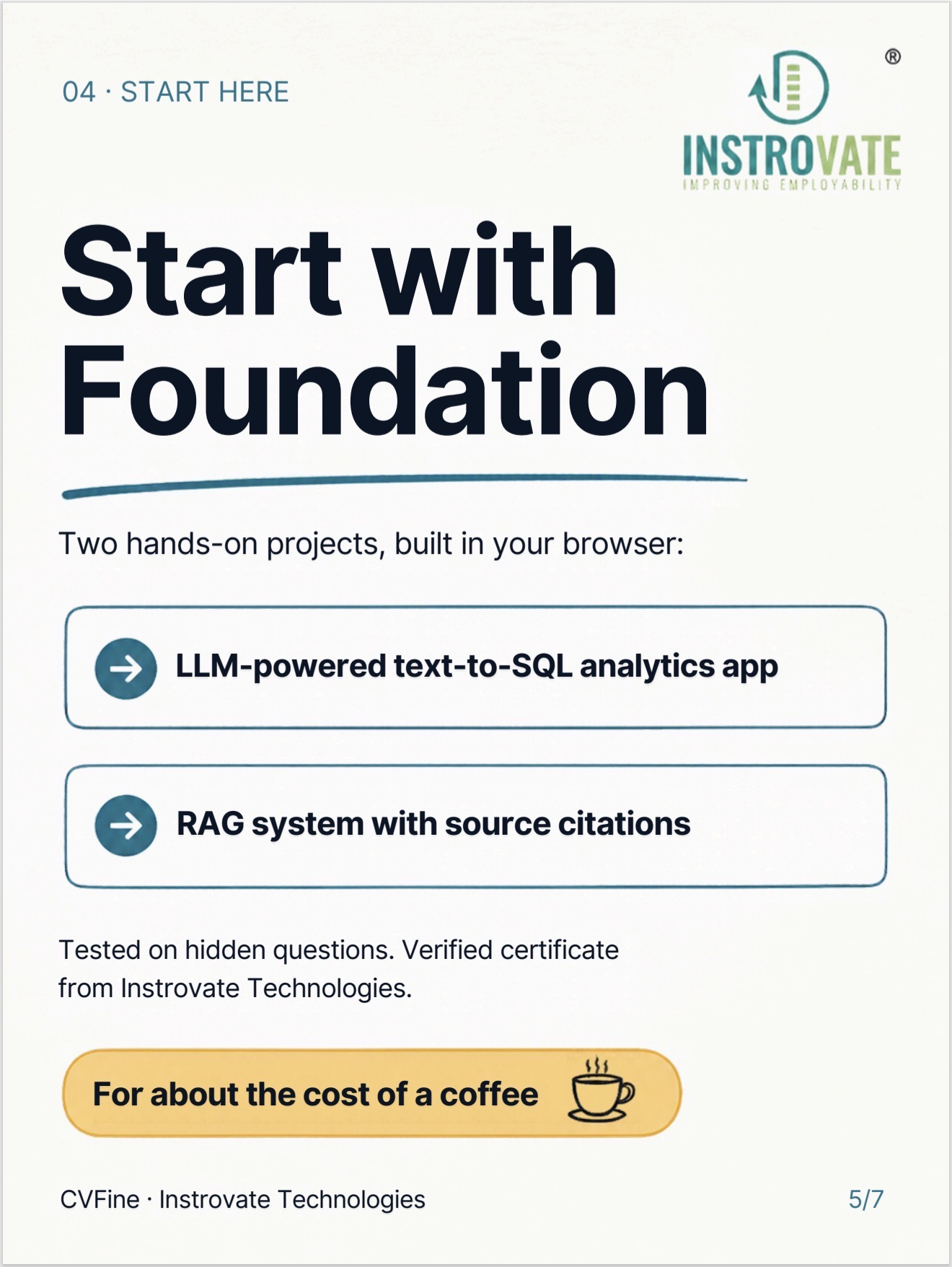
The Foundation pathway includes two hands-on AI engineering projects.
Project 1: Build an LLM-powered Text-to-SQL Analytics Application
Imagine a business user asking:
“What were our top five products by revenue last quarter?” Instead of manually writing SQL, the user asks a question in natural language.
The application uses an LLM to understand the question, generate SQL, execute the query and return the result.
This project helps you understand how LLMs interact with structured data and how to build an application around that capability.
You work with concepts such as:
Natural language to SQL.
Database interaction.
LLM integration.
Query execution.
Application development.
Validating generated outputs.
Project 2: Build a RAG System with Source Citations
Imagine uploading a collection of company documents and asking questions about their contents.
A RAG application retrieves relevant information from the documents and uses that context to generate an answer.
But there is an important additional requirement: the answer should include references to its sources.
This project introduces you to:
Document processing.
Text chunking.
Embeddings.
Vector search.
Retrieval pipelines.
LLM-based response generation.
Source citations and answer validation.
Both projects are designed to be completed in the browser. You also get automatic checks and the opportunity to test your solutions against hidden questions.
On successful completion, you earn a verified certificate of completion from Instrovate Technologies. The idea is simple: don’t just learn the concepts. Build something and demonstrate that it works.
You can access the below at our website
Step 2: Advanced - Experience the complete FDE lifecycle
Once you have developed the foundational engineering skills, the next step is to understand what it takes to deliver a solution in a real customer environment.
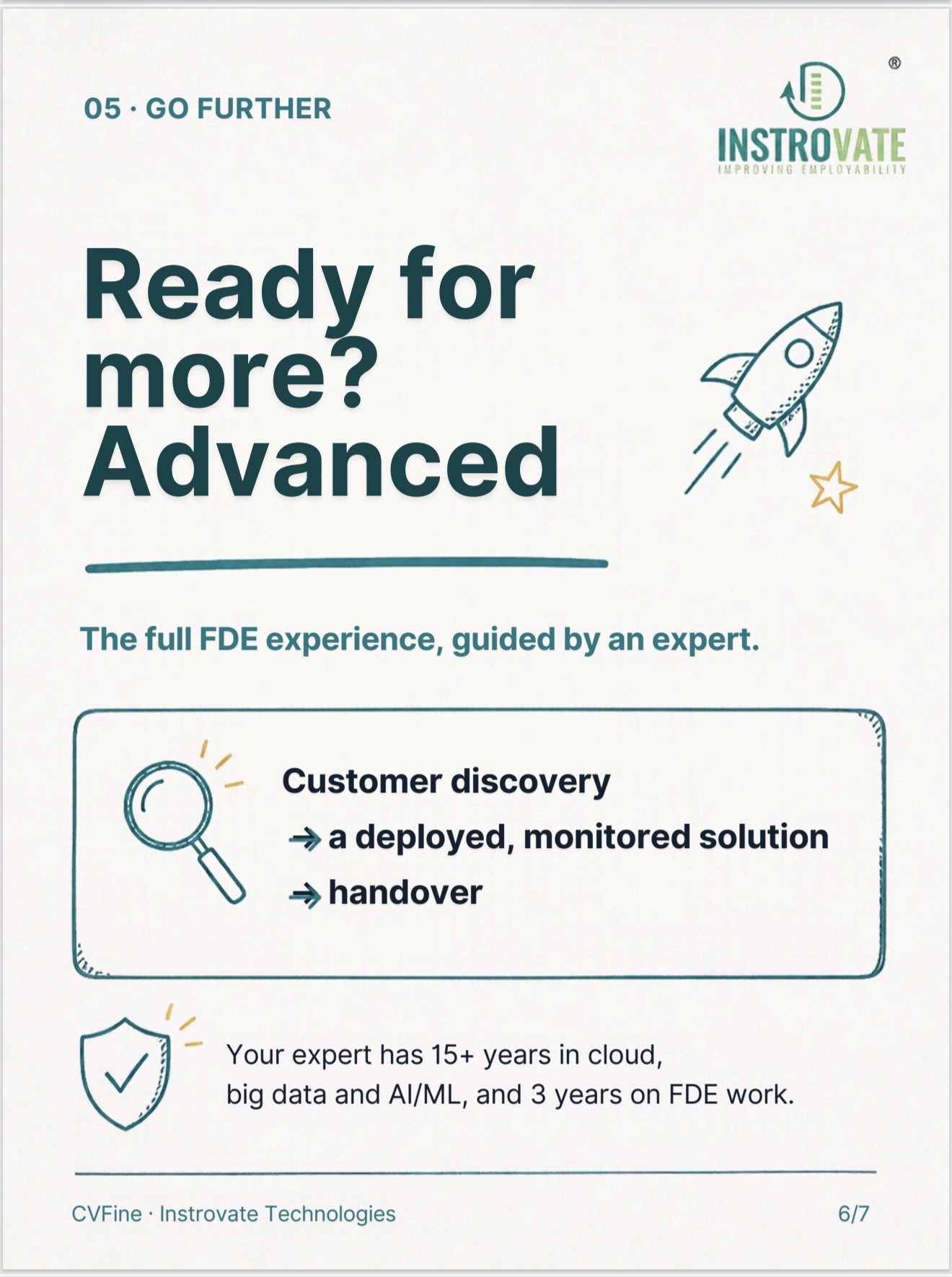
The Advanced pathway is designed around the broader FDE experience.
You work with an expert who brings:
15+ years of corporate experience in cloud, big data and AI/ML.
The last three years of experience working on FDE engagements.
The focus goes beyond building an individual AI application.
You explore the broader lifecycle:
Customer discovery and requirement understanding.
Solution design and development.
Building and deploying a working solution.
Monitoring and improving the deployed application.
Customer handover.
This is where the different engineering skills start coming together.
You begin to understand not only how to build an AI solution, but also how to approach the problem as an engineer responsible for delivering an outcome.
7. Who should consider this learning path?
The FDE career path can be particularly relevant for:
Software Developers: If you already build applications, you can extend your skills into LLM integration, RAG, AI agents and enterprise AI solutions.
Data Engineers: Your understanding of databases, pipelines and data architecture gives you a strong foundation for building AI applications connected to enterprise data.
Cloud Engineers: If you understand cloud infrastructure, deployment and integrations, you can extend your capabilities into AI-powered enterprise solutions.
AI and ML Professionals: If you have experience with models and machine learning, developing application engineering and customer-facing skills can help you move towards implementation-focused roles.
Technology Consultants: If you already work with customers and understand business requirements, developing hands-on AI engineering skills can help bridge the gap between consulting and implementation.
You don’t necessarily need to master every technology before starting. What matters is developing the ability to learn, build, troubleshoot and deliver.
8. The opportunity ahead: Think beyond traditional AI learning
One of the biggest mistakes aspiring AI professionals can make is focusing entirely on learning individual tools.
Learning a framework, experimenting with an LLM or completing a certification is valuable.
But the industry increasingly needs professionals who can bring different capabilities together.
Think about the difference:
Knowing what RAG is versus building a working RAG application.
Knowing SQL versus building an AI-powered analytics assistant.
Understanding cloud deployment versus deploying and monitoring an application.
Understanding a business requirement versus translating it into a technical solution.
The transition from learning concepts to engineering solutions is an important part of becoming industry-ready.
And that is the direction in which we believe practical AI engineering education should move.
At Instrovate Technologies, our objective is to help learners develop skills they can demonstrate through working projects, not just theoretical knowledge.
Ready to explore Forward Deployed Engineering?
You don’t need to commit to a long programme to begin exploring this career path.
Start with the Foundation projects and experience building two practical AI applications.
The Foundation pathway is priced at approximately the cost of a coffee, making it an accessible starting point.
When you’re ready to take the next step, explore the Advanced pathway and experience the broader FDE lifecycle with an experienced professional.
Explore the projects here:
https://cvfine.com/ai-work-projects
You can also comment COFFEE here, to start the conversation . The future of AI engineering isn’t just about building smarter models.
It’s about making those models work where they matter most: in the real world.
Build. Deploy. Solve real problems. Think like an FDE.
Brought to you by Instrovate Technologies – Improving Employability.
#ForwardDeployedEngineer #FDE #AIEngineer #GenerativeAI #RAG #TextToSQL #AIEngineering #CareerGrowth #Instrovate
Originally published on Substack