🛑 You Wouldn’t Hand a Scalpel to a Plumber — So Why Let AI Turn Anyone Into a ‘Doctor’?
I need to get this off my chest. We’ve hit this weird phase in the AI hype cycle where everyone with a ChatGPT login suddenly thinks they’re a subject-matter…
I need to get this off my chest. We’ve hit this weird phase in the AI hype cycle where everyone with a ChatGPT login suddenly thinks they’re a subject-matter expert.
No degree? No real-world experience? No idea how the thing you’re talking about actually works?
No problem. Just ask ChatGPT to whip up 500 words and post it with a confident caption.
Boom. You’re now a “thought leader.”
Except… you’re not.
Let me put it like this.
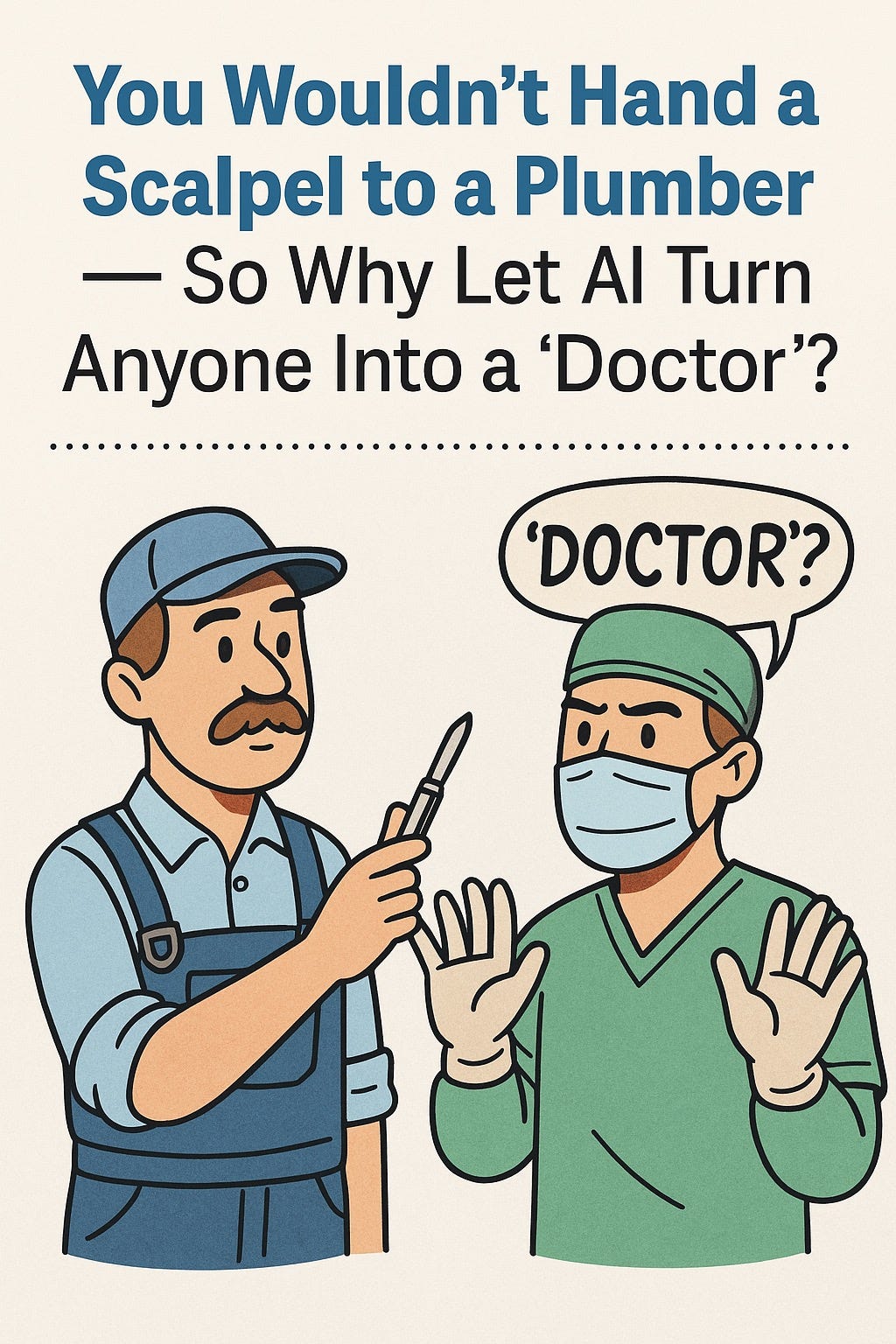
You wouldn’t hand a scalpel to a plumber and say, “Go ahead, perform heart surgery — he says he’s a doctor.”
Sounds ridiculous, right?
So why are we acting like AI is some magical filter that turns anyone into a professional… instantly?
It’s not. And the fact that we’re starting to believe it does — that’s actually the scary part.
The Real Problem Isn’t AI. It’s Us.
AI isn’t lying to us. We’re lying to ourselves.
We’re treating polished, well-written output as proof of credibility.
As if sounding right and being right are the same thing.
It’s not that AI enables fakers. It’s that it makes faking look really, really good.
And in a world already full of noise, that’s dangerous.
Here’s what’s actually happening:
People with zero background are creating pitch decks for industries they barely understand.
Interns are writing “market analysis reports” that sound like they came from McKinsey.
Social media is flooded with flashy advice from folks who’ve never once done the thing they’re talking about.
All because AI helps you skip the hard part — learning, doing, failing, and actually gaining expertise.
So what do we do? Ban AI? Obviously not.
AI isn’t the villain here. It’s a tool.
And like any tool, its impact depends on who’s using it.
Give it to a seasoned pro? You get something powerful.
Give it to someone pretending to be a pro? You get chaos — dressed in a nice font with emojis.
We don’t need less AI.
We need more accountability.
Verification is the New Differentiator
We’re entering a world where it’s no longer enough to sound like you know what you’re doing.
You have to prove it.
Here’s what we need more of:
🔍 Show your work — If you’re offering advice, back it up with real examples. Talk about stuff you’ve actually done, not what you prompted a chatbot to explain.
🎓 Credentials still matter — Certifications, experience, past clients… these are still valid ways to signal “I know my stuff.”
🧠 Depth over dazzle — If you can’t answer follow-ups, contextualize, or adapt your advice to real-world nuance, I’m out.
👀 Ask better questions — Before you trust someone’s AI-powered insights, ask: Have they ever done this without AI? Do they actually understand it?
Final thought
The people who’ll thrive in this next phase?
Not the ones trying to cheat their way to credibility.
But the ones who combine real expertise with smart tools.
People who already knew what they were doing — and now have AI in their back pocket to go even further.
That’s the move.
Everyone else? You’re just a plumber with a scalpel.
And sorry — I’m not letting you near my heart, no matter how good your LinkedIn post sounded.
👂What do you think?
Ever come across someone who clearly had no clue, but presented AI-generated stuff with full confidence?
Let’s talk about how we can keep things real — before the internet becomes one giant talent cosplay.
Originally published on Substack