Everyone’s Talking About AI — But Does Anyone Know What to Do With It?
After reading and subscribing to dozens of AI newsletters (mine included 😅), can anyone please raise their hand 🖐️ and say they actually have clarity on what…
After reading and subscribing to dozens of AI newsletters (mine included 😅), can anyone please raise their hand 🖐️ and say they actually have clarity on what to do next in AI?
Because right now, it feels like this:
Everyone’s confused.
Everyone’s scared to be “left behind.”
And half the people I meet have stopped learning Python, Java, React, SQL — because apparently “AI will handle it.”
The Great AI Confusion
Let’s be honest — none of the AI “gurus” have clearly told you what to do with all this information.
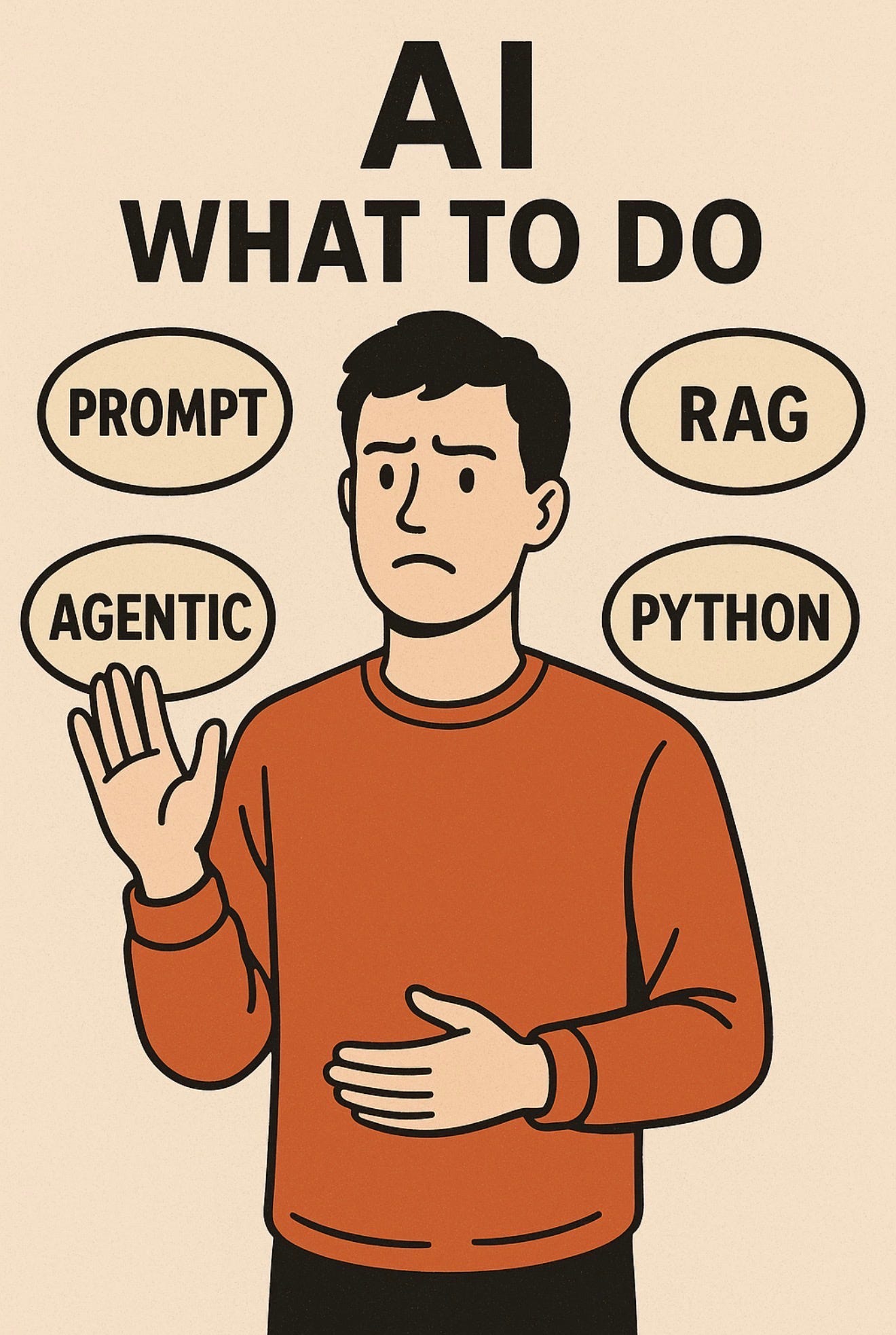
Should you:
Become a Prompt Engineer? (Except… most prompts are now written by AI. And can you name a company that’s actively hiring only prompt engineers?)
Learn RAG (Retrieval Augmented Generation)? (Cool tech — but how many companies are actually hiring for “RAG Developer”?)
Build AI Agents? (Sounds futuristic, but what even counts as “expertise” here?)
If you’re feeling this fog — you’re not alone.
What’s Actually Hiring Right Now
Let’s cut through the hype and look at real hiring trends:
✅ Prompt Engineering – Yes, there are job listings. Titles like “Prompt Engineer” or “AI Prompt Designer” exist — but most expect Python, LLM evaluation, and workflow automation. It’s not “just write clever prompts.”
✅ RAG / LLM Developer – Companies are hiring engineers who can connect LLMs to private data using vector databases, embeddings, and APIs. Think: “ChatGPT for my company data.”
✅ AI Agent Developer – Still emerging, but roles are showing up for people who can orchestrate LLMs, tools, and APIs together (LangChain, LangGraph, etc).
✅ AI Literacy Roles – Beyond engineering, recruiters are asking for AI-literate professionals in marketing, product, and ops — people who can use AI effectively in their existing jobs.
So What Should
You
Learn Now?
Here’s the simple truth:
🧱 Foundations still matter.
If you skip learning programming, data, and logic because “AI will do it,” you’re setting yourself up to be replaced — not empowered.
So here’s a no-BS roadmap 👇
🎓 Phase 1: Build Foundations
Learn Python and SQL.
Understand how data flows and how AI models work.
Build something small — even a chatbot using OpenAI API or a mini RAG system on Streamlit.
⚙️ Phase 2: Pick a Specialty
Choose one depending on your interest:
Prompt Engineering + Evaluation
RAG / LLM Integration
Agentic AI (multi-tool workflows)
Then build a portfolio project and share it online.
🚀 Phase 3: Go from Learner → Practitioner
Add your projects to GitHub.
Share your learnings on LinkedIn/Substack.
Apply for roles titled “LLM Engineer,” “AI Integration Specialist,” “Prompt Engineer,” or “AI Solutions Developer.”
That’s it.
No mystical secrets. No “AI whispering.”
Just real skills, visible work, and the ability to connect dots.
The Hard Truth
If you want to build a career in AI — you don’t need to chase buzzwords.
You need to combine:
Foundations + Applied AI + Problem Solving.
Because the future belongs to people who don’t just use AI — they understand how to make it useful.
💬 Question for You
What’s your next step in AI?
Are you learning something, building something, or still figuring it out?
Comment below — let’s make this thread the most honest AI career discussion on Substack.
Originally published on Substack