The AI Agent Trap: Why Your First Win Might Be Your Biggest Obstacle
You just shipped your first AI automation. The workflow runs. Notifications ping. Data hops from Tool A to Tool B. Maybe it even drafts emails or summarizes…
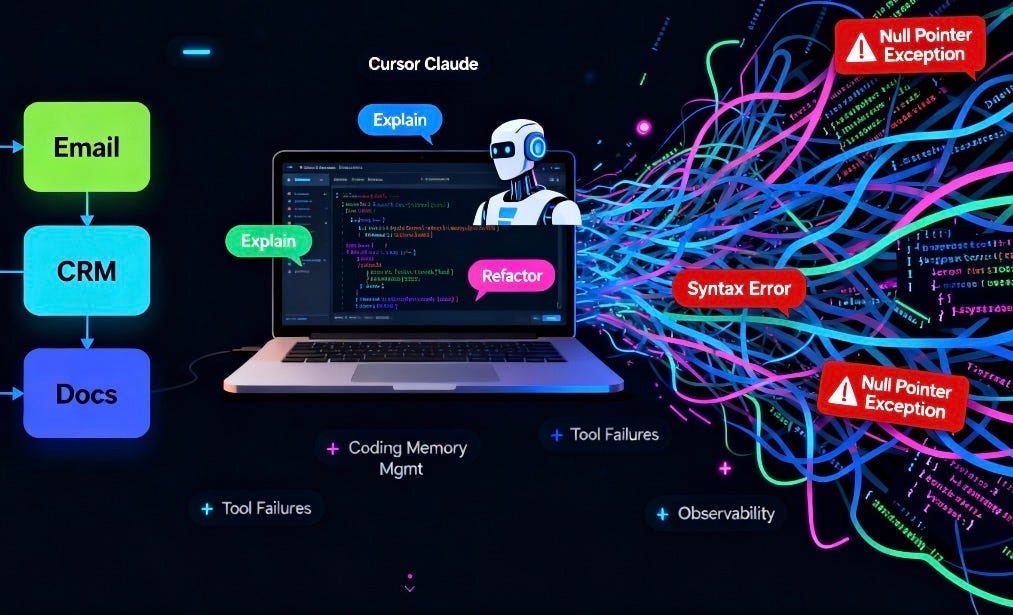
You just shipped your first AI automation.
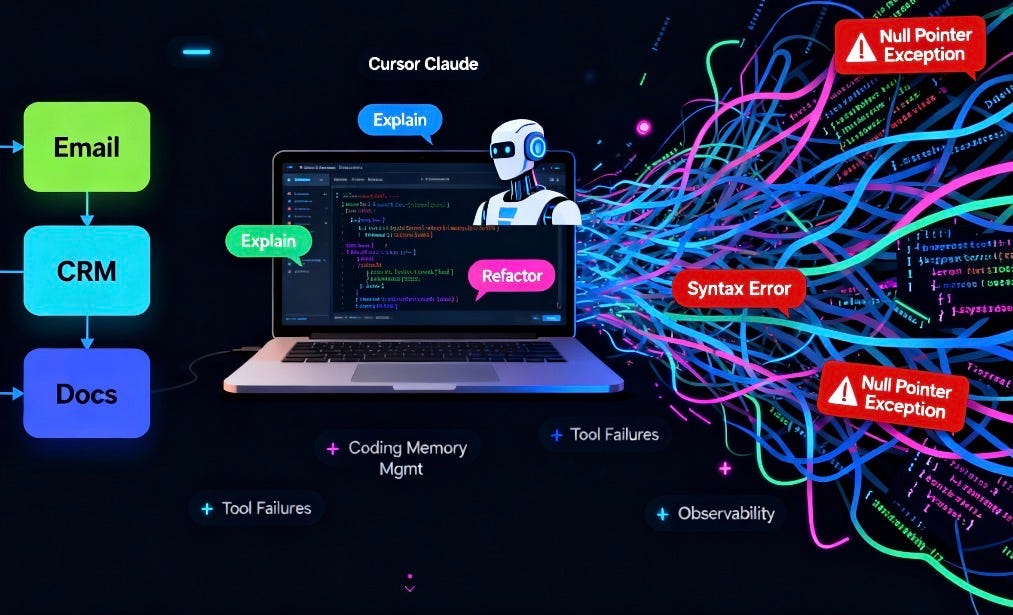
The workflow runs. Notifications ping. Data hops from Tool A to Tool B. Maybe it even drafts emails or summarizes meetings. It feels like magic.
Then you try to change one thing.
You add a conditional branch. A second model. A bit of memory. Some error handling for edge cases. Suddenly, that elegant flow turns into a spaghetti wall of nodes, tokens, and half-broken paths.
You are not alone. In 2025, this is happening everywhere, from solo founders wiring up Make and n8n to enterprises rolling out “agentic AI” pilots on top of their CRMs.
The uncomfortable truth: most people are not building AI agents. They are building fragile demos on top of shifting abstractions.
They are learning tools, not principles. Memorizing clicks, not understanding systems.
And as the AI stack changes faster every quarter, with new models, new “agent” platforms, and new security expectations, that gap is where projects go to die.
The Visual Builder Illusion (2025 Edition)
No code and low code tools have never been better.
• Zapier is shipping native AI actions.
• Make and n8n actively market full “agentic” capabilities.
• CRM, helpdesk, and cloud vendors are adding “AI agents” into every workflow.
These platforms are powerful. They absolutely belong in your toolkit.
But they also create a dangerous illusion: that being good at wiring blocks together is the same as understanding how AI agents actually work.[nurix]
It is like learning to drive a Tesla and assuming you understand battery management, power electronics, and control systems. You can get from point A to point B, until something fails outside the happy path. Then you are stuck staring at an opaque dashboard.
Most agent failures in 2025 are not because models are “not smart enough”. They fail because:
• Context windows are mismanaged.
• Tools are wired with no safeguards.
• Memory is bolted on without thinking about lifecycle or security.
• Error handling is an afterthought, not a design constraint.
Visual builders hide this complexity, right up until they do not.
Why So Many Agent Projects Stall
Across companies and indie builders, the same pattern shows up:
1. Phase 1: Demo high. A POC agent impresses everyone in a controlled environment.
2. Phase 2: Real world chaos. Messy data, unpredictable user input, flaky APIs, and new security constraints hit at once.
3. Phase 3: Debugging hell. No one knows why the agent did what it did. Logs are incomplete, prompts are copy pasted, and nobody owns the architecture.
4. Phase 4: Quiet sunset. The project is labeled “too unreliable”, “too risky”, or “too expensive to maintain” and is quietly shelved.
Analysts now estimate that a large share of agentic AI initiatives are being cancelled before scaling, not because AI “does not work”, but because teams cannot make systems reliable, observable, and economically sustainable.
The difference is not “better tools”.
It is better fundamentals.
The Path That Actually Works (In 2025)
Attention has shifted from “prompt engineer” to “agent engineer”. Job descriptions ask for experience with memory, tool orchestration, evaluation, and AI assisted development workflows, not just “knows how to use ChatGPT”.
The people who are winning with agents follow a very different path from the typical “try every new tool on social media” cycle.
Here is a roadmap you can realistically follow over 4 to 5 focused months.
Stage 1: Vibe Coding, Without Becoming a Vibe Casualty (3 to 4 Weeks)
2025 gave a name to how many people already like to code: vibe coding, describing what you want in natural language and letting an AI assistant generate most of the code. Tools like Cursor, Copilot, Claude Code, and Google AI Studio now let you spin up real apps by talking to your IDE instead of wrestling with syntax.
Used well, vibe coding is the fastest way for non developers to step into code and for developers to move two to three times faster. Used badly, it produces codebases that nobody understands, including the person who “built” them.
Your goal in Stage 1 is to combine vibe coding with core code literacy, not replace it.
What to Actually Learn
Over 3 to 4 weeks, aim for:
• Python basics: variables, data types, lists and dicts, functions, conditionals, loops.
• APIs 101: what an HTTP request and response is, status codes, headers, JSON payloads.
• Error fluency: how to read a traceback, search an error, and reproduce a bug.
• AI assisted workflow: how to talk to an AI coding assistant effectively, and when not to trust its output.
You are not trying to become a traditional software engineer in a month.
You are trying to become someone who:
• Can read and reason about the code your AI assistant generates.
• Can spot obviously wrong or risky behavior.
• Can glue small pieces together without panicking.
How to Use Vibe Coding Intentionally
Vibe coding, as Karpathy described it, is about “fully giving in to the vibes” and letting AI write almost everything. That is great for prototyping, but dangerous if you never look under the hood.
So in Stage 1, apply three constraints:
1. Always read the diff. Even if you accept most suggestions, scan what changed.
2. Ask the AI to explain, not just generate. “Explain this function line by line” should be a daily prompt.
3. Refactor by hand at least a little. Rename variables, split big functions, or add comments yourself.
Concrete micro projects, using AI heavily but with conscious review:
• A CLI calculator where you ask the AI to scaffold, then you adjust logic.
• A text cleaner that normalizes messy notes, where you inspect every regular expression.
• A simple web scraper that pulls titles from a site, where you debug one failing case.
Use tools like Cursor, Copilot, or Claude Code, but treat them as accelerators for your understanding, not shortcuts around it.
If Stage 1 ends and you are still scared of opening a code file, you are vibe coding in the wrong way.
Stage 2: Master One Agent Framework Deeply (4 to 5 Weeks)
Once you are comfortable reading and lightly editing AI generated code, you are ready for a real agent framework.
In 2024 and 2025, the ecosystem exploded: LangChain, LlamaIndex, CrewAI, AutoGen, SaaS “agent platforms”, plus model native SDKs. Many now include built in support for tools, memory, and evaluation.
Most people treat them like apps on their phone: install, try for a weekend, then abandon.
Resist that urge. Pick one and commit.
Learn:
• How it models agents, tools, and memory.
• How it handles retries, timeouts, and tool failures.
• How it shapes prompts and manages context windows.
• How it represents and stores state, whether JSON, databases, or vector stores.
Depth beats breadth:
• Deep fluency with one framework gives you mental models that transfer when you inevitably need to switch.
• Surface familiarity with five frameworks only gives you confusion and brittle copy paste.
Rebuild official examples from scratch. Then deliberately break them, with wrong schemas, slow APIs, or malformed outputs, and watch how the system behaves.
Stage 3: One Real Problem, One Clear Promise (3 to 4 Weeks)
Now you leave tutorial land.
Pick a real problem with a single, sharp promise. For example:
• Answer 80 to 90 percent of internal policy questions from your company docs.
• Categorize and draft replies for inbound leads in your inbox.
• Turn every client meeting into clean notes plus clear action items.
• Summarize industry news into a weekly internal brief.
Constraints:
• One user group.
• One primary task.
• One success metric, such as accuracy, time saved, tickets deflected, or similar.
Run it on real, messy data, not cherry picked ideal examples.
This is where you learn what “production ready” actually means:
• Handling rate limits gracefully.
• Designing fallbacks when the model gives malformed JSON.
• Logging enough to replay a failure.
• Knowing when to escalate to a human instead of hallucinating.
Teams that skip this discipline and jump straight to “multi agent orchestration” almost always ship fragile systems that silently fail in the wild.
Stage 4: Add Complexity Deliberately (5 to 7 Weeks)
Once one narrow agent is stable, then you add layers:
• External tools, such as search, databases, CRMs, ticketing, and calendars.
• Richer memory, including short term conversation and long term profiles.
• Evaluation loops, including automated test sets, spot checks, and user feedback.
• Multi agent patterns where they actually make sense.
Design rules:
• Add one capability at a time.
• After every change, run a small regression suite of realistic scenarios.
• Instrument everything: timestamps, inputs and outputs, costs, and key decisions.
This is where security, governance, and reliability become non negotiable:
• Prompt injection, data exfiltration, and over permissive tools are now real risks, documented in 2025 case studies.
• Memory can be poisoned through crafted inputs if you are not careful.
• Agents with write access need clear scopes, audit trails, and rollbacks.
The 2025 story is clear: autonomous behavior without observability and control is a liability, not an asset.
Stage 5: Return to Visual Builders (Strategically)
Only now is it time to go back to your favorite no code canvas.
But this time, your relationship to it is very different:
• You understand what each node is doing, whether it is an HTTP call, a transform, or a state update.
• You can read and validate JSON schemas instead of guessing.
• You can identify when you have created an unmaintainable maze and refactor it into services.
Visual tools become interfaces over a mental model you already possess, not substitutes for that mental model.
This is also when you:
• Wrap agents as APIs or cloud functions and orchestrate them visually.
• Combine agents with traditional automation, such as rules, webhooks, and scheduled jobs.
• Add monitoring, logging, and alerts that non technical teammates can understand.
Abstractions are now accelerators, not hiding places.
Stage 6: Share, Teach, and Stress Test (Ongoing)
The final unlock happens when you expose your ideas to other humans.
• Publish build logs or case studies of your agents.
• Share architecture diagrams and test strategies.
• Help others debug their workflows in public.
In 2025, there is a growing ecosystem of practitioners sharing not just cool demos, but hard won patterns, anti patterns, and metrics. Adding your learnings to that pool forces you to sharpen your thinking and often surfaces issues before they become expensive outages.
Every “dumb” question reveals an assumption baked into your system.
The Timeline Reality Check
From true beginner to someone who can design and ship production grade agents, a 4 to 5 month runway is realistic:
• 1 month: vibe assisted coding plus core fundamentals.
• 1 month: one framework in depth.
• 1 month: one real agent to reliability.
• 1 to 2 months: layering complexity, integrating tools, deploying, and measuring.
That may feel slow in an industry where a new agent platform launches every week.
But compare it to the alternative: years of bouncing between tools, never quite understanding why things break, and living in permanent POC mode while competitors turn agentic AI into a real operating advantage.
The Real Barrier Is Not Technical
In 2025, people with non traditional backgrounds are building serious agents, while experienced engineers still ship brittle RAG chatbots that fall over in production.
The differentiators are mindset and habits:
People who compound:
• Accept confusion as a natural state, not a signal to switch tools.
• Ship ugly first versions quickly, then iterate with data.
• Debug systematically instead of poking random settings.
• Ask “Why did this work?” as often as “Why did this fail?”
• Treat errors and incidents as design feedback, not personal failures.
People who plateau:
• Swap platforms the moment things get hard.
• Copy prompts and flows without understanding.
• Blame the framework, the model, or “AI not being ready”.
• Chase the perfect tutorial instead of running small experiments.
• Avoid messy, real world deployment where the real learning happens.
The technology is advancing. The question is whether your approach is.
Originally published on Substack