Navratri: The Battle Between the Divine and the Demons Within Us
Part 1 — From the Worship of Maa Durga to the Awakening of Shakti Within
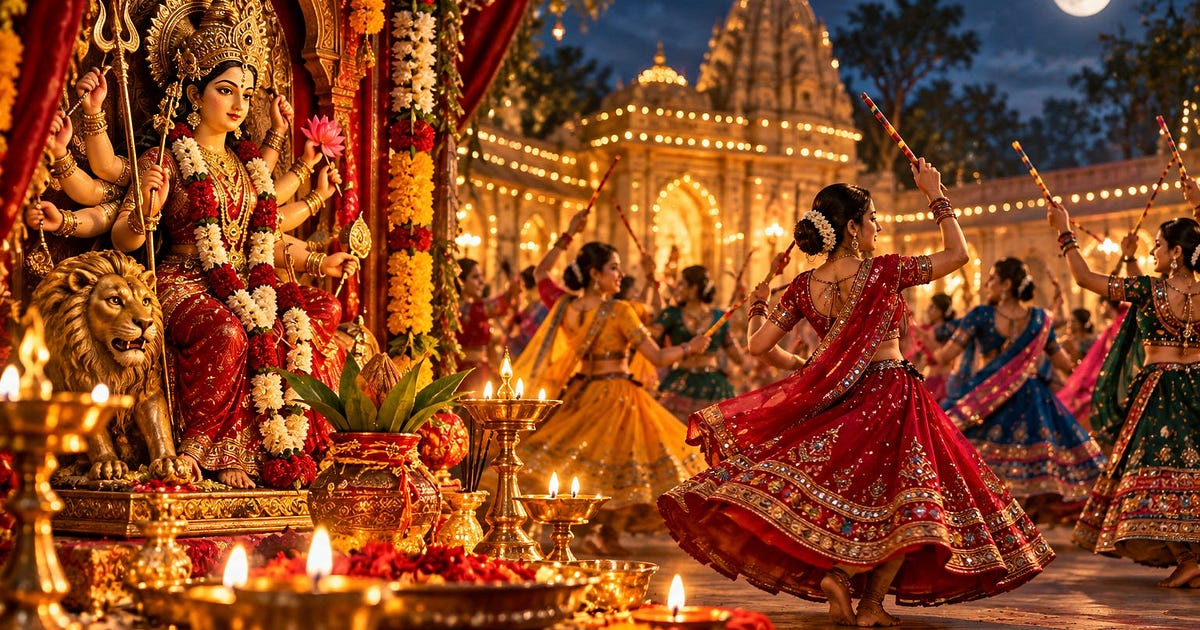
Every year, as Navratri arrives, something begins to change. The air fills with devotion. Temples glow with lamps, homes welcome the Goddess, and millions of people gather to celebrate nine nights dedicated to the divine feminine. Some observe fasts, some chant mantras, some dance through the night, and others simply fold their hands before Maa Durga and ask for her blessings.
For many, Navratri is a celebration of faith. For others, it is a time of purification, discipline, and new beginnings. But have you ever wondered why we celebrate nine nights in honour of the Goddess? Why does Maa Durga fight demons? Why does the story of her victory hold such a powerful place in Hindu tradition? And what if these ancient stories have something to teach us not only about the world around us, but also about the world within us?
What if the battlefield described in our scriptures is, in another sense, the battlefield of the human mind? To explore this possibility, we must begin with the festival itself.
The Nine Nights of the Divine Mother
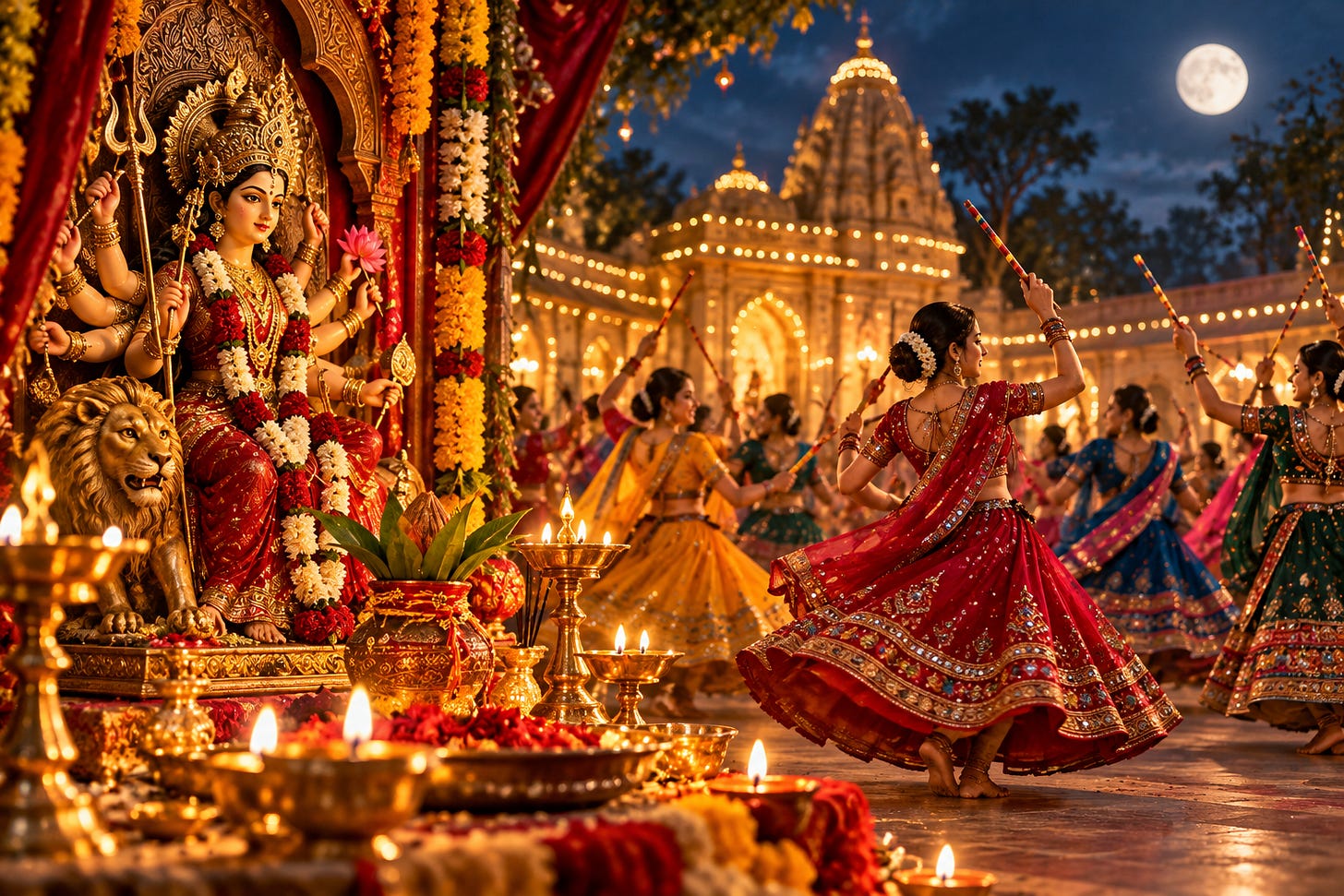
The word Navratri comes from two Sanskrit words: nava, meaning nine, and ratri, meaning night.
Across these nine nights and ten days, devotees honour the many forms of the Goddess, particularly as expressions of Shakti - the divine feminine power that sustains creation, movement, transformation, and life itself.
In many traditions, Navratri celebrates Maa Durga’s victory over Mahishasura, the buffalo demon who represents a formidable force of disorder and arrogance. The Goddess, formed through the combined divine powers of the gods, defeats him after an intense battle. The festival culminates in the celebration of victory over evil, commonly observed as Vijayadashami, or Dussehra.
At first glance, the message seems straightforward: good triumphs over evil. And it does. But Hindu traditions often invite us to contemplate stories at more than one level. A story can be a sacred narrative, a celebration of divine power, a moral teaching, and a source of personal reflection, all at once.
The Goddess’s victory can remind us of the triumph of courage over fear, wisdom over ignorance, and righteousness over arrogance. It can also invite us to examine the forces within ourselves that prevent us from living with clarity and compassion.
After all, we may never encounter a buffalo demon on a battlefield. Yet we encounter anger, jealousy, uncontrolled desire, pride, fear, and attachment in our everyday lives.
These forces may not carry weapons, but they can influence our decisions, consume our attention, and pull us away from the person we wish to become. Perhaps this is one reason the story of Maa Durga continues to speak to us across generations.
The Goddess does not turn away from the darkness. She enters the battlefield. And that is where our inner journey begins.
What Does Maa Durga Represent Within Us?
To understand this deeper perspective, we must first understand a central concept in Hindu spiritual philosophy: Shakti.
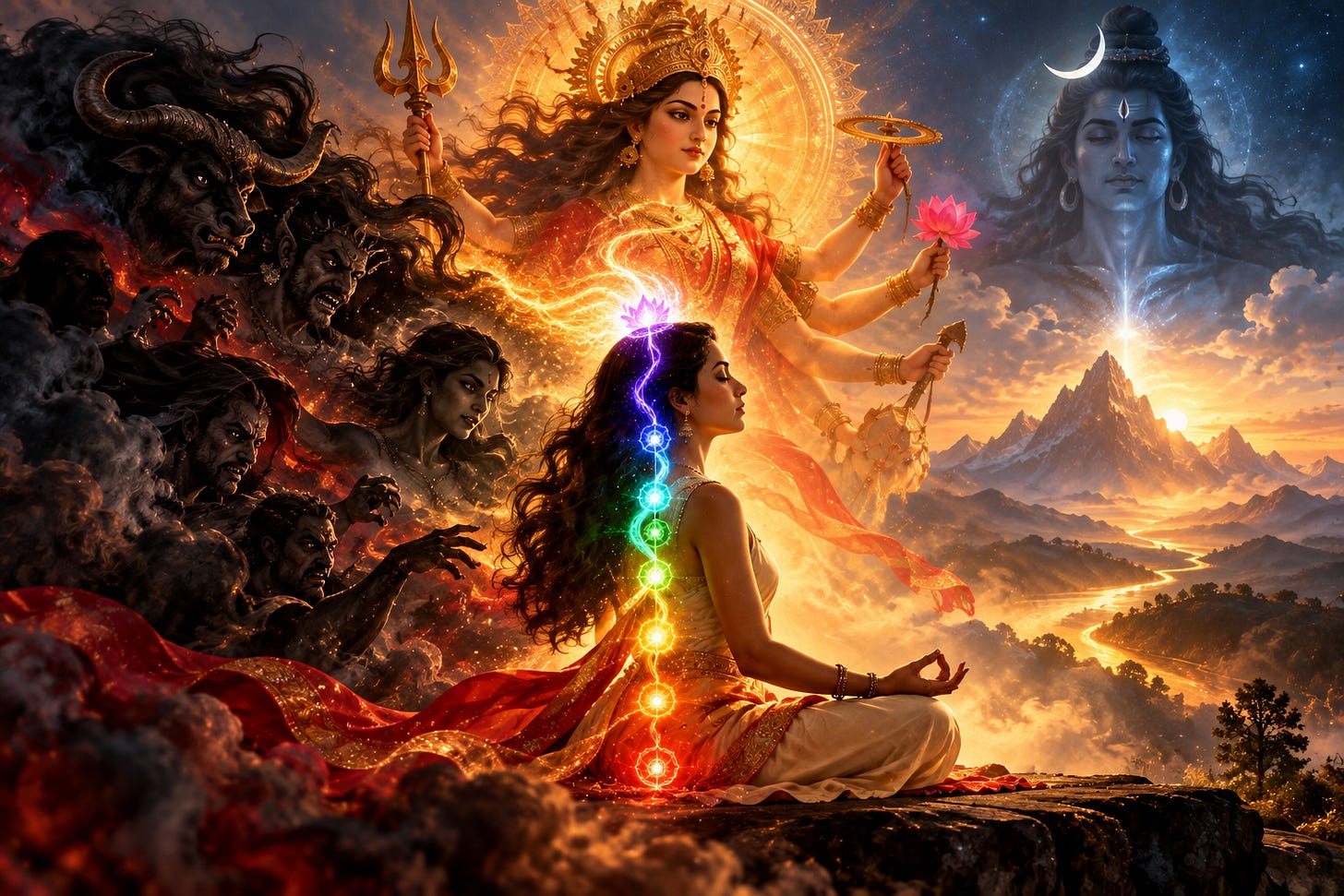
Shakti is often described as the divine feminine power - the dynamic energy through which the universe comes into being, expresses itself, and continues to transform. Think of consciousness as the capacity to witness, know, and be aware. Energy is what moves, creates, acts, and transforms.
In several Hindu philosophical and Tantric traditions, these two principles are represented by Shiva and Shakti.
Shiva symbolises pure consciousness. Shakti symbolises dynamic power. They are not simply representations of a man and a woman. They point towards complementary principles that can be contemplated within existence and within ourselves.
Without movement, potential remains unexpressed. Without awareness, movement can become directionless. Their relationship is therefore not a struggle in which one must defeat the other. It is a relationship of profound interdependence.
This brings us to one of the most beautiful ways of contemplating Navratri: the Goddess’s battle is not necessarily about destroying life or desire itself. It can be understood as a journey towards bringing our inner forces into harmony.
Maa Durga represents power guided by purpose. She is fierce, yet not chaotic. She is compassionate, yet not powerless. She carries many weapons, each of which can be contemplated as a different capacity needed to overcome the challenges of existence.
Her lion represents courage and mastery over instinct. Her many arms suggest that divine power can respond to many challenges. Her radiance evokes a strength that is not diminished by the darkness it confronts.
In this reading, worshipping the Goddess becomes more than asking for protection from difficulties outside ourselves. It becomes an invitation to cultivate the strength, clarity, and discernment needed to face what lies within.
But if the Goddess represents this awakened power, what do the demons represent?
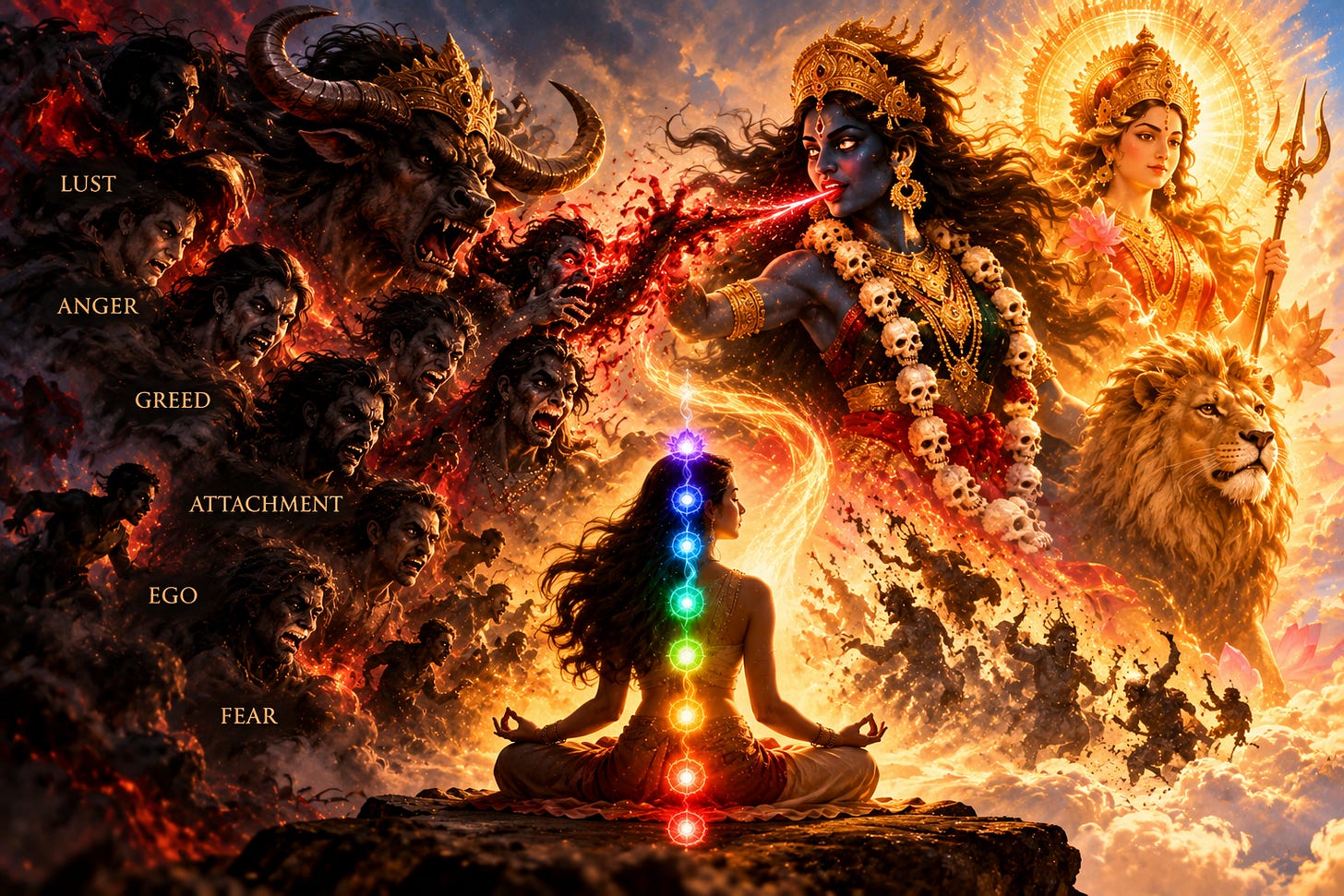
To explore that question, let us look more closely at two of the most compelling figures in the Devi Mahatmyam, a sacred text also known as the Durga Saptashati or Chandi Path.
Mahishasura: When Instinct Becomes Our Master
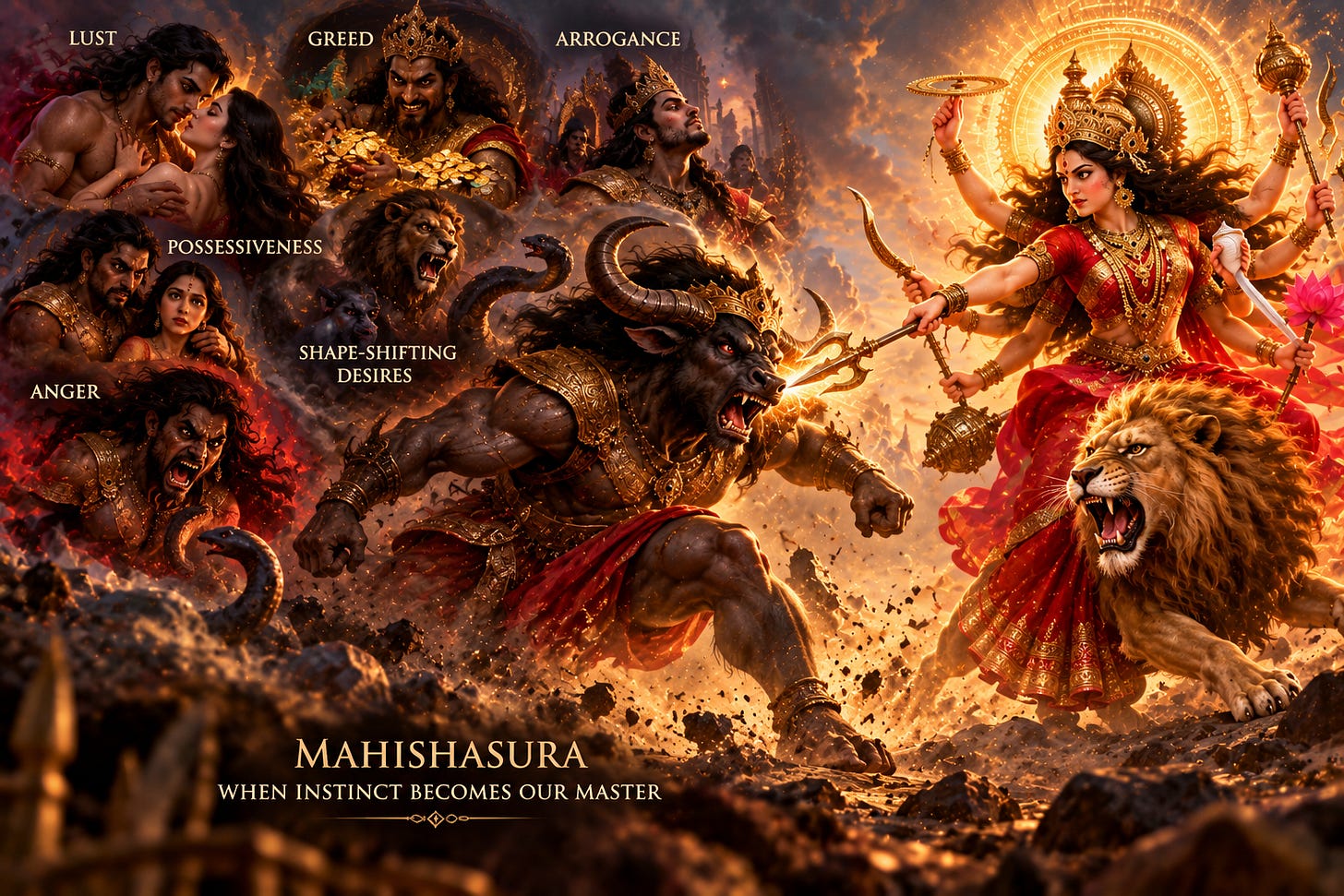
The story of Mahishasura is one of the most celebrated narratives associated with Navratri.
Mahishasura possesses extraordinary power and repeatedly changes his form during his battle with the Goddess. He is not easily defeated. Just when the battle seems to be reaching its conclusion, his transformations make him difficult to overcome.
Finally, Maa Durga defeats him.
In a psychological reading of the story, Mahishasura can represent the parts of human nature that become destructive when left without awareness or restraint.
Consider what happens when an ordinary desire becomes an obsession. The desire for success can become greed. The desire for love can become possessiveness. The desire for pleasure can become dependency. The desire for recognition can become arrogance. The original impulse may be natural. The problem begins when it takes control of us.
Mahishasura’s changing forms offer a powerful metaphor for this experience. A single unresolved impulse can disguise itself in many ways. We may tell ourselves that we are seeking happiness when we are actually seeking validation. We may believe we are exercising freedom when we are being driven by compulsion.
The form changes, but the underlying struggle remains. Maa Durga’s victory invites us to develop the discernment to recognise these patterns and the courage to overcome them.
This does not require us to hate our instincts or deny our humanity. Rather, it asks us to become conscious of our impulses instead of allowing every impulse to dictate our actions.
And this distinction becomes especially important when we begin exploring the more esoteric interpretations of Navratri.
From Desire to Discipline: The Esoteric Meaning of Vital Energy
In several Indian spiritual traditions, the human body is not viewed merely as a physical structure. It is also understood as a field of life, awareness, breath, and subtle energy.
Within this framework, concepts such as prana, virya, and ojas become important.
Prana is commonly understood as vital life force. Virya can refer to potency, vitality, courage, or generative strength; in some contexts, it specifically refers to reproductive essence. Ojas is described in certain yogic and Ayurvedic traditions as a subtle essence associated with vitality, resilience, and radiance.
These concepts have different meanings across texts and traditions, and they should not be treated as interchangeable scientific terms.
Nevertheless, they offer a fascinating starting point for contemplating self-mastery.
Sexual desire is a natural part of human life. The spiritual question is not simply whether desire exists, but how we relate to it.
Does desire serve our conscious choices, or do our choices become servants of desire?
Can we experience an impulse without immediately acting upon it? Can we direct our attention towards creativity, meaningful work, devotion, relationships, and inner growth rather than being repeatedly pulled towards immediate gratification?
Some yogic traditions explore these questions through Brahmacharya, a discipline associated with the wise regulation of sensuality and the conservation or right use of vital energy. Depending on the tradition and stage of life, Brahmacharya may involve celibacy, moderation, disciplined conduct, or freedom from compulsive attachment.
In certain interpretations, the conservation of reproductive vitality is associated with the cultivation of Ojas.
Here, the deeper lesson is about the transformation of one’s relationship with desire.
Self-mastery is not the same as self-rejection. Discipline is not the same as suppression.
Suppressing an impulse while remaining consumed by it is different from understanding it, developing awareness of it, and choosing how to respond.
Nor does this mean that semen retention has been scientifically established to awaken Kundalini or that every person must practise celibacy to achieve spiritual growth. Those are claims that require more careful treatment than a simple allegorical reading can provide.
Instead, we can approach this symbolism as an invitation to investigate a broader question: what happens when our energy is no longer scattered by every passing impulse?
This question leads us to another demon in the Goddess’s mythology—a figure whose story offers an especially striking metaphor for the restless mind.
His name is Raktabija.
Raktabija: The Desire That Multiplies When We Fight It
In the Devi Mahatmyam, Raktabija possesses a terrifying boon: whenever a drop of his blood falls to the ground, another demon just like him emerges.
During the battle, every wound creates more enemies. The harder the Goddess’s forces strike him, the more overwhelming the battlefield becomes.
The problem is no longer simply the strength of one demon. It is the multiplication of the problem itself.
Consider how familiar this pattern can feel in everyday life. You decide not to think about something, and the thought returns more insistently. You try to suppress an emotion, but it keeps resurfacing. You struggle with a particular desire, and soon your mind is occupied with variations of the same desire.
One thought becomes ten. Ten become a hundred. The more attention we give a recurring thought through fear, resistance, or compulsive engagement, the more space it can occupy in our inner world.
This does not mean every attempt to resist desire makes it stronger. Healthy boundaries and deliberate restraint can be effective. But when resistance becomes a cycle of obsession, the struggle itself can keep the thought alive.
Through a contemplative yogic lens, Raktabija can represent this multiplication of mental impressions and habitual tendencies.
In yogic psychology, chitta vrittis refers to the movements or fluctuations of the mind. Vasanas are often understood as latent tendencies or habitual inclinations. These concepts help describe how previous experiences and repeated patterns can shape our present reactions.
The demon’s blood can therefore serve as a metaphor for the way an unresolved pattern reproduces itself whenever the conditions for its continuation are present.
We might try to defeat anger with more anger, pride with wounded pride, or desire with an obsessive fear of desire.
In doing so, we risk creating more of the very thing we wish to overcome.
So how does Maa Durga defeat an enemy whose every wound creates another enemy?She does not approach the problem in the ordinary way.
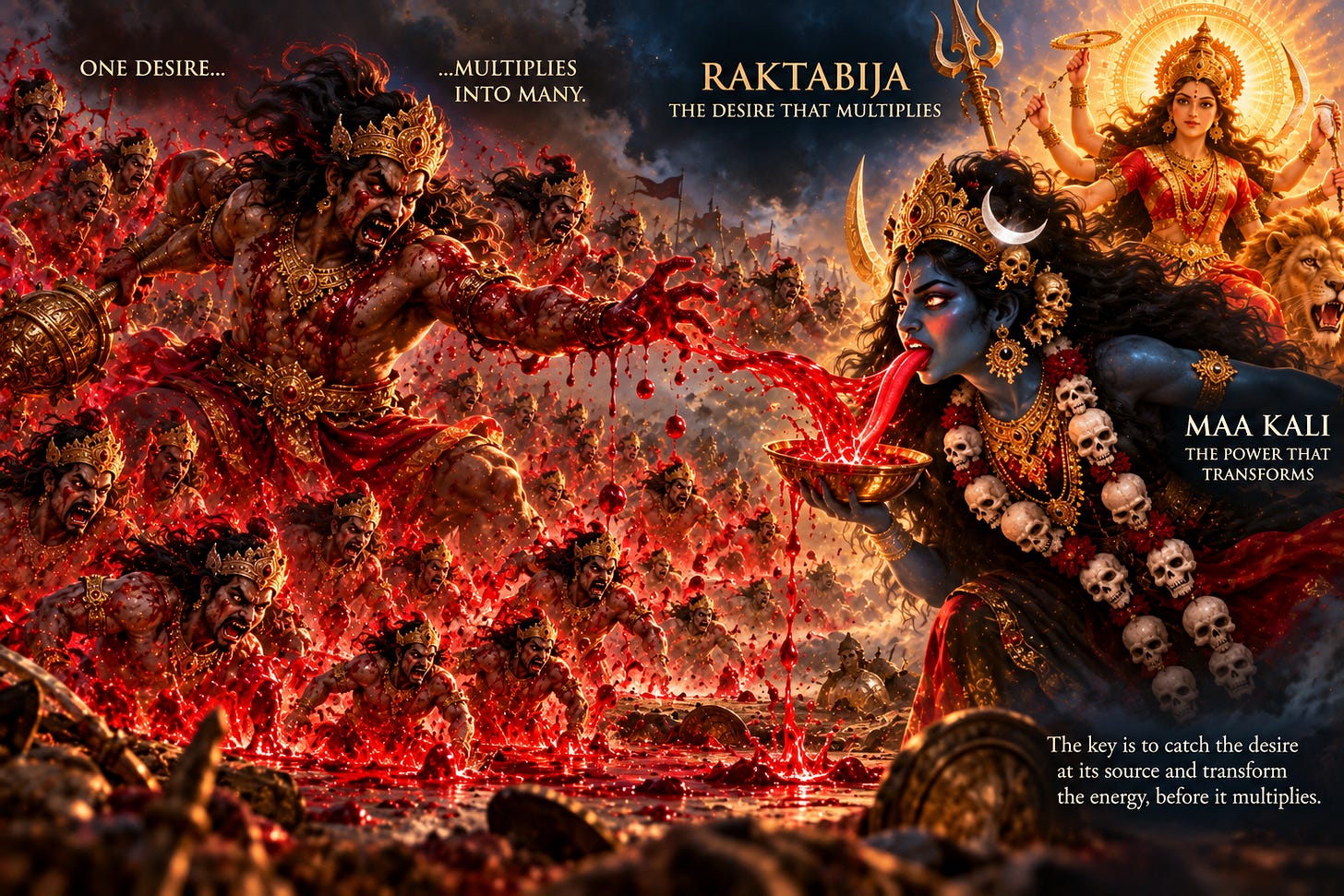
In the story, the Goddess manifests Maa Kali, who catches and consumes Raktabija’s blood before it can fall to the earth and generate further demons.
The strategy changes. Instead of allowing the source of multiplication to continue, the Goddess prevents the cycle from reproducing itself.
As a metaphor for inner life, this is a profound teaching. What if the answer is not always to fight every thought that arises, but to become aware of the pattern before it takes hold?
What if we learn to recognise the first movement of an impulse, observe it without being carried away, and redirect our attention before it becomes a chain of compulsive reactions? This is where awareness, discipline, meditation, and discernment begin to work together.
And it is here that the symbolism of Maa Kali opens another door.
Maa Kali: The Power That Transforms
Maa Kali is among the most powerful and complex forms of the Divine Mother in Hindu traditions.
Her fierce appearance can be startling to those encountering her imagery for the first time. Yet she is also worshipped as a compassionate mother, a liberating force, and a power that confronts what ordinary consciousness struggles to face.
In the Raktabija narrative, Kali’s role is essential because she interrupts the demon’s ability to multiply.
In an esoteric interpretation, her action can be contemplated as the capacity to meet an impulse at its source rather than allowing it to become another cycle of attachment.
Can the energy that once kept us trapped in repetitive patterns become a source of greater awareness?
Can the same intensity that fuels an obsession be redirected towards devotion, creativity, discipline, or self-understanding?
Can we learn to hold our impulses without being controlled by them?
These are questions that can be explored without assuming that all desire is harmful or that spiritual growth requires a particular physical practice.
The central invitation is to become less fragmented, less reactive, and more conscious of how we use our attention and energy.
But this brings us to the deepest question of all.
If the Goddess represents the power of transformation, where does that transformation ultimately lead?
The Inner Journey: From Shakti to Shiva
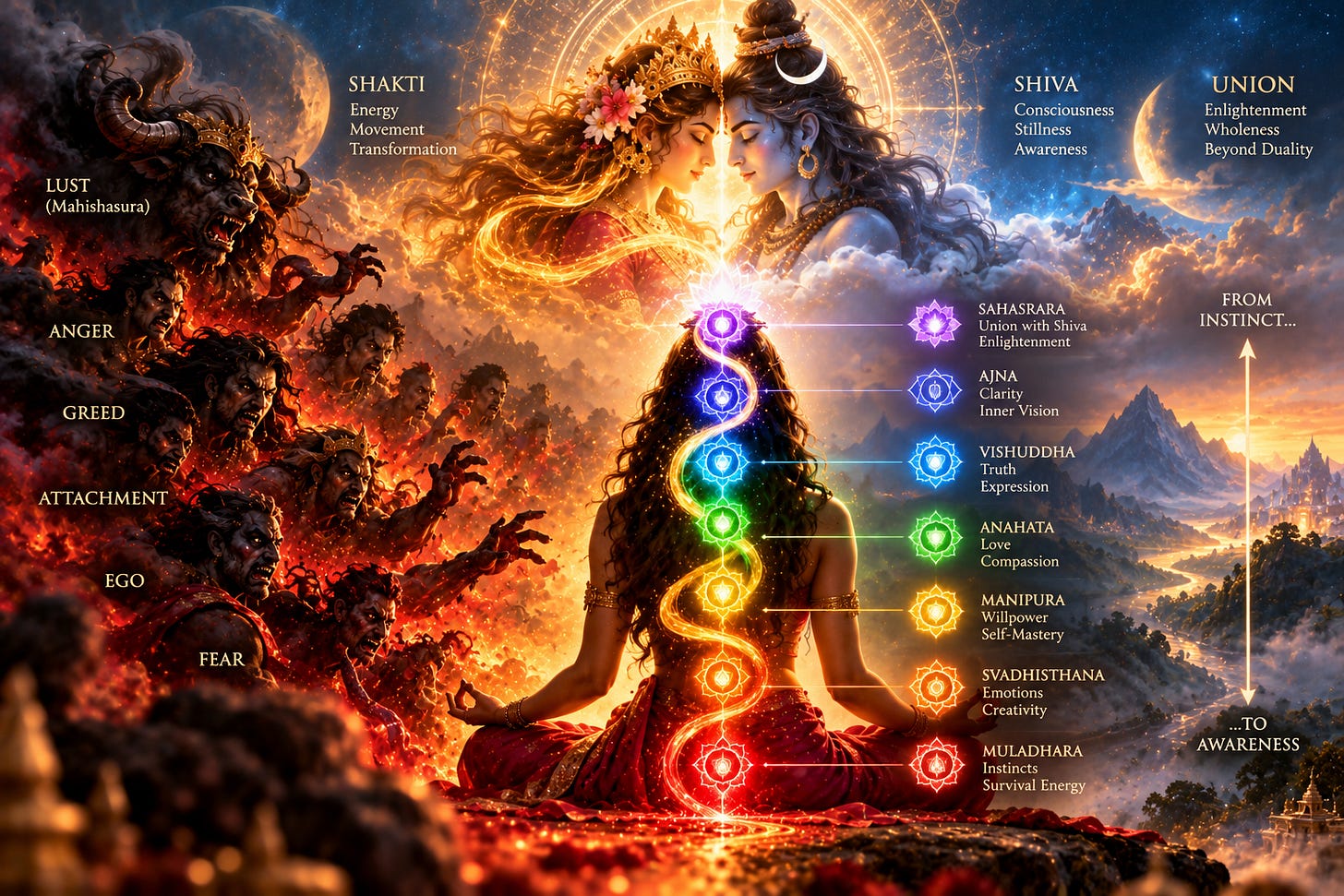
In many Tantric and Kundalini Yoga traditions, the human body is contemplated as a microcosm - a reflection, in miniature, of the greater universe.
One of the best-known images within this framework is Kundalini Shakti, traditionally represented as a dormant, coiled power at the base of the spine.
At the crown of the head is the Sahasrara, associated in many Kundalini systems with the culmination of spiritual awakening. Shiva, in this symbolic language, represents pure consciousness, while Shakti represents the dynamic power that unfolds and reveals itself.
The imagery describes an extraordinary journey.
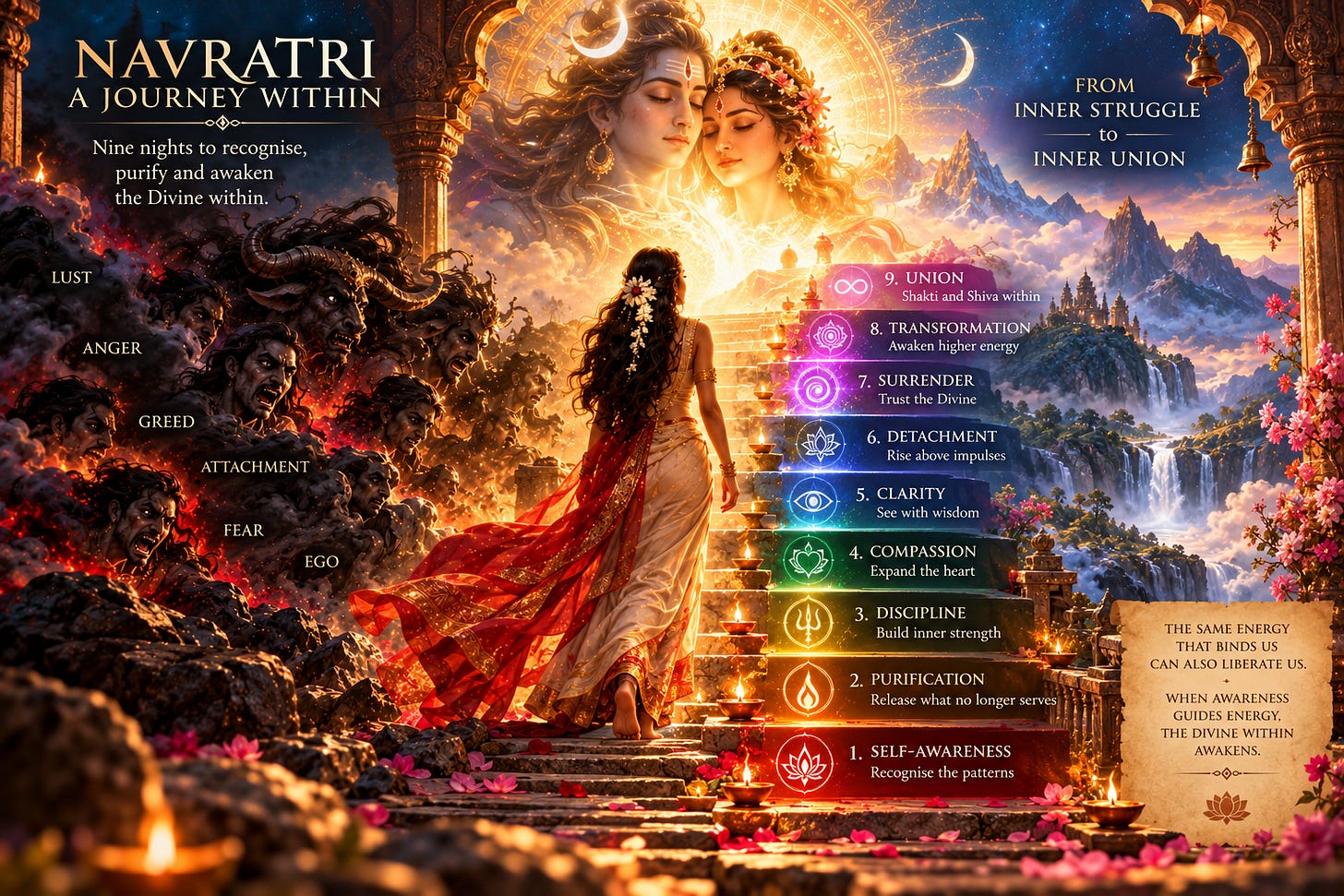
Shakti awakens from her dormant state and rises through the subtle centres known as chakras. Along this journey, the practitioner seeks to move beyond ignorance, attachment, and limiting patterns of identity. In some traditions, the culmination is described as the union of Shakti and Shiva.
This union does not mean that a physical woman must reunite with a physical man within the body.
It is a symbolic expression of the reconciliation of energy and consciousness, movement and stillness, manifestation and awareness.
The precise interpretation varies across Tantric lineages, and the chakras and nadis belong to traditional subtle-body maps rather than established anatomical structures.
Yet the symbolism offers a beautiful way of thinking about spiritual transformation.
We begin by being carried along by our impulses. Gradually, we develop the ability to observe them. Through practice, we cultivate greater discipline and clarity. We begin to recognise that we are not required to obey every thought, fear, or desire that arises.
Our inner life becomes less divided.
The journey is not about destroying the human being. It is about seeing more clearly, acting more consciously, and discovering a deeper relationship with existence.
Seen through this lens, Navratri becomes a celebration not only of the Goddess’s victory over a demon, but also of the possibility of transformation within every human being.
The battle is not won in a single night. Awareness must be cultivated. Old patterns may return. Discipline must be renewed. And the process of understanding ourselves continues.
Perhaps that is why the Goddess is worshipped across nine nights: each night can become an opportunity to pause, reflect, and begin again.
We honour Maa Durga for her strength. We honour Maa Kali for her fearless transformation. We honour Shakti as the power that makes change possible.
And slowly, the story begins to turn inward.
The demon is no longer only a figure in an ancient battlefield. He becomes a question we ask ourselves.
Where am I being ruled by instinct rather than awareness?
Where is my energy being scattered?
What am I fighting without truly understanding?
And what might happen if I learned to transform rather than merely resist?
These questions bring us to the threshold of a much deeper exploration.
Because in some of the most esoteric interpretations of Hindu spirituality, the Goddess’s battle is not merely a story about the victory of good over evil.
It is a map of the inner journey—from instinct to awareness, from fragmentation to integration, and from unconscious living towards the possibility of awakening.
And perhaps the most beautiful way to end this first part is with a thought to carry into the nine nights of Navratri:
The Goddess we worship in the temple may also remind us of the power we are learning to awaken within ourselves.
The demons we ask her to destroy may also be the patterns we must learn to recognise. The weapons she carries may represent the qualities we must cultivate. And her victory may be an invitation to discover a strength that does not come from controlling the world around us, but from becoming more conscious of the world within us.
In the next part, we will go deeper into this inner battlefield.
We will explore the symbolism of Virya and Ojas, the discipline of Brahmacharya, the awakening of Kundalini Shakti, and the ancient image of Shiva and Shakti coming together, not as a battle between masculine and feminine, but as a movement towards the integration of consciousness and energy.
For perhaps the deepest mystery of Navratri is not simply how the Goddess defeats the demons.
It is what happens when we begin to recognise the battlefield within ourselves—and discover that the power to transform it may have been waiting there all along.
Jai Maa Durga.
Originally published on Substack