Enterprise AI Agents: Architecture vs Demo
Over the past year, I’ve reviewed multiple initiatives labeled as “AI agent implementations.” Most of them, in reality, are still conversational systems with…
Over the past year, I’ve reviewed multiple initiatives labeled as “AI agent implementations.”
Most of them, in reality, are still conversational systems with tools bolted on.
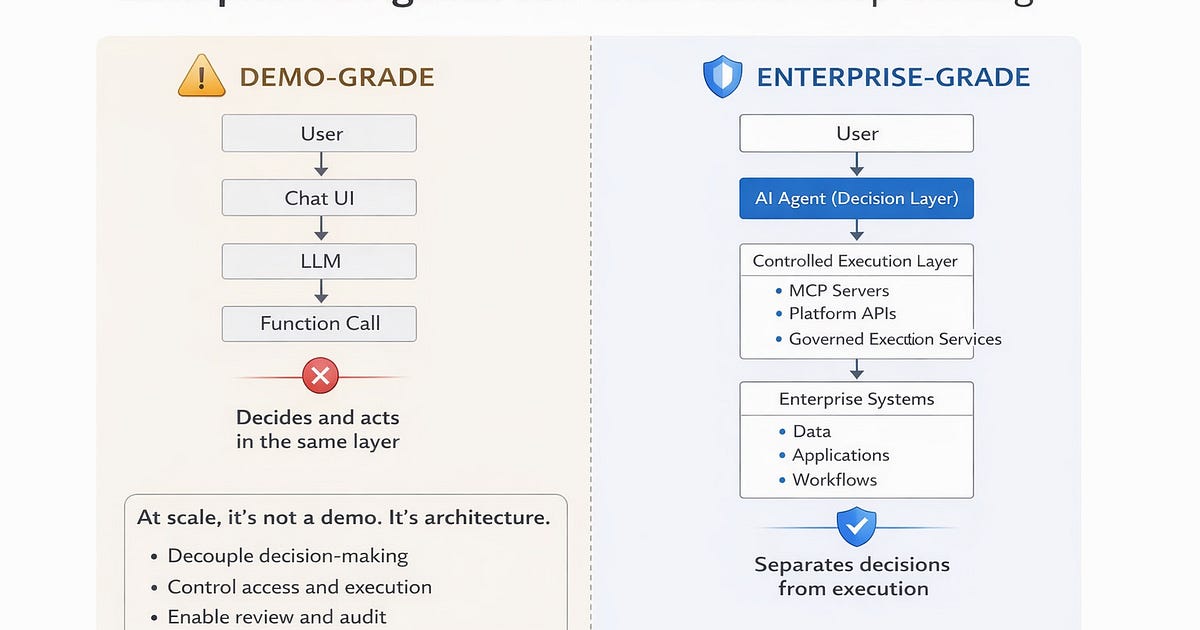
At a high level, they look like this:
User → Chat UI → LLM → (optional function call) → Response
This pattern is useful for experimentation.
It is not an enterprise agent architecture.
At scale, the distinction is not semantic — it’s architectural.
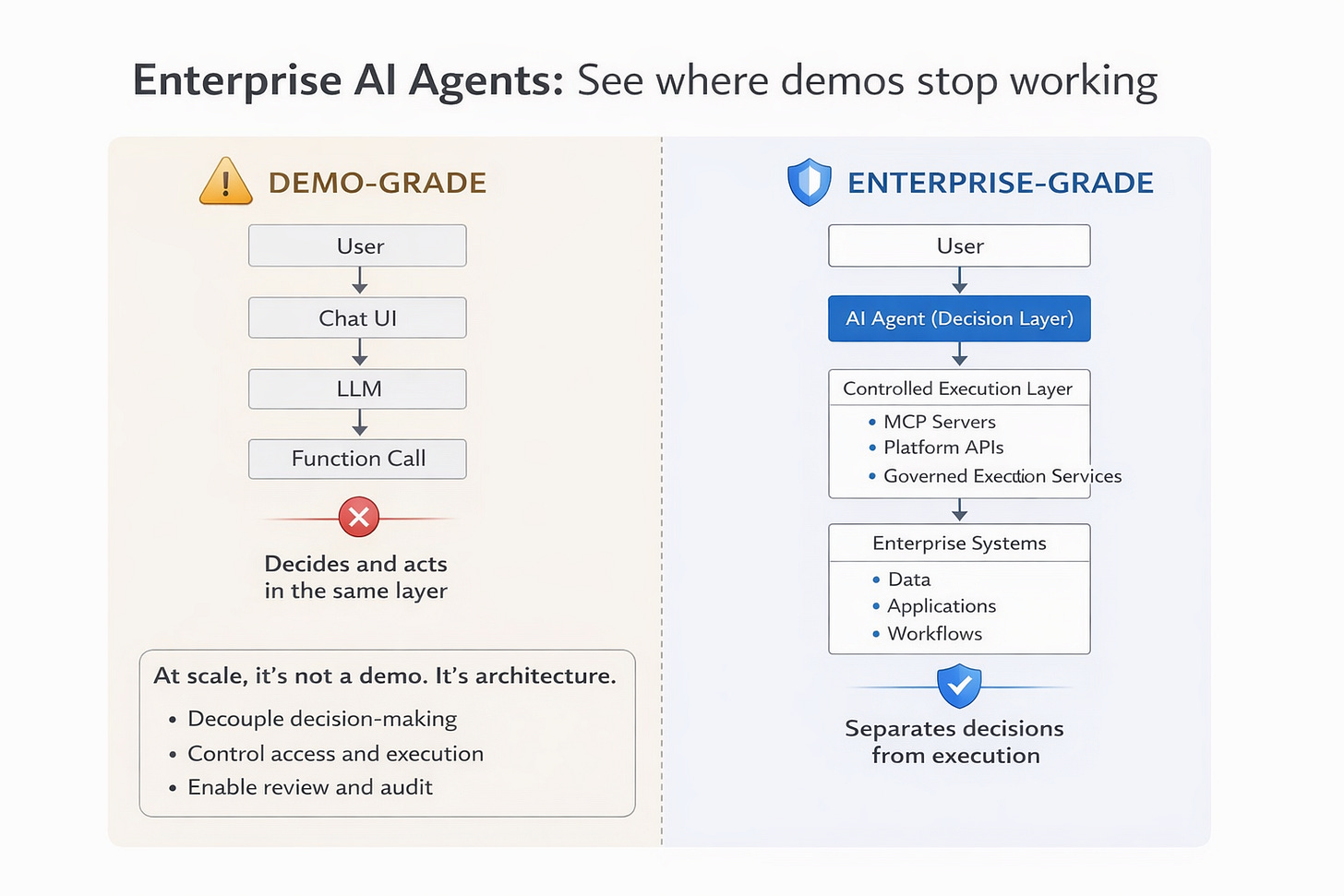
Where demos stop working
In most demos, the model decides and acts in the same place.
The LLM:
interprets the user request
decides what to do
calls a tool
touches data or systems directly
That coupling is exactly what breaks under enterprise scrutiny.
Security, platform, and risk teams don’t evaluate intent.
They evaluate authority, blast radius, and control.
What changes at enterprise scale
A real agent-based system separates decision-making from execution.
The agent becomes a decision layer, not a system operator.
Execution is delegated to controlled platform layers:
MCP servers
governed platform APIs
agent runtimes (Agent Bricks, Genie, Copilot-style execution layers)
These layers are what security, platform, and compliance teams can actually review, approve, and audit.
An AI agent is not defined by:
the model it uses
the UX it sits behind
how “smart” the prompt feels
It is defined by:
the decisions it is authorized to make
and the systems it is permitted to touch
What mature agent architectures do not allow
In production-grade systems:
agents do not talk directly to databases
agents do not hold credentials
agents do not self-expand their capabilities
Instead, agents interact with enterprise systems only through controlled execution layers:
MCP servers
platform APIs
governed execution services
This separation is what keeps autonomy from turning into risk.
The three questions that matter immediately
When evaluating any agent design, three questions surface fast — usually in the first governance review.
1. What decision is the agent making independently?
If this isn’t explicit:
the agent has no defined responsibility
governance teams cannot assess risk
escalation paths are unclear
In mature organizations, this is written down clearly and reviewed like any other system responsibility.
2. Which enterprise systems does that decision impact?
This determines:
security classification
access controls
logging and monitoring requirements
If you can’t trace a decision to impacted systems, you don’t have an agent — you have an uncontrolled automation.
3. How are authority, scope, and auditability enforced?
Enterprise systems require:
enforcement outside the model
deterministic execution layers
audit logs independent of LLM behavior
If enforcement lives only in prompts, the design won’t survive first contact with reality.
Where most agent demos collapse
The pattern is predictable:
security asks for access diagrams
platform teams ask for ownership boundaries
risk teams ask for failure modes
legal asks about accountability
Most “agent demos” collapse right here.
Not because the model failed —
but because the architecture never existed.
The real shift after pilots
Once agents move beyond experimentation, the work shifts quickly:
from prompt quality → platform design
from clever tools → execution boundaries
from demos → shared ownership between AI, data, and security teams
This is where hands-on engineering experience starts to matter more than experimentation.
The teams that scale agents successfully
The organizations that scale AI agents are not the ones with the flashiest demos.
They are the ones that treat agents as:
first-class architectural components, not features
That distinction makes all the difference.
Originally published on Substack