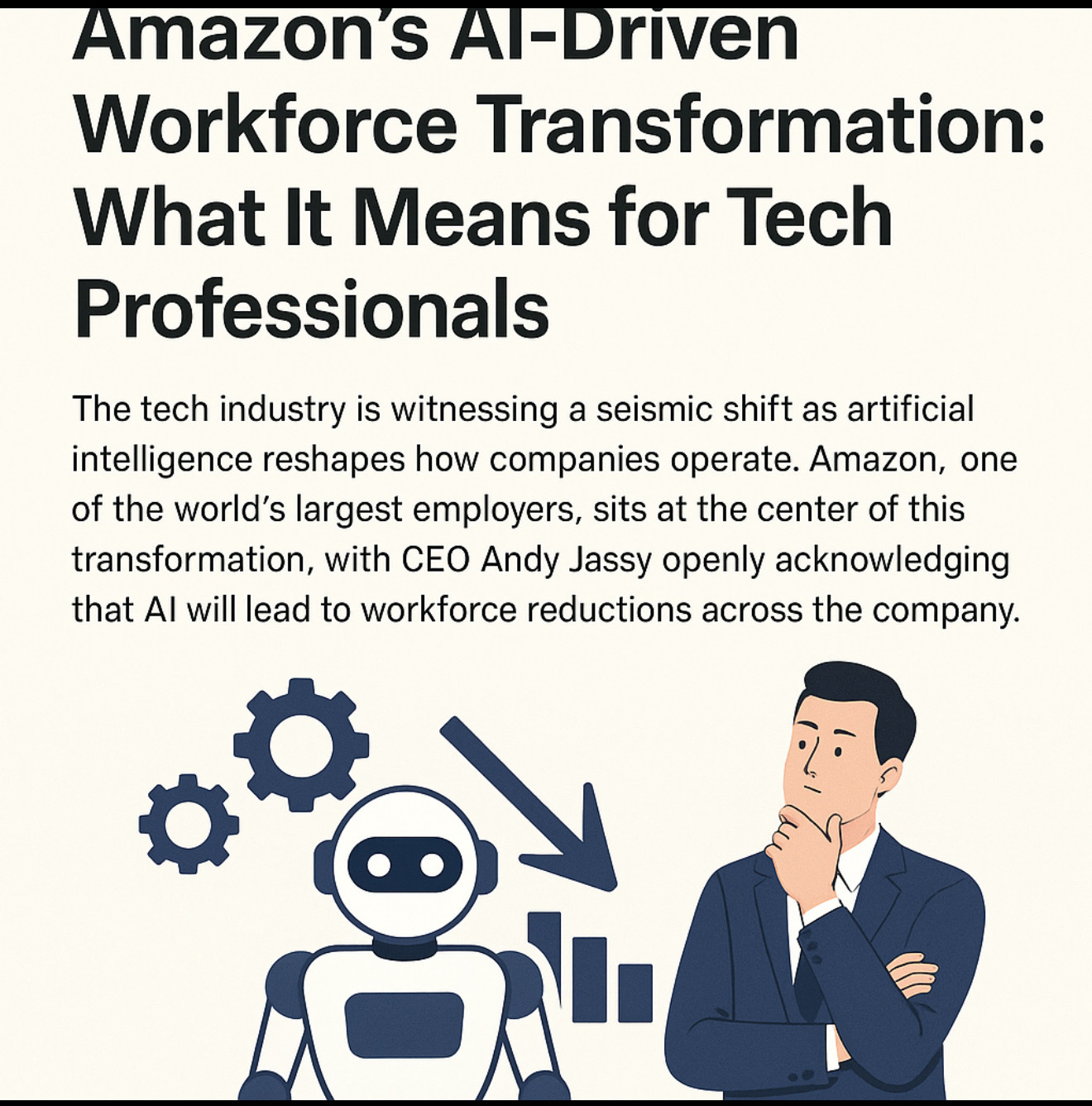
Amazon’s AI-Driven Workforce Transformation: What It Means for Tech Professionals
The tech industry is witnessing a seismic shift as artificial intelligence reshapes how companies operate. Amazon, one of the world’s largest employers, sits…
The tech industry is witnessing a seismic shift as artificial intelligence reshapes how companies operate.
Amazon, one of the world’s largest employers, sits at the center of this transformation, with CEO Andy Jassy openly acknowledging that AI will lead to workforce reductions across the company.
The Numbers Behind the Change
According to Morgan Stanley analysts, Amazon could eliminate approximately 14,000 managerial positions by early 2025, representing a 13% reduction in the company’s global management workforce. This move could save the company between $2.1 billion and $3.6 billion annually, based on estimated manager costs of $200,000 to $350,000 per year.
The projection isn’t just speculation—it’s grounded in Amazon’s broader cost-cutting strategy and Andy Jassy’s public statements about AI’s impact on employment. In June 2025, Jassy told employees that the company’s workforce would shrink as it adopts more generative AI tools and agents.
AI’s Real Impact on Amazon Operations
Amazon’s AI transformation isn’t theoretical—it’s already delivering measurable results:
• Code Development: Amazon’s AI coding assistant saved programmers 4,500 years of work by accelerating software upgrades
• Operational Efficiency: The company has automated significant portions of its infrastructure and customer service operations
• Warehouse Operations: AI-powered robots are increasingly handling tasks previously performed by human workers
The Broader Industry Context
Amazon’s workforce evolution reflects a wider trend across tech. In the first five months of 2025 alone, “technological updates” including AI implementation led to 20,000 layoffs across the industry. Companies are discovering that AI doesn’t just assist workers—it can replace entire categories of roles.
What This Means for Tech Professionals
For Managers and Middle Management
The Morgan Stanley analysis specifically targets managerial positions, suggesting that AI is particularly effective at handling coordination, reporting, and decision-making tasks traditionally performed by middle management. This trend indicates that:
• Flat organizations are becoming more viable with AI handling workflow coordination
• Strategic roles that require human judgment and relationship-building remain valuable
• Technical management skills may become more important than pure people management
For Technical Workers
While the immediate focus is on management roles, technical professionals should prepare for continued automation:
• Specialization in AI-resistant skills becomes crucial
• AI collaboration skills are becoming as important as traditional technical skills
• Adaptability to work alongside AI systems is now a core competency
The Skills That Matter Now
As Amazon and other tech giants reshape their workforces, certain skills are becoming premium:
1. AI Integration: Understanding how to work with AI tools rather than competing against them
2. Complex Problem-Solving: Tackling challenges that require human creativity and intuition
3. Cross-Functional Expertise: Combining technical skills with business acumen
4. Continuous Learning: Staying current with rapidly evolving AI capabilities
Looking Forward
Amazon’s transformation signals a fundamental shift in how tech companies will operate. The question isn’t whether AI will change your role—it’s how quickly you can adapt to work alongside it.
For tech professionals, this moment represents both challenge and opportunity. Those who embrace AI as a productivity multiplier rather than a threat will likely thrive in this new landscape. Those who resist may find themselves on the wrong side of the efficiency equation.
The message from Amazon’s boardroom is clear: the future belongs to organizations that can seamlessly blend human creativity with AI efficiency. For individuals, that means developing skills that complement rather than compete with artificial intelligence.
This analysis is based on publicly available information including Morgan Stanley research notes, Amazon CEO qstatements, and industry reports. The actual implementation of workforce changes may vary based on business conditions and strategic decisions.
Originally published on Substack