AI Won’t Just Change How We Work. It May Change What It Means to Be a Professional.
The next professional advantage may not come from knowing more than everyone else, but from combining expertise, AI and judgement to deliver outcomes that matter.
For decades, we have built careers around what we know. A data analyst learns to analyse data. A software developer learns to write code. A cloud engineer develops expertise in cloud platforms. A technology trainer builds deep knowledge of a subject and learns how to transfer that knowledge to others.
Over time, experience becomes expertise. Expertise builds credibility. And credibility creates opportunities. That has been the familiar path of professional growth.
But AI is beginning to change an important part of this equation.
Today, a professional can use AI to research unfamiliar topics, write and review code, analyse information, create learning materials, automate repetitive tasks and explore possible solutions to problems that previously required considerable time or additional support.
Work that once demanded several tools, multiple handoffs or hours of preparation can sometimes be completed much faster.
This does not mean expertise is becoming irrelevant. It means we need to reconsider how expertise creates value. And I believe this shift could have implications far beyond productivity. It could influence how people develop their careers, how businesses access talent and how professionals turn their knowledge into meaningful work.
The difference between knowing something and being able to deliver something
Consider a technology professional who has spent several years working with Power BI. They understand data modelling, DAX, visualisation and business reporting. They have built dashboards, solved problems and perhaps trained hundreds of learners.
Now imagine that professional starts using AI effectively.
They can accelerate the preparation of training materials, generate initial versions of practical exercises, explore unfamiliar concepts, develop supporting scripts and create demonstrations tailored to a customer’s requirements.
With appropriate validation, this can improve productivity and free up time for the work that requires human judgement.
The professional has not suddenly become an expert in every adjacent technology. But they may now be able to explore new capabilities faster, prepare better and serve customers more effectively.
The same principle applies to a data engineer who uses AI to accelerate code development, a consultant who uses AI to research a business problem, or a business analyst who uses AI to explore automation opportunities.
The interesting shift is that a professional’s capabilities may no longer be limited quite as tightly by the time and effort traditionally required to perform every supporting task manually.
However, there is an important distinction.
AI can help expand what a professional can attempt. It does not automatically expand what that professional is qualified to deliver.
Generated code still needs to be tested. Analysis still needs to be checked. Training content still needs to be technically accurate. Business recommendations still need to reflect the customer’s context.
The professional’s expertise, judgement and accountability remain essential.
In fact, when producing an initial answer becomes easier, knowing whether that answer is correct and whether it solves the right problem can become even more valuable.
The rise of the AI-enabled professional
I think we need to start looking beyond the idea of the AI-enabled professional as simply someone who knows how to use ChatGPT or another AI tool.
Tool proficiency is useful, but it is only one layer.
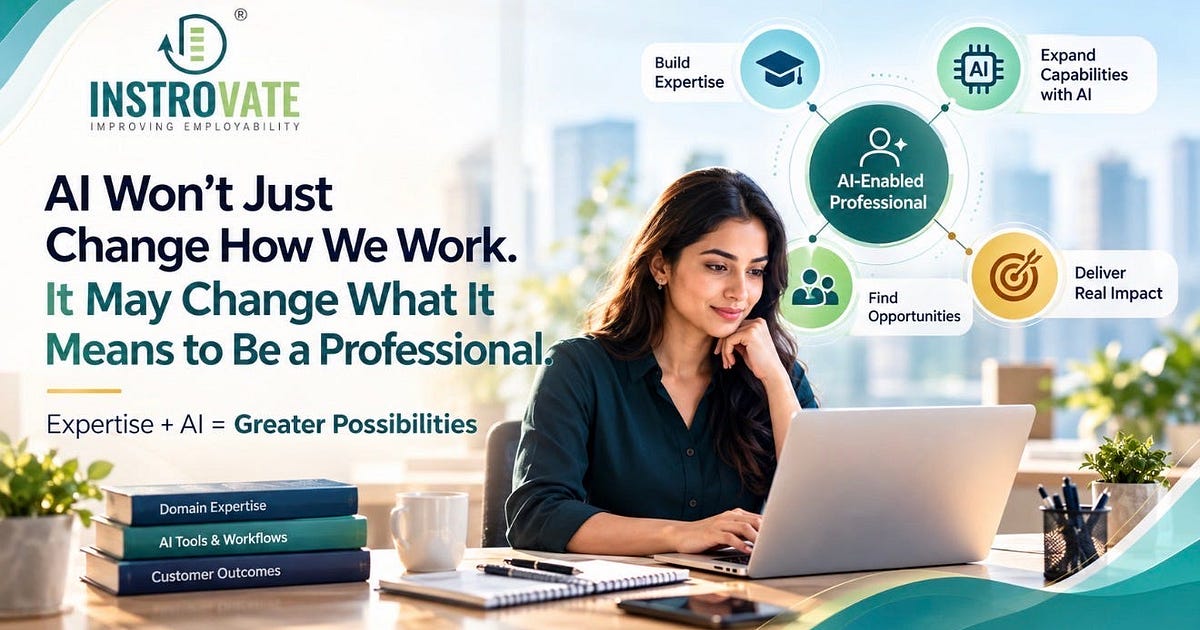
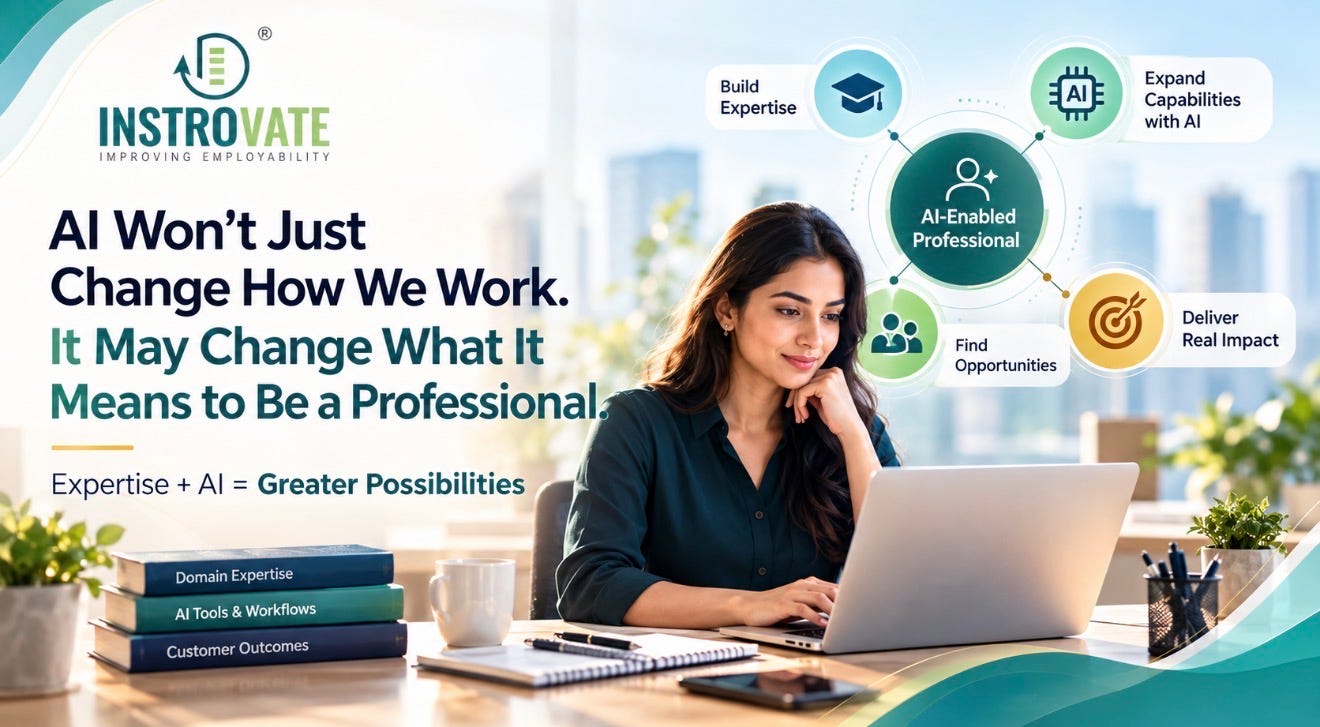
An AI-enabled professional combines four capabilities.
First, domain expertise. They understand a subject well enough to recognise meaningful problems, evaluate possible solutions and distinguish good work from poor work.
Second, AI-enabled productivity. They know how to use AI tools, agents and workflows to accelerate research, analysis, development and delivery.
Third, professional judgement. They can validate outputs, recognise limitations, protect sensitive information and make decisions that cannot safely be delegated to an AI system.
Fourth, outcome orientation. They understand the person or organisation they are helping. They can translate a requirement into a solution and explain why that solution matters.
The combination is important.
Someone who knows a great deal about AI but lacks domain expertise may produce impressive-looking work that fails under scrutiny.
Someone with deep expertise who refuses to adapt may miss opportunities to work more efficiently or tackle broader problems.
And someone who combines expertise with AI but cannot understand customer needs may still struggle to turn their capabilities into commercial value.
The opportunity lies in bringing these elements together.
Your job title may not describe your full potential
Traditional career development often encourages us to specialise. Become a data analyst. Become a cloud engineer. Become a Power Platform developer. Become a technology trainer.
Specialisation remains valuable. Businesses need people who understand complex subjects deeply.
But specialisation does not have to mean that our capabilities remain permanently confined to one narrow set of tasks.
Imagine a data analyst who understands business reporting and begins using AI to accelerate SQL development, investigate data quality issues and prototype simple automation workflows.
Or a Microsoft technology trainer who uses AI to prepare better practical labs, create customer-specific learning pathways and explore related technologies through structured, hands-on learning.
Or a cloud consultant who uses AI to accelerate documentation, compare architectural approaches and develop initial implementation plans that are then reviewed against real technical requirements.
In each case, the professional starts with a strong foundation and gradually expands their ability to solve related problems.
That expansion should be deliberate. Reading an AI-generated explanation is not the same as developing competence. Professionals still need structured learning, practical experience, assessment and feedback.
But the path to acquiring and applying additional capabilities may become more accessible.
Your job title describes the role you perform today. It does not necessarily describe every valuable problem you could learn to solve tomorrow.
I find that distinction particularly interesting because it changes how we might think about professional development.
Instead of asking only, “Which new tool should I learn?”, we can begin asking, “Which additional problems could I become capable of solving?”
That is a more commercially meaningful question.
The bigger opportunity is not productivity alone
Most conversations about AI productivity focus on doing the same work faster.
Write the report in less time. Generate code more quickly. Automate repetitive tasks. Prepare presentations with less effort.
These are genuine benefits.
But I believe there is another question worth exploring.
What happens when AI helps a professional expand the range of services they can credibly deliver?
A consultant who previously spent most of their time on analysis might develop the ability to build a working prototype. A trainer might combine instruction with practical implementation support. A data specialist might learn to connect analytics with workflow automation.
Not every professional should expand in every direction. Nor should AI be used to disguise a lack of experience.
The objective is to identify adjacent capabilities that complement existing expertise, develop those capabilities properly and establish where they create genuine customer value.
If that works, the benefit could extend beyond saving time.
It could open up new service offerings, new ways of working and new forms of collaboration between specialists.
And this is where the conversation becomes more interesting to me as someone who works in technology training and consulting.
Because becoming more capable is only part of the challenge.
The next challenge is turning that capability into an opportunity.
Being capable is not the same as finding work
Consider two professionals with comparable technical skills.
The first works within an established organisation. They have access to customers, colleagues, internal systems, project managers and a clear process for getting work done.
The second is an independent professional. They may have excellent technical skills and use AI effectively, but they must also identify potential customers, build trust, explain their services, define project scope, agree on commercial terms and manage delivery.
AI may help both professionals. But it does not automatically give the independent professional access to customer demand. It does not guarantee a steady pipeline of paid work, provide a trusted reputation or ensure that a project is commercially viable.
This is an important distinction as we think about the future of work. The ability to perform a task is one thing. The ability to find someone who needs that task performed, agree on a valuable outcome and deliver it reliably is another.
For many professionals, the second challenge can be just as significant as the first. That is why I do not believe the answer to the changing nature of work is simply to encourage everyone to become a freelancer or entrepreneur.
Permanent employment will remain an important and valuable career path. Many people prefer the stability, collaboration and shared responsibility that established organisations provide.
Others may want to combine employment with permitted external projects, explore independent consulting or gradually develop a specialised service business.
The opportunity is not to prescribe one career model for everyone. It is to help professionals build capabilities that give them more options and to understand what is required to turn those capabilities into real value.
What if professional development connected more directly to delivery?
This is the question I keep coming back to. Traditionally, professional development, AI adoption and commercial opportunities have often been treated as separate activities. A person takes a course to develop a skill. They experiment with AI tools to become more productive. They then have to figure out independently how to apply those capabilities to customer problems and find opportunities to use them.
There is nothing inherently wrong with that approach. But it leaves a gap between learning something and using it to deliver valuable work.
What if we designed professional development around that entire journey?
Imagine a model in which a technology professional starts with a clear area of expertise, learns to use AI to improve their workflow, completes practical projects to demonstrate competence, receives feedback on delivery quality and develops the ability to scope and communicate customer solutions. Where genuine customer demand exists, qualified professionals could then participate in suitable projects through a structured delivery network.
Such a model would require much more than courses and AI tools. It would need credible assessment, customer relationships, quality standards, appropriate commercial arrangements and clear accountability.
It would also need to prove that customers are willing to pay for the services being offered.
But the underlying idea is worth exploring: professional development could be designed not only around what someone learns, but also around what they become capable of delivering.
For a technology training and consulting business, this creates an interesting possibility. Instead of focusing exclusively on teaching people technologies, an organisation could help them develop expertise, use AI responsibly, demonstrate their capabilities and participate in a broader professional ecosystem.
That is a different ambition from simply offering another AI course.
A question I am exploring at Instrovate
At Instrovate Technologies ( https://instrovate.com ) , our work in technology training and consulting has given us a practical view of the relationship between expertise, professional development and business needs.
As AI changes how technical work gets done, I believe it is worth exploring how that relationship might evolve.
Could we help experienced technology professionals expand their capabilities through guided learning, practical projects and reusable AI workflows?
Could we help them demonstrate that they can deliver quality work, rather than relying only on certificates or claims of AI proficiency?
Could we build stronger connections between qualified professionals and businesses that need training, analytics, cloud, automation or AI implementation services?
And could a trusted organisation provide some of the shared infrastructure that makes those connections more practical—such as mentoring, quality assurance, project scoping and delivery coordination?
These are questions to investigate, not assumptions that the model will automatically work.
Customer demand would have to be established. Professionals would need to demonstrate competence. The economics would need to make sense for customers, the business and the people doing the work.
We would also need to be thoughtful about contracting, data protection, intellectual property and the obligations that come with different working arrangements.
But I believe this is a more interesting direction to explore than treating AI adoption as an isolated technology training exercise.
The opportunity may be to connect three things that are often separated:
Expertise + AI-enabled productivity + access to genuine commercial opportunities.
The professional brings knowledge, judgement and accountability. AI can provide leverage. A trusted ecosystem could help connect those capabilities to customer needs and support consistent delivery.
The value would not come from AI alone, or from simply assembling a network of people.
It would come from making the entire process work reliably.
The professional advantage of the future
I do not think we have a complete picture yet of how AI will reshape careers, organisations and independent work.
Some roles will change substantially. Some new opportunities will emerge. Others will remain difficult to automate because they depend on trust, context, relationships and accountability.
The effects will vary by industry, profession and market.
But one principle seems increasingly useful: investing in expertise remains important, and learning how to apply AI effectively can help professionals put that expertise to work in new ways.
The next step is to connect capability with outcomes.
For professionals, that means thinking beyond tool proficiency and asking which valuable problems they can solve.
For businesses, it means looking beyond AI adoption metrics and asking whether AI-enabled work actually improves quality, speed, cost or customer value.
For organisations involved in training and consulting, it means exploring whether professional development can be connected more directly to practical delivery and genuine customer demand.
I believe this is an important conversation to have now. Not because every professional needs to become an entrepreneur, and not because AI guarantees a better career.
But because the ability to develop expertise, apply AI responsibly and deliver meaningful outcomes may create new possibilities for how people work and how businesses access capabilities.
And that leads to a question I would like to explore further:
If AI makes it possible for a skilled professional to accomplish more, what would it take to help that professional turn those expanded capabilities into trusted, valuable work?
That is the question behind the next stage of my thinking about AI, professional development and the future of Instrovate.
I’d be interested in hearing how others are approaching this shift particularly technology professionals, trainers, consultants and business leaders who are already experimenting with AI in their work .
Interested in being part of this journey?
If this vision resonates with you and you have expertise in an area where you’d like to collaborate, I’d love to connect. Create your professional profile at CVFine.com and send me a DM on LinkedIn. Let’s explore how we can combine expertise, AI and collaboration to create meaningful opportunities.
Originally published on Substack