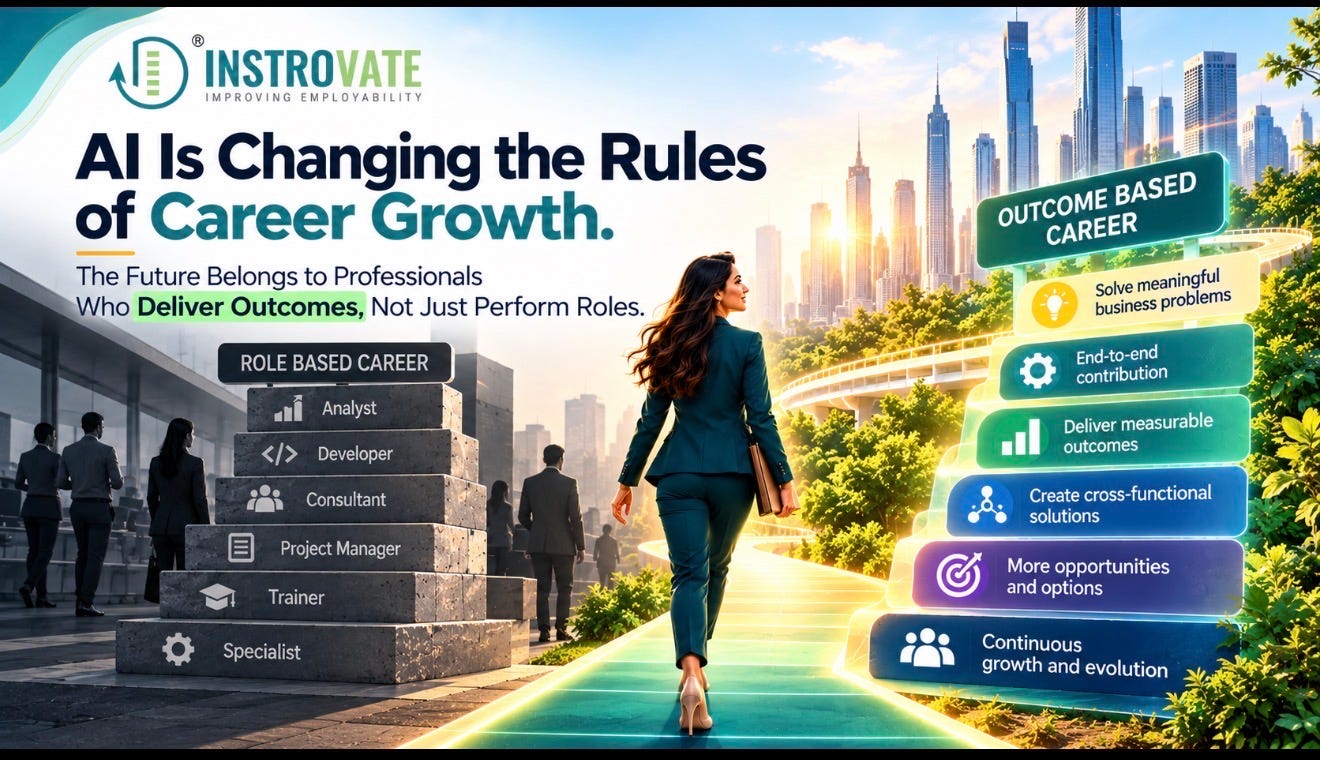
AI Is Changing the Rules of Career Growth. The Future Belongs to Professionals Who Deliver Outcomes, Not Just Perform Roles.
How AI is breaking traditional work boundaries and creating new opportunities for professionals who can combine expertise, expand their capabilities and deliver end-to-end business value.
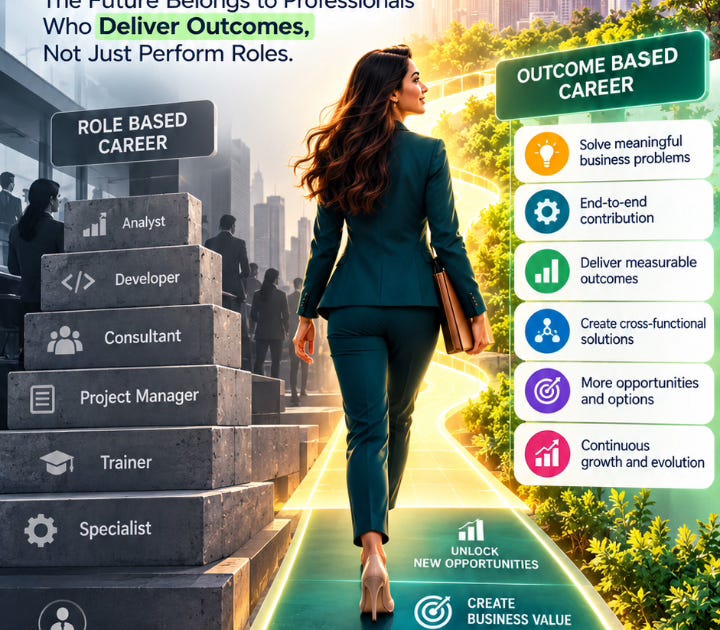
In an AI-enabled world, professional value may increasingly be measured not just by the role you occupy, but by the problems you can solve and the outcomes you can deliver.
For most of our professional lives, we have been taught to think in terms of job titles. We become software developers, data analysts, project managers, business consultants, trainers, architects, marketing specialists or finance professionals.
Our job titles define our responsibilities. Our responsibilities define our boundaries. And often, our career progression is measured by how far we move within that structure.
We move from analyst to senior analyst, from developer to technical lead, from consultant to manager. There is nothing wrong with this model. Organisations need defined roles, accountability and specialised expertise.
But I believe something is beginning to change.
As AI becomes part of everyday professional work, the boundaries between certain activities are becoming more flexible. People can research faster, explore unfamiliar concepts, generate initial solutions, automate processes and collaborate across disciplines more effectively.
This raises an interesting question:
What if our professional value is no longer defined only by what our job description says we should do, but increasingly by what we are capable of delivering?
The difference between completing a task and delivering an outcome
Let’s take a simple example.
A company needs to understand why its sales performance has declined.
Traditionally, several people might be involved.
A business analyst gathers requirements and studies the business process. A data analyst extracts information and identifies trends. A data engineer prepares the data. A Power BI developer builds dashboards. A business consultant interprets the findings and recommends improvements.
Each person contributes within their area of responsibility.
Now imagine a professional who understands business analysis, data, analytics and AI-enabled workflows.
With the right expertise and tools, this person may be able to understand the business problem, explore the data, develop an analytical solution, create a decision-support dashboard and communicate actionable recommendations.
They may still need specialists for complex engineering, governance, security or implementation. But they can potentially take greater ownership of the problem from beginning to end.
The difference is significant.
One approach focuses on completing an assigned task.
The other focuses on helping solve the underlying business problem.
The value is no longer just in producing the dashboard. It is in helping the organisation make a better sales decision.
This is the shift I find particularly interesting.
AI is expanding the scope of individual contribution
AI is not automatically making everyone an expert in multiple disciplines.
However, it is lowering some of the barriers that previously made it difficult for professionals to explore work outside their immediate specialisation.
A developer can use AI to accelerate documentation, testing and code exploration.
A data analyst can experiment with automation and more advanced analytical techniques.
A business consultant can research unfamiliar industries, analyse information and develop initial solution approaches.
A trainer can create practical simulations, learning assistants and personalised exercises.
The professional still needs to understand the domain, evaluate the output and take responsibility for the result.
But their ability to contribute to a broader solution can increase.
This is where the combination of expertise and AI becomes powerful.
It allows professionals to move from a narrowly defined contribution towards a broader understanding of how different pieces come together to create business value.
The limitations of the traditional job-title mindset
One challenge with a role-based career model is that it can sometimes make professionals underestimate their own capabilities.
A person may have spent ten years working in data analytics. They may understand business requirements, SQL, data modelling, reporting, automation and stakeholder management.
But when asked what they do, they simply say:
“I’m a Power BI developer.”
That description may be accurate, but it does not communicate the full range of problems they can solve.
Similarly, someone who has spent years delivering technology training may describe themselves only as a trainer, even though they understand enterprise technology, business challenges, solution architecture and professional capability development.
Our job titles often describe where we sit in an organisation.
They do not always describe the full value we can bring.
This becomes particularly important when professionals begin exploring new opportunities, consulting assignments or cross-functional work.
If we communicate only our job title and tools, we may be limiting how others understand our capabilities.
From role-based work to outcome-based contribution
I believe we will increasingly see organisations and professionals thinking in terms of outcomes.
This does not mean job roles will disappear. Organisations will continue to need specialists, defined responsibilities and clear ownership.
But the way work is organised and evaluated may evolve.
Consider the difference:
Role-based thinking
Outcome-based thinking
I build dashboards
I help businesses make better decisions
I write code
I develop solutions to business problems
I manage projects
I ensure initiatives deliver intended value
I conduct training
I help professionals become workplace-ready
I analyse data
I identify insights that support business action
The second column does not eliminate the technical work in the first.
It connects that work to its purpose.
And that connection matters.
A business does not ultimately want a dashboard, a piece of code or a training session simply because those things can be produced.
It wants better decisions, working solutions, improved processes and people who can apply their knowledge effectively.
The professional who understands this connection can communicate their value more clearly.
What does this mean for professionals?
I think there are four areas worth focusing on.
1. Understand the problem, not just the assigned task
When you receive an assignment, understand why it exists. What is the business trying to achieve? Who benefits from the solution? What would success look like?
This broader understanding helps you make better decisions and identify opportunities to contribute beyond the immediate task.
2. Develop capabilities around your core expertise
You do not need to abandon your specialisation.
Instead, identify the capabilities that complement it. A data analyst might explore data engineering fundamentals, automation and AI-assisted analytics. A project manager might develop stronger data analysis and AI-enabled reporting capabilities.
Build depth in your core area while gradually expanding your range.
3. Learn to use AI across workflows
Do not limit your AI learning to writing prompts or generating content.
Explore how AI can support research, analysis, development, testing, documentation, automation and communication.
Understand how different tools fit together and where human validation remains essential.
4. Learn to demonstrate outcomes
This may be one of the most important professional skills of the coming years.
Instead of saying, “I know SQL, Power BI and Python,” explain the business problems you have solved using those capabilities.
Show how your work improved reporting, reduced manual effort, supported decisions or enabled a new process.
The ability to communicate measurable value can make a significant difference to how your professional experience is perceived.
A challenge for organisations too
This shift is not only a responsibility for individuals.
Organisations also need to rethink how they identify, develop and utilise talent.
If employees are encouraged to work only within narrowly defined responsibilities, organisations may miss opportunities to benefit from the wider capabilities of their people.
AI creates the possibility of more flexible collaboration, but it also requires clear accountability, quality standards, appropriate governance and recognition of individual contributions.
Managers will need to look beyond whether someone has completed a particular task and consider whether the work has delivered the intended result.
This does not mean expecting one person to do the work of an entire team. Nor does it mean using AI as an excuse to overload professionals.
It means designing work around meaningful outcomes while ensuring the right expertise and support are available.
Are we preparing professionals for the next way of working?
This is where I believe professional development needs to evolve.
For years, much of the training industry has focused on teaching technologies, preparing people for certifications and helping them qualify for specific job roles.
These foundations remain valuable.
But are we doing enough to help professionals understand how to combine their skills, use AI responsibly, solve practical business problems and demonstrate the value of their work?
Knowing a technology is one thing.
Being able to apply it in a real business scenario is another.
And being able to take ownership of a solution, collaborate with others and deliver a meaningful outcome is a further step.
At Instrovate, this is the direction I have been thinking about more deeply.
What if professional development could go beyond training and help experienced people identify their wider capabilities, strengthen them with AI, demonstrate delivery readiness and collaborate on real business challenges?
What if we created better connections between professional expertise and the outcomes organisations actually need?
It is an idea worth exploring.
The next career advantage
I do not believe the future belongs only to people who know the most AI tools.
Nor do I believe traditional job titles will suddenly become irrelevant.
I believe the advantage will increasingly belong to professionals who combine deep expertise with the ability to learn, adapt, collaborate and deliver.
Your job title may explain what you were hired to do.
But your ability to solve problems and create value may increasingly define what opportunities become available to you.
Perhaps the most important career question is no longer just, “What role do I want next?”
It is:
“What meaningful outcomes am I capable of delivering next?”
That is a question every professional should start exploring.
Interested in being part of this journey?
If this vision resonates with you and you have expertise in an area where you’d like to collaborate, I’d love to connect.
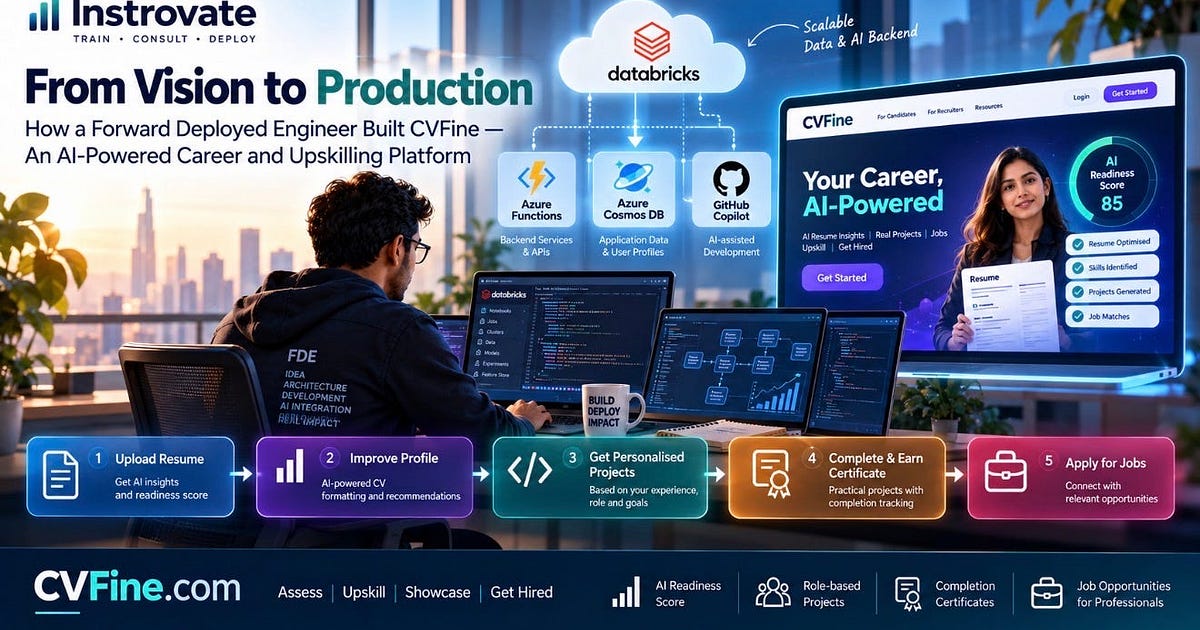
Create your professional profile at CVFine.com and send me a DM on LinkedIn: linkedin.com/company/instrovate.
Let’s explore how we can combine expertise, AI and collaboration to create meaningful opportunities.
This is the third article in the series: The AI-Enabled Professional - From Skills to Outcomes.
Originally published on Substack