When Your Time Becomes the Bottleneck - How to Delegate Without Breaking the System
As your system starts running smoothly, growth exposes a new challenge - you.
Agenda: What We’ll Decode. You’ve built your system.
Clients are happy, your small team works well, and your AI workflows are humming.
But now… every major decision still needs you.
Every approval, every client message, every exception - it all comes back to your inbox.
That’s not leadership - that’s a bottleneck disguised as control.
In this post, we’ll explore how to delegate effectively without losing the structure you’ve worked so hard to build.
Here’s what we’ll unpack:
1. The Founder Bottleneck Problem
How your need for control can quietly slow down growth - and how to spot the signs before burnout hits.
2. Delegation vs. Abdication
Why most founders fail at delegation -and how to delegate intelligently without losing oversight.
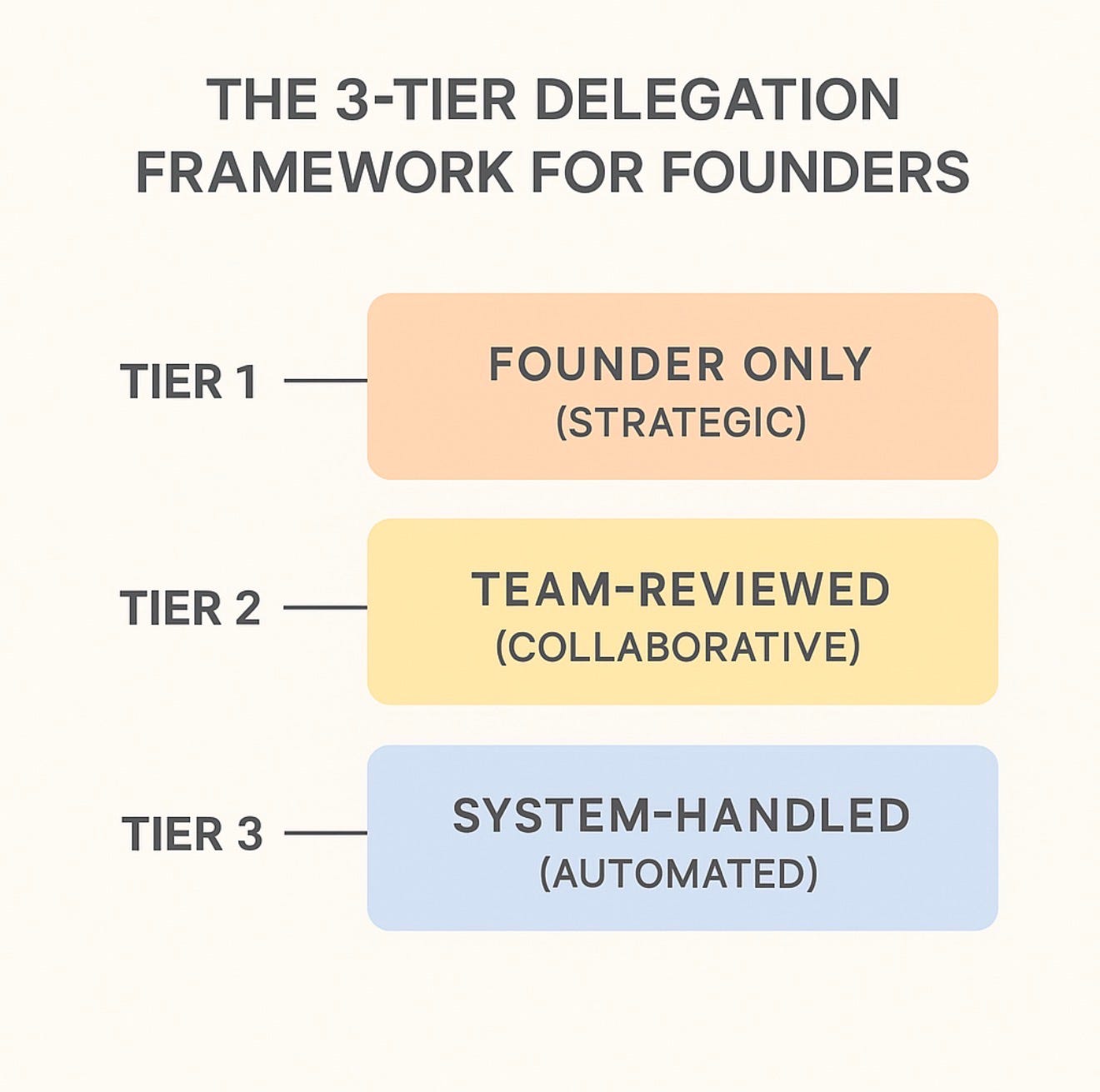
3. The 3-Tier Delegation Framework
A structured system to decide which tasks stay with you, which go to the team, and which your system or AI can handle automatically.
4. Building Decision Visibility
How to stay in control without being in the way - dashboards, summaries, and automated check-ins that give you clarity without micromanaging.
5. Scaling Yourself
How to transfer not just work, but thinking - so your business runs on systems and decisions that mirror your standards even when you’re not there.
If you’ve reached a stage where everything still depends on you - even though you have people, tools, and systems in place -
the next section (for paid subscribers) will help you scale yourself out of the bottleneck.
1. The Founder Bottleneck Problem
Every founder who scales beyond the first few clients eventually hits this wall.
You’ve built something that works - but only when you’re watching.
You find yourself thinking:
“If I don’t check everything myself, something will go wrong.”
So you end up reviewing every document, replying to every client, approving every line of code.
You’re not running a business anymore - the business is running through you.
The biggest irony?
The systems you built to scale your business are now limited by your time.
2. Delegation vs. Abdication
Most founders don’t actually delegate.
They either dump tasks or hover over them.
Delegation means transferring ownership with structure.
Abdication means throwing a task and hoping for the best.
Here’s how to tell the difference:
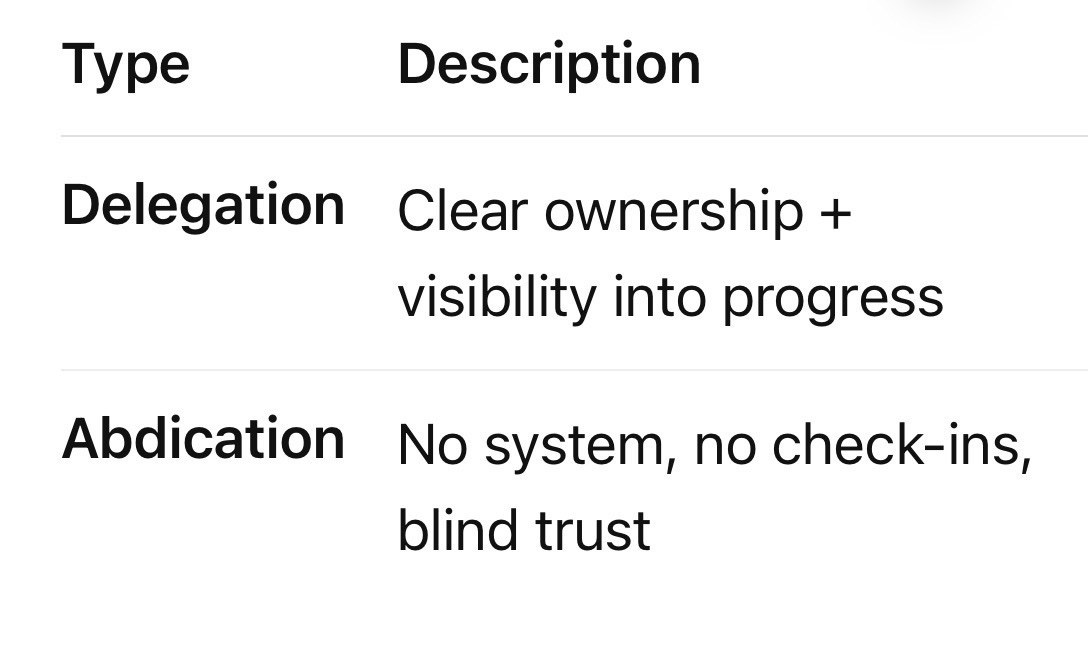
When you delegate correctly, your systems - not you - create accountability.
You stay in control without staying involved.
⸻
3. The 3-Tier Delegation Framework
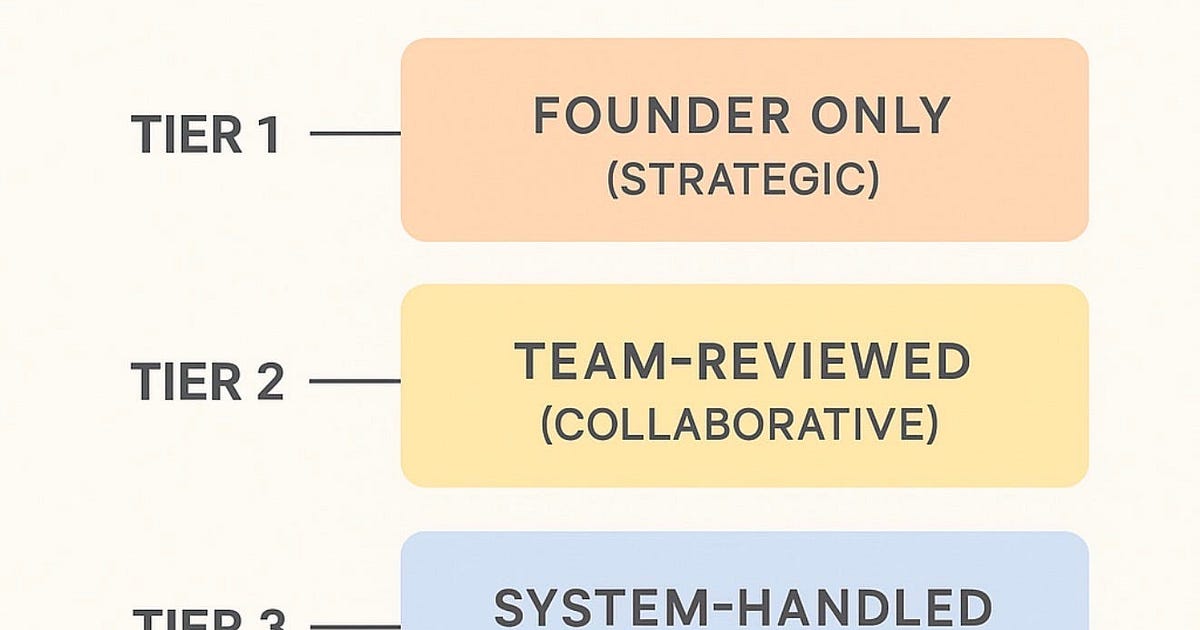
To scale effectively, classify every task into three levels:
Tier 1 - Founder Only (Strategic)
Tasks only you can do - brand decisions, key client negotiations, partnerships, pricing, hiring core leaders.
Your goal: reduce these tasks over time by documenting the thinking behind them.
⸻
Tier 2 - Team-Reviewed (Collaborative)
Tasks where your team executes, but you stay informed through visibility systems.
Examples: project delivery, client updates, and training interns.
You don’t approve every task - you review the summary dashboard that tells you what’s done, what’s delayed, and what needs escalation.
⸻
Tier 3 - System-Handled (Automated or AI)
Tasks that don’t require human judgment can be handled by your system or AI.
Examples:
• Sending client updates
• Generating weekly reports
• Moving tasks across project stages
• Invoicing and follow-ups
Each of these adds back hours to your week and frees you from “checking in” constantly.
⸻
4. Building Decision Visibility
The real secret to delegation is visibility without interruption.
You shouldn’t need 15 messages to know what’s happening.
Instead, you should have dashboards or AI-generated summaries that tell you everything you need to know in minutes.
Set up these visibility checkpoints:
• Weekly Digest: A one-page summary of all ongoing projects, generated by your team or automation tools.
• Client Summary Bot: AI summarizing key client messages or changes in tone.
• Performance Dashboard: Tracks metrics like project throughput, customer satisfaction, and payout ratios.
• Delegation Tracker: A simple Notion or Lovable board listing every delegated item, owner, and next review date.
Once your team learns that updates go into the system - not your inbox - you reclaim your calendar and maintain control.
⸻
5. Scaling Yourself
At this stage, you don’t just need to delegate work - you need to delegate thinking.
That’s what creates independence.
Start recording short Loom videos explaining why you make certain decisions.
Document your frameworks - how you decide which clients to accept, which proposals to prioritize, and what “done well” looks like.
That becomes your Decision Library - your real intellectual property.
This ensures your team, interns, and even AI copilots can continue your judgment even when you’re not there.
You scale not by multiplying hours - but by multiplying judgment.
⸻
Example: The 30-Minute Founder
Here’s a model I follow and teach:
• Monday: Review dashboards, AI summaries, and top 3 team updates.
• Wednesday: 30-minute sync for bottlenecks.
• Friday: AI-compiled end-of-week report + reflection notes.
That’s it.
No constant Slack pings, no chaos.
Your systems talk to you — not your team.
And that’s when you finally become a true System Founder - someone who builds a business that runs through structure, not supervision.
⸻
Final Thought
The hardest thing about scaling isn’t learning new tools.
It’s unlearning your own control.
When you delegate with visibility and structure, you stop being the bottleneck -
and start being the architect.
Leadership isn’t about doing more.
It’s about designing systems where less of you creates more of everything else.
Originally published on Substack