The Great Knowledge Drain: How AI Risks Starving the Internet That Fed It
AI feels like an all-knowing oracle. Ask ChatGPT, Claude, or Gemini anything, and you’ll get a polished answer in seconds. But here’s the hidden truth: these…
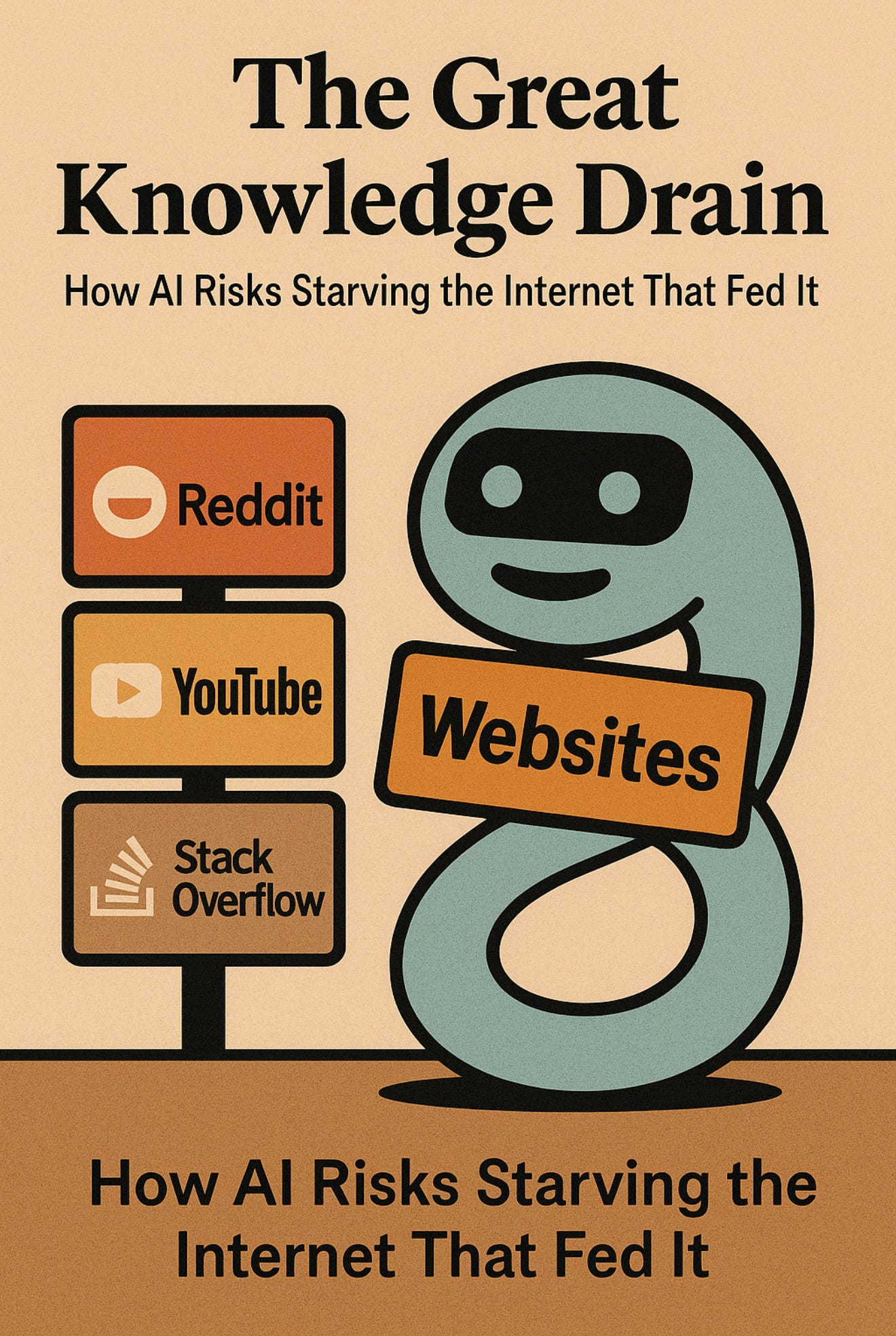
AI feels like an all-knowing oracle. Ask ChatGPT, Claude, or Gemini anything, and you’ll get a polished answer in seconds. But here’s the hidden truth: these answers don’t come from nowhere. They’re built on the backs of millions of humans who once shared knowledge freely—on Stack Overflow, Reddit, YouTube, blogs, and forums.
For years, this was the deal. You wrote, others searched, traffic flowed, ads paid out a little, reputations grew, and the knowledge commons thrived. But the deal is breaking.
Why? Because people no longer click through. Instead of Googling, they go straight to AI. That convenience means fewer visits to the original sources. Fewer clicks means less income, less recognition, and less incentive for experts to keep writing.
The result? The well that feeds AI is slowly drying up.
We’re already seeing it. Stack Overflow activity has dropped. Independent bloggers report collapsing traffic. More knowledge is moving behind paywalls or private groups. And here’s the kicker: without fresh human input, AI models will end up training on their own recycled answers, or worse, on the flood of low-quality AI-generated sludge now filling the web.
When AI learns from AI, the spiral begins. Answers grow bland, nuance disappears, and the ecosystem that made AI smart in the first place starts to decay.
This isn’t just a problem for creators—it’s a problem for AI itself. And by extension, for all of us.
So what can be done? AI companies could give credit, send traffic back to sources, or even share revenue. Creators can lean into what AI can’t fake—lived experience, case studies, and deep analysis. And readers—you and me—can choose to support the original voices that keep the commons alive.
Because if the commons collapses, the future of AI collapses with it.
The machines are clever, but they cannot conjure knowledge out of thin air.
They need us. And we need to decide if the open web is worth saving.
Share in the comment if you have an idea how can it be saved ?
Originally published on Substack