If AI Can Write Your Resume, What Actually Proves You’re Good at Your Job?
In a world where anyone can generate a polished profile, an impressive article or a professional portfolio with AI, how do we distinguish someone who can talk about expertise from someone who can actually deliver it?
Imagine two professionals applying for the same opportunity. Both have impressive resumes. Both have well-written LinkedIn profiles. Both have published thoughtful articles about their domain expertise. Both have portfolios that look professional. And both have used AI to prepare their application materials.
Now imagine you are the person making the hiring decision. How do you know who actually understands the subject? Who has genuinely worked on complex problems?
Who can make sound decisions when things don’t go according to plan? Who can deliver the outcome you need? This is becoming an increasingly important question.
Because AI has changed something fundamental about how we communicate our professional capabilities.
For years, a resume represented a summary of our experience. A technical article demonstrated our understanding. A portfolio showcased our work.
These were never perfect indicators of competence, but they gave us some signals. Today, AI can help almost anyone create a polished version of these signals.
A person can use AI to write a compelling resume, generate an impressive article, create a portfolio website, prepare a presentation and even develop a prototype.
But the question remains:
Does the ability to produce an impressive professional profile mean that the person has the capability to deliver the work?
Not necessarily. And this is where I believe the conversation about professional growth needs to take a different direction.
The problem is not that people are using AI
Let me be clear. I don’t believe using AI to write a resume, improve a LinkedIn post or prepare an article is inherently wrong.
If AI helps a professional communicate their experience more clearly, that can be a positive thing.
A highly skilled professional may not be a great writer. Someone may have excellent technical knowledge but struggle to articulate their achievements.
Someone may have spent years solving complex problems but never learned how to create a compelling professional profile.
AI can help bridge that communication gap. Research published in Management Science in 2025 examined algorithmic writing assistance for job seekers. In a large field experiment, writing assistance improved hiring outcomes, with treated job seekers hired more often and at higher wages.
So perhaps the real problem is not AI-assisted communication. Perhaps the problem is that we are still using communication as a proxy for capability.
When everyone can create a polished resume, the resume alone becomes a weaker way to distinguish professional competence.
When everyone can publish a well-structured LinkedIn article, the article alone may tell us less about the author’s ability to execute.
When everyone can generate a prototype, the prototype alone may not tell us whether the person understands the architecture, the trade-offs, the risks or the business problem.
AI is not necessarily making professionals less capable. It is making some traditional signals of capability easier to produce.
And that requires us to rethink how expertise is demonstrated.
The uncomfortable question: What does your resume actually prove?
Let’s take a data professional.
Their resume says:
Experienced in Microsoft Fabric and Databricks.
Skilled in data modelling and ETL development.
Proficient in SQL and PySpark.
Experienced in building enterprise analytics solutions.
Strong understanding of data architecture.
These statements may be completely accurate. But they are also relatively easy to write.
What would happen if we asked a few deeper questions?
What was the most complex data architecture you designed?
Why did you choose that architecture?
What alternatives did you consider?
How did you handle data quality issues?
What performance problems did you encounter?
How did you validate the solution?
What would you change if you had to build it again?
These questions begin to reveal something different. They explore the professional’s thinking, experience, decision-making and understanding.
The distinction is not whether the resume was written by a human or an AI. The distinction is whether the claims in that resume can be supported by meaningful evidence.
What if we changed the way professionals demonstrate expertise?
I have been thinking about this question. Perhaps the future professional profile should not simply be a collection of written claims.
Perhaps it should be a structured representation of what someone knows, what they have done and what they can demonstrate.
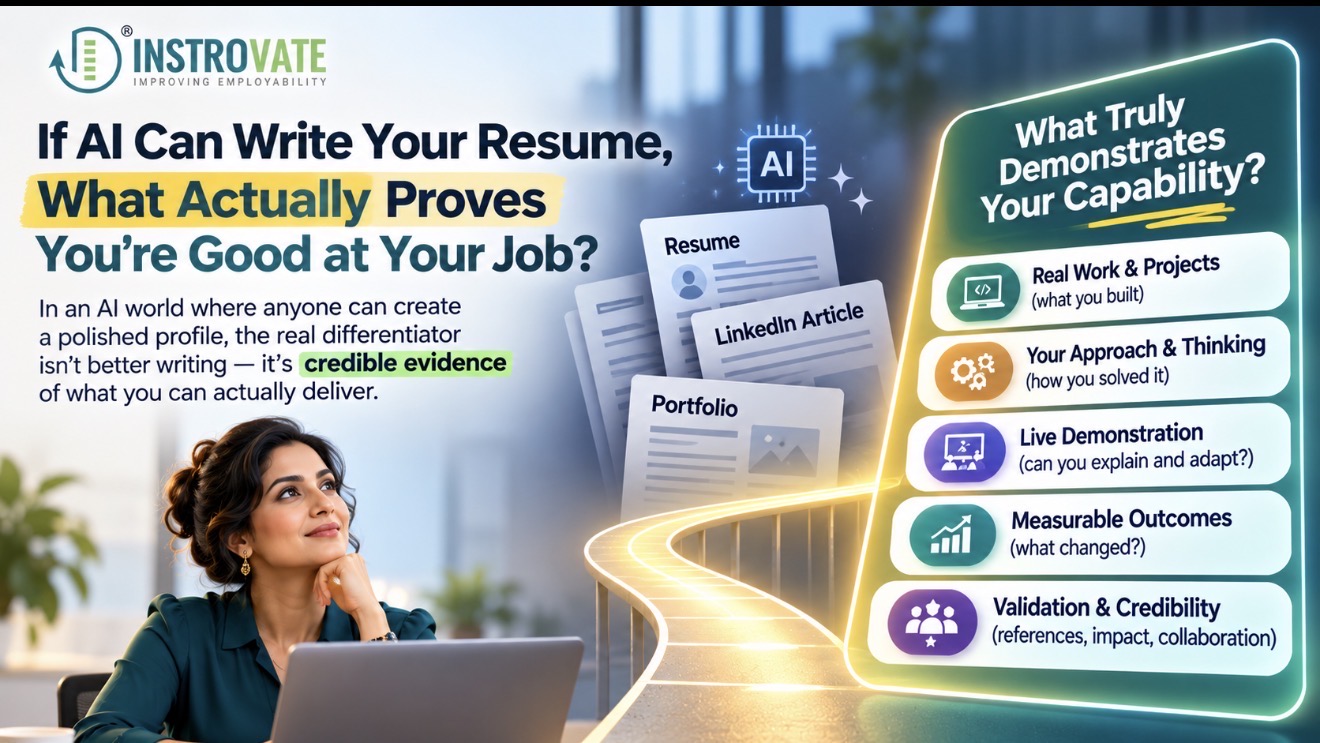
Imagine a professional profile with five dimensions.
1. Expertise: What do you understand?
A professional should be able to communicate their core areas of expertise. But instead of simply listing technologies or skills, they should explain the depth of their understanding.
For example:
“I understand data modelling.”
Versus:
“I have designed dimensional models for enterprise analytics, handled changing dimensions, optimised relationships for reporting performance and evaluated modelling approaches based on business requirements.”
The second statement provides more context.
It gives the reader something meaningful to explore.
2. Evidence: What have you actually built or delivered?
This is where a professional portfolio becomes important. But I don’t mean a portfolio that simply contains screenshots, certificates or attractive project descriptions.
I mean evidence of practical work.
A data professional could demonstrate a complete analytics solution.
A developer could showcase an application with its architecture and implementation.
A business analyst could present a case study showing how they translated business requirements into a solution.
A trainer could demonstrate how they designed a practical learning experience and evaluated its effectiveness.
The evidence should show what the professional contributed, not just what the team accomplished. Of course, confidentiality matters. Enterprise work cannot always be shared publicly. Sanitised case studies, synthetic datasets, anonymised architecture diagrams or recreated demonstrations can provide evidence without exposing customer information.
3. Process: How do you think?
This may be one of the most valuable signals. A final solution tells us what was produced. The process tells us how the professional approached the problem.
What was the initial requirement?
What assumptions were made?
What challenges appeared?
What alternatives were evaluated?
What decisions were taken?
What did the professional learn?
And where was AI used?
For example, a professional could share a short case study documenting the journey from a business requirement to a working solution. AI may have helped generate code, explore alternatives or accelerate development.
That is perfectly acceptable.
But the professional should be able to explain the decisions, validate the result and demonstrate their understanding.
The value is not in proving that AI was never used. The value is in demonstrating that the professional knows how to use it responsibly.
4. Demonstration: Can you explain and defend your work?
Imagine being able to explore a professional’s solution and then have a short conversation with them.
Ask them to walk through the architecture.
Ask why they selected a particular approach.
Introduce a change in the requirement.
Ask how they would respond.
Ask what could fail and how they would address it.
This is not about creating an intimidating examination. It is about giving professionals an opportunity to demonstrate their understanding in context.
A short live walkthrough, practical assessment or structured discussion can reveal dimensions of capability that a resume cannot.
This is particularly important in an AI-enabled environment where the ability to generate an output and the ability to understand that output are not necessarily the same thing.
5. Outcomes: What changed because of your work?
Ultimately, professional expertise creates value when it solves a problem. A professional should be encouraged to demonstrate outcomes wherever possible.
Did the solution reduce manual effort?
Did it improve reporting accuracy?
Did it accelerate a business process?
Did it improve decision-making?
Did it help a customer achieve a particular objective?
Not every outcome needs to be expressed in a financial metric. But the professional should be able to explain the impact of their contribution.
And when numbers are used, they should be accurate, contextual and verifiable where possible. This is where the professional conversation moves beyond skills and towards value.
The solution may not be a better resume. It may be better evidence.
I don’t think we need to eliminate resumes. They will continue to be useful. I don’t think we need to stop publishing LinkedIn articles. Professional communication and thought leadership will continue to matter. And I don’t think we need to reject AI-assisted portfolios.
AI can be a powerful tool for creating and presenting work. But perhaps we need to stop expecting any single artefact to prove professional competence.
A more meaningful approach could combine several signals:
A clear professional profile.
Specific and credible experience.
Practical work samples.
A documented problem-solving process.
A short demonstration or discussion.
References or validation where appropriate.
Evidence of outcomes.
Each signal provides a different perspective. Together, they create a more complete picture of professional capability.
This approach also needs to be fair and proportionate. Not every opportunity should require a lengthy unpaid assignment. Assessments should be relevant to the work, respect candidates’ time and evaluate the capabilities actually needed.
The objective should be to make expertise easier to recognise, not to create another barrier for professionals.
What about certifications?
I believe certifications will continue to have value. They demonstrate that a professional has invested time in learning and has met a defined standard of knowledge.
But a certification and the ability to deliver a real-world solution are different things. A professional may hold a certification and still need practical experience.
Another professional may have considerable practical experience without holding the latest certification. Both forms of evidence can be useful.
Perhaps we need to think of professional credibility as a combination of learning, experience, demonstrated capability and validated outcomes.
This becomes even more important as AI accelerates the learning process and makes it easier to explore new technologies.
We should encourage people to learn faster. But we should also create opportunities for them to demonstrate what they have learned.
A different approach to professional opportunity
This question leads me to something bigger. If professional profiles become more evidence-based, could it become easier for businesses to identify the right expertise?
Imagine a business looking for someone who can develop a data pipeline in Microsoft Fabric.
Instead of evaluating only resumes that mention Fabric, the business could explore professionals who have demonstrated relevant capabilities.
It could review their work samples, understand their approach, examine their experience and validate their expertise through a practical discussion.
If the requirement involves several different capabilities, professionals could potentially collaborate.
The opportunity would be to connect demonstrated expertise with genuine business requirements.
This is one of the ideas I have been exploring at Instrovate. Could we help professionals move beyond simply describing what they know and towards demonstrating what they can deliver?
Could professional development, practical validation and commercial opportunity become more closely connected?
Could AI support the process without becoming the only basis on which someone is evaluated?
I don’t believe there is a single perfect answer yet. There are challenges around validation, fairness, privacy, confidentiality, customer trust and the cost of assessments. And a profile or portfolio should never be treated as an automatic guarantee of future performance.
But I believe the direction is worth exploring.
The professional advantage in an AI-enabled world
Perhaps the future professional advantage will not come from having the most polished resume. Perhaps it will not come from publishing the most impressive articles. Perhaps it will not even come from knowing the largest number of AI tools.
It may come from being able to demonstrate something much more meaningful:
That you understand the problem.
That you know how to approach it.
That you can use AI and other tools responsibly.
That you can evaluate the output.
That you can explain your decisions.
And that you can deliver an outcome that creates value. AI may help us communicate our capabilities. But evidence is what can help others evaluate them.
In a world where almost anyone can generate an impressive professional profile, the real differentiator may be the ability to demonstrate what stands behind it.
That is the conversation I believe we need to start having.
Interested in being part of this journey?
If this vision resonates with you and you have expertise in an area where you’d like to collaborate, I’d love to connect.
Create your professional profile at CVFine.com and send me a DM on LinkedIn: linkedin.com/company/instrovate.
Let’s explore how we can combine expertise, AI and collaboration to create meaningful opportunities.
This is the fourth article in the series: The AI-Enabled Professional - From Skills to Outcomes.
The central question we’re exploring: How do we help professionals move from learning skills to demonstrating capability and from capability to meaningful opportunities?
Download our free e-book on “The AI Engineering Cost Trap” here : https://instrovate.com
Originally published on Substack