AI job losses are coming. Other than praying, what is your actual backup plan?
The answer to this question lies in this article! I posted a handwritten note yesterday. Three questions on a notebook page. AI job losses are coming. What is…
The answer to this question lies in this article!
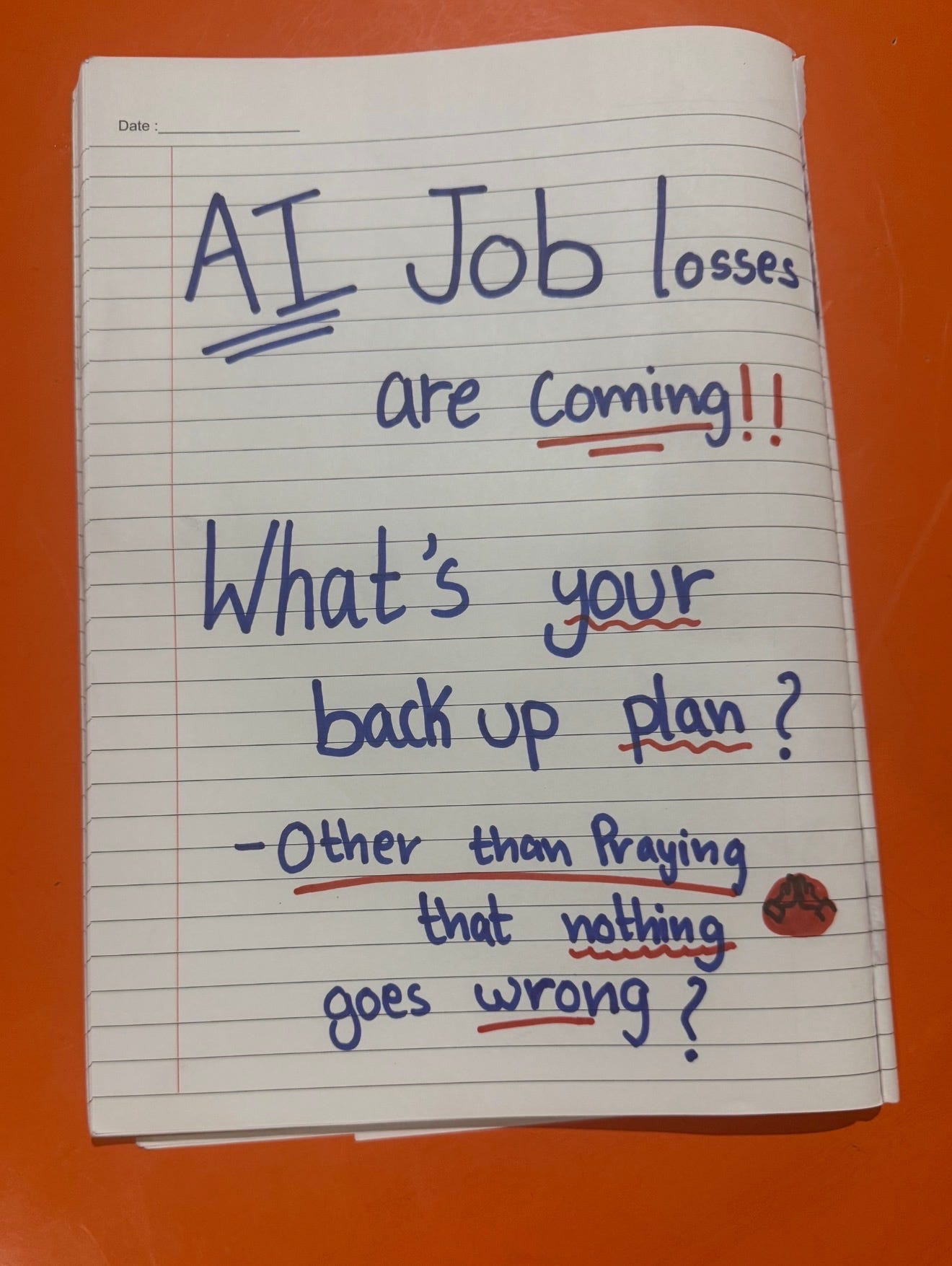
I posted a handwritten note yesterday. Three questions on a notebook page.
AI job losses are coming. What is your backup plan? Other than praying that nothing goes wrong?
I was not expecting much. It was a raw thought, not a polished post.
The response surprised me. Not just the volume of it. The nature of it. People were not debating whether job losses would happen.
They were asking the same question back at me, genuinely. What is the actual backup plan? What does someone practically do?
So this article is my honest answer to that question.
First, let us be clear about what is actually happening.
Companies are not sitting in boardrooms plotting to fire people because of AI. It is quieter and more structural than that.
A process that needed three people now needs one. A report that took a day now takes twenty minutes. A role that existed to bridge two systems is no longer needed because AI bridges them automatically.
Nobody gets fired in a dramatic moment. The role just stops being created. The headcount does not get replaced when someone leaves.
The team of eight becomes a team of five over eighteen months and nobody announces it.
That is how it happens. Gradually, then suddenly, to borrow a line that applies here better than almost anywhere.
The professionals who are caught off guard are the ones who assumed that because nothing had changed yet, nothing would.
The backup plan most people have without realising it is not a plan.
It is one of three things.
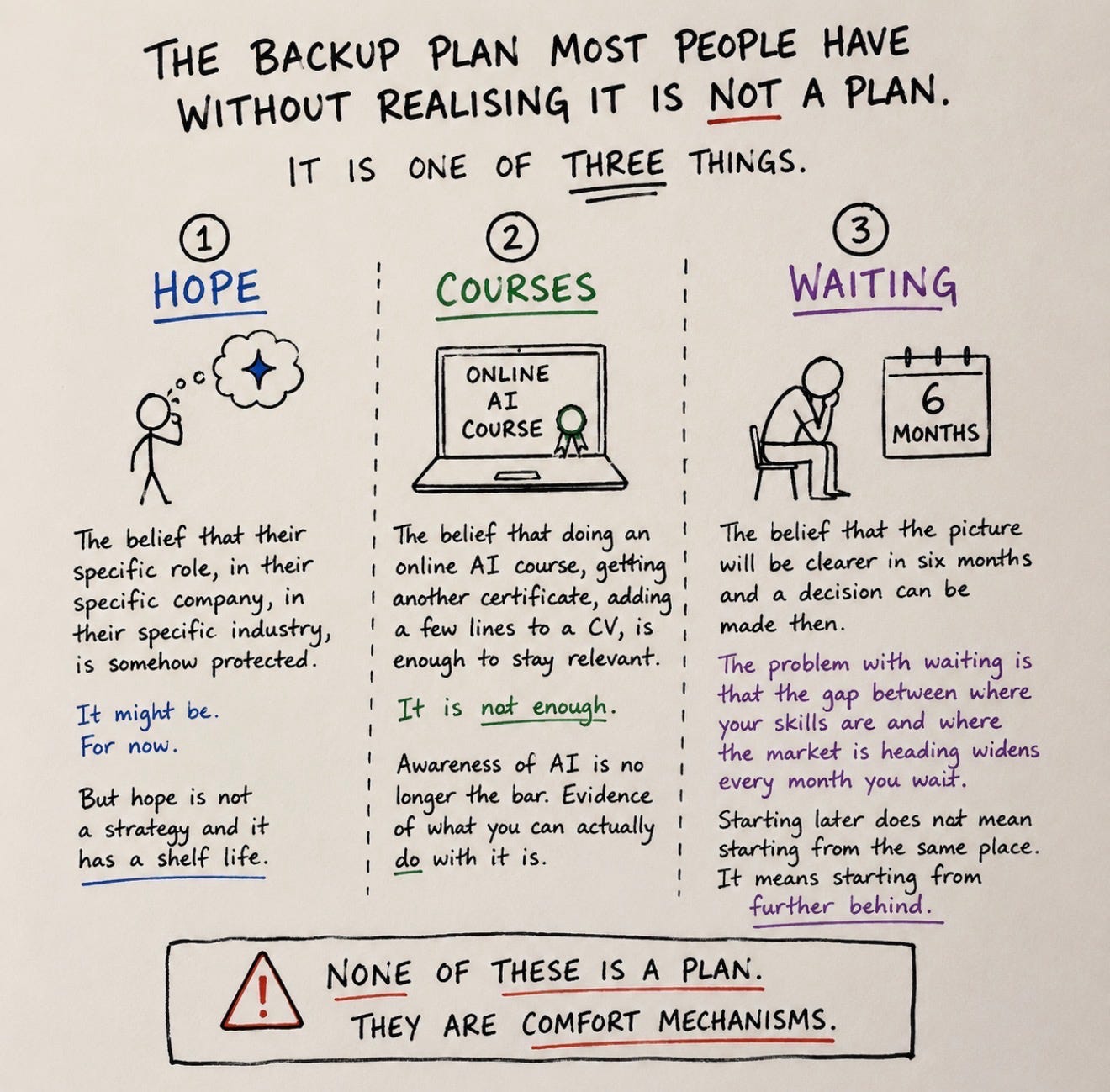
Hope. The belief that their specific role, in their specific company, in their specific industry, is somehow protected. It might be. For now. But hope is not a strategy and it has a shelf life.
Courses. The belief that doing an online AI course, getting another certificate, adding a few lines to a CV, is enough to stay relevant. It is not enough. Awareness of AI is no longer the bar. Evidence of what you can actually do with it is.
Waiting. The belief that the picture will be clearer in six months and a decision can be made then. The problem with waiting is that the gap between where your skills are and where the market is heading widens every month you wait. Starting later does not mean starting from the same place. It means starting from further behind.
None of these is a plan. They are comfort mechanisms.
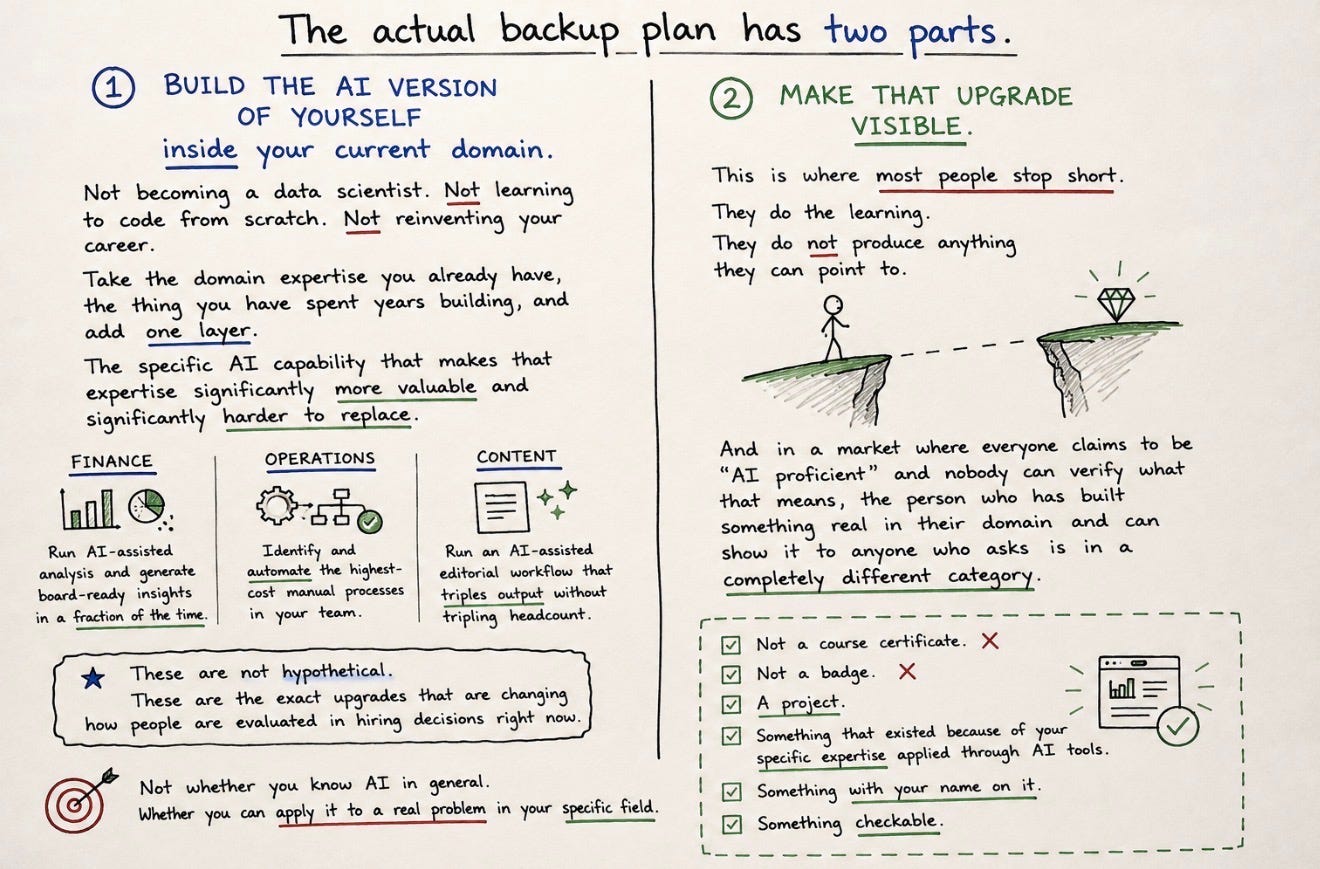
The actual backup plan has two parts.
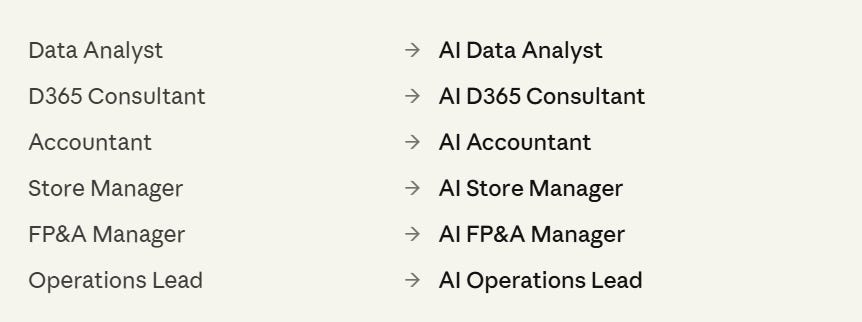
The first part is building the AI version of yourself inside your current domain.
Not becoming a data scientist. Not learning to code from scratch. Not reinventing your career. Taking the domain expertise you already have, the thing you have spent years building, and adding one layer. The specific AI capability that makes that expertise significantly more valuable and significantly harder to replace.
A finance professional who can run AI-assisted analysis and generate board-ready insights in a fraction of the time. An operations manager who can identify and automate the highest-cost manual processes in their team. A content professional who can run an AI-assisted editorial workflow that triples output without tripling headcount.
These are not hypothetical. These are the exact upgrades that are changing how people are evaluated in hiring decisions right now. Not whether you know AI in general. Whether you can apply it to a real problem in your specific field.
The second part is making that upgrade visible.
This is where most people stop short. They do the learning. They do not produce anything they can point to. And in a market where everyone claims to be “AI proficient” and nobody can verify what that means, the person who has built something real in their domain and can show it to anyone who asks is in a completely different category.
Not a course certificate. Not a badge. A project or another freelance job . Something that existed because of your specific expertise applied through AI tools. Something with your name on it. Something checkable - another freelance delivery, github repo , anything that you can show actually works .
Why this matters more than most people realise.
Your full time job is, at the end of it, a client relationship. The company pays you for a service. The moment a faster, cheaper, or more reliable way to get that service exists, the rational business decision is to move toward it. That is not cynicism. That is how organisations work.
The professionals who will be fine are not necessarily the smartest or the most experienced. They are the ones who took their expertise seriously enough to invest in its next version before they were forced to.
The ones who will struggle are the ones who waited for their employer to tell them what to do, or waited for the picture to get clearer, or waited for the right moment.
The right moment is always now and it always feels slightly too early. That is how it works.
The question I posted yesterday was not rhetorical.
I genuinely want to know. What is your backup plan? Not in theory. In practice.
What is the one skill, the one project, the one capability you are building right now that would keep you relevant if your current role disappeared tomorrow?
If you have an answer, I would genuinely like to hear it in the comments.
If you do not have one yet, that is also worth sitting with.
Originally published on Substack