What could I become capable of doing if I combined my existing expertise with AI ?
The next step in professional growth may not be learning an entirely new skill. It may be learning how to combine what you already know with what AI now makes possible.
For years, professional growth has followed a fairly familiar path. You choose a domain, develop expertise, gain experience, build a reputation and gradually become known for what you do.
A data analyst becomes a senior data analyst.
A software developer becomes a technical lead.
A finance professional moves into financial planning and strategy.
A trainer develops deeper expertise in a particular technology or subject.
We build our careers by becoming better at something. That foundation is still important. But something interesting is happening.
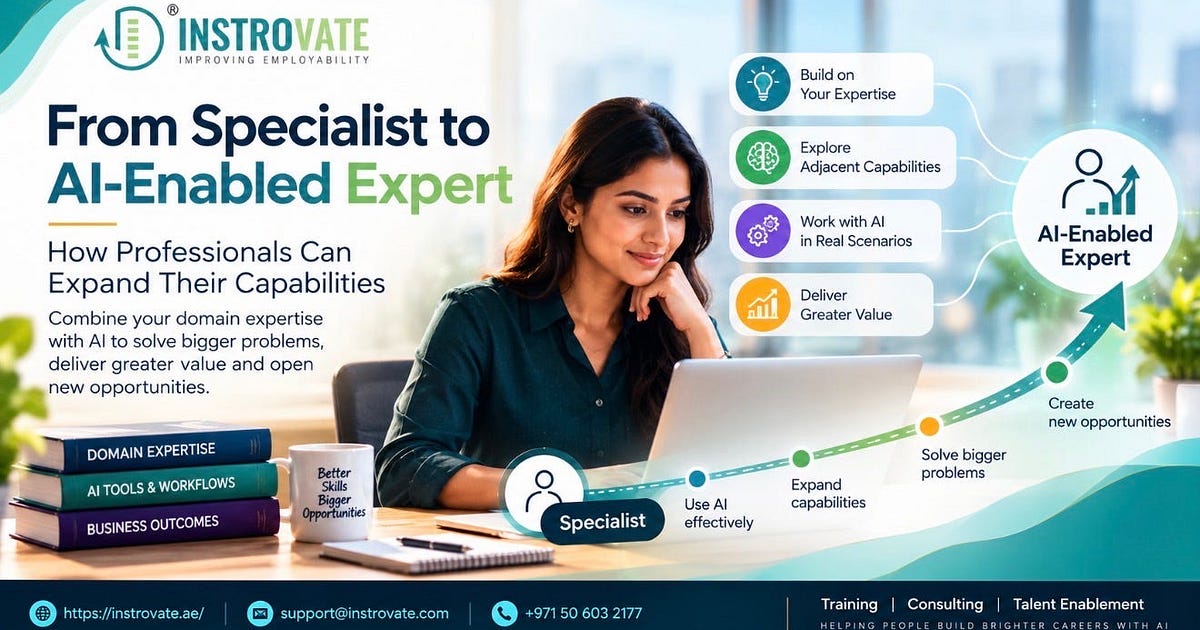
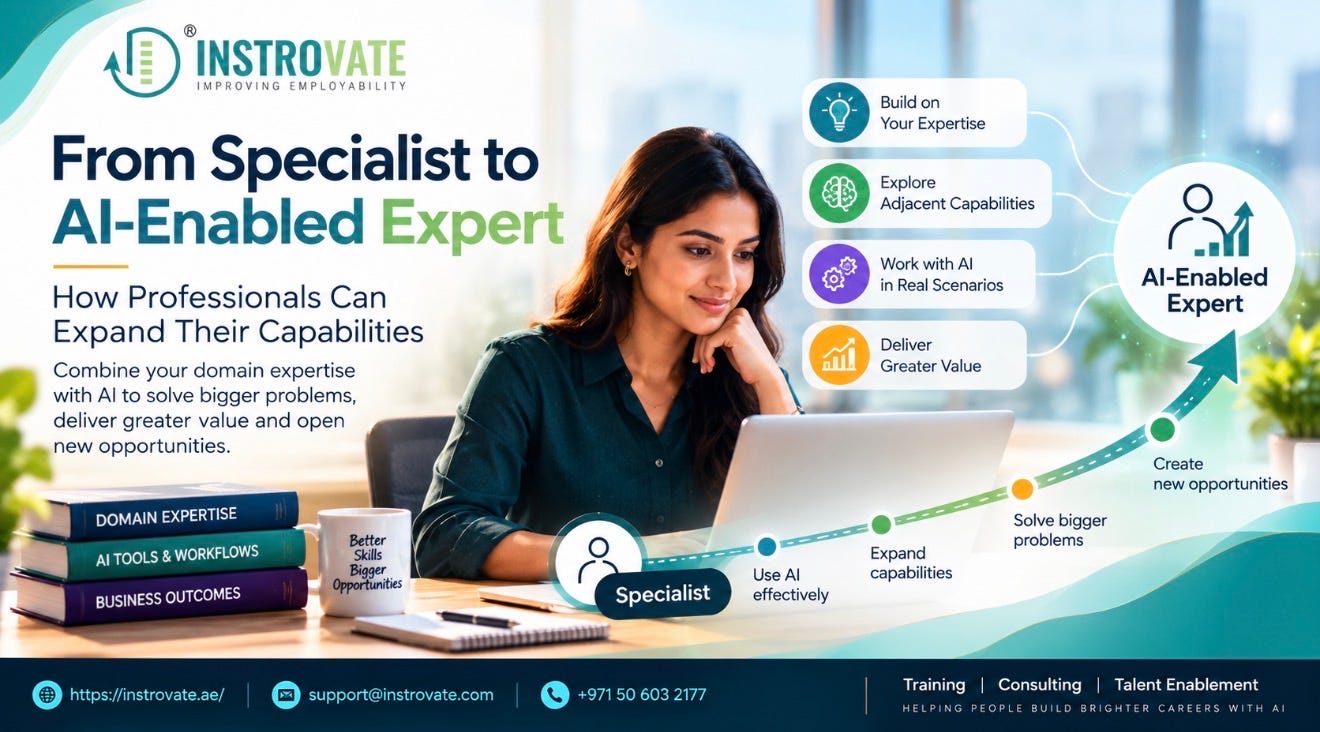
Artificial intelligence is beginning to change how far our existing expertise can take us. A professional who understands their domain can now use AI to explore adjacent areas, accelerate research, create solutions, automate repetitive work and experiment with tasks that previously required a different specialist.
This does not mean everyone should become an expert in everything. It means the boundaries of what one professional can contribute may be expanding.
Your expertise is still your starting point
Let’s consider a data analyst. Traditionally, their responsibilities might include understanding business requirements, extracting data, writing SQL queries, analysing trends, building dashboards and presenting insights.
Now imagine that the same analyst is comfortable working with AI. They can use it to explore unfamiliar datasets, generate and refine SQL queries, investigate possible explanations for unusual trends, draft documentation, create initial versions of reports and even experiment with simple automation.
With appropriate technical knowledge and validation, they may also begin exploring tasks that previously required collaboration with a data engineer or application developer. The analyst has not suddenly become a qualified data engineer or software developer. But their ability to contribute to a broader solution has increased. That distinction matters.
AI does not automatically transfer expertise from one discipline to another. It can, however, help an experienced professional explore new territory, provided they understand the problem, recognise limitations and validate the results.
The same principle applies across industries.
A finance professional can use AI to accelerate financial analysis and scenario exploration. A marketing specialist can investigate customer segments, develop campaign variations and analyse performance. A trainer can create learning simulations, generate practical exercises and personalise learning experiences.
The opportunity is not simply to do the same work faster. It is to expand the range of problems we can meaningfully contribute towards solving.
From using AI to working with AI
There is an important difference between knowing how to use an AI tool and knowing how to integrate AI into professional work. Many people can ask an AI assistant to write an email, summarise a document or generate a presentation.
These are useful capabilities, but they are only the starting point. The real value emerges when we understand where AI fits into a complete workflow.
For example, a professional might use AI to:
Research a business problem and organise the available information.
Explore possible approaches before choosing a solution.
Generate an initial draft of code, queries, documentation or designs.
Compare alternatives and identify potential gaps.
Automate repetitive steps within an established process.
Communicate findings more clearly to stakeholders.
But the professional still needs to decide what problem is worth solving, what information can be trusted, which approach is appropriate and whether the final result meets the required standard.
That is where domain knowledge becomes even more important. AI can generate an answer. Professional expertise helps us determine whether that answer is relevant, accurate, practical and responsible.
The risk of becoming dependent on AI
There is another side to this conversation that we should not ignore.
If we use AI to complete tasks without understanding them, we may become faster at producing outputs while becoming less capable of evaluating those outputs independently.
A recent study published in Nature Human Behaviour on 26 October 2026 examined 487 management consultants using ChatGPT to work on data science tasks outside their areas of expertise.
The researchers found that AI access and training helped participants perform better on those tasks. However, their improved performance did not translate into equivalent independent data science expertise when AI was no longer available. https://www.nature.com/articles/s41562-026-02566-6
This is an important distinction.
Being able to complete a task with AI is not the same as having acquired the expertise to perform it independently.
We should not confuse capability expansion with expertise acquisition. The goal should be to use AI as a learning and productivity partner, not as a substitute for professional understanding.
That means asking why a solution works, checking assumptions, testing results and learning from the process.
The strongest professionals will not necessarily be those who delegate the most work to AI. They will be those who know what to delegate, what to retain, what to question and what to verify.
Five ways to become an AI-enabled expert
I believe professionals can approach this transition through five practical steps.
1. Build on what you already know
Start with your strongest area of expertise. Understand the problems you solve, the decisions you make and the value your work creates. AI becomes more useful when you can give it meaningful context.
2. Identify the boundaries of your current role
Look at the activities that surround your work. What happens before your contribution begins? What happens after you finish? Are there adjacent tasks that slow down delivery or require additional coordination? These are potential areas where AI could help you contribute more.
3. Experiment with adjacent capabilities
Choose one area outside your immediate comfort zone. Use AI to learn the fundamentals, explore examples and build a small practical solution. Do not claim expertise simply because you can generate an output. Develop the understanding to evaluate it.
4. Learn to validate, not just generate
Develop the habit of checking facts, testing code, reviewing outputs, protecting confidential information and understanding the limitations of AI systems. Accountability cannot be delegated to a chatbot.
5. Connect capability to business outcomes
Ultimately, organisations do not adopt technology simply because it is interesting. They want better decisions, improved customer experiences, lower costs, faster processes, stronger products and measurable business value. Learn to explain how your expanded capabilities help achieve those outcomes.
The professional profile is changing
I think this shift will gradually influence how we describe ourselves professionally. Instead of defining ourselves only by a job title or a list of tools, we may increasingly need to explain the problems we can solve and the outcomes we can deliver.
Consider the difference:
A Power BI developer who builds dashboards. Versus A Data Professional who understands business questions, models data, develops decision-support solutions and uses AI to accelerate analysis and delivery.
A trainer who teaches technology. Versus a learning professional who combines deep technical knowledge, AI-enabled learning experiences and practical industry scenarios to help people become workplace-ready.
The underlying expertise remains important. But the second description communicates a broader ability to create value. This does not mean job titles will disappear. It means they may become less effective as the only way to communicate professional capability.
A new kind of professional growth
For organisations, this creates an opportunity to rethink how teams develop and collaborate. Instead of looking only at the number of specialists required for individual tasks, organisations can explore how experienced professionals, supported by AI, can contribute across a wider range of activities.
For professionals, it creates a responsibility to keep learning. And for training and consulting organisations, it raises an important question: are we preparing people only to pass certifications and learn tools, or are we helping them become capable of solving real-world problems?
At Instrovate, this is a question I find increasingly important.
Technology training must go beyond explaining features and demonstrating tools. Professionals need opportunities to apply what they learn, work through realistic scenarios, develop judgement and understand how their skills translate into business value.
I believe the next phase of professional development should bring together domain expertise, AI-enabled capability development and practical delivery experience. Not to turn everyone into a generalist, but to help specialists become more versatile, effective and valuable in their chosen fields.
The question we should be asking
The AI conversation often begins with a concern: Will AI replace my job?
Perhaps a more useful question is:
What could I become capable of doing if I combined my existing expertise with AI?
That question moves us from fear to preparation.
It encourages us to strengthen our foundations, explore adjacent capabilities and take responsibility for the quality of our work.
AI may make certain tasks easier to perform. But becoming someone who can identify the right problem, bring the right expertise, use the right tools and deliver a meaningful outcome will still require effort, judgement and accountability.
The opportunity is not to compete with AI at doing everything. It is to become the professional who knows how to make the best use of it.
Interested in being part of this journey?
If this vision resonates with you and you have expertise in an area where you’d like to collaborate, I’d love to connect.
Create your professional profile at CVFine.com and send me a DM on LinkedIn: linkedin.com/company/instrovate.
Let’s explore how we can combine expertise, AI and collaboration to create meaningful opportunities.
This is the second article in the series: The AI-Enabled Professional : From Skills to Outcomes.
Originally published on Substack