The AI Coding Reality Check: Why Human Developers Still Hold the Keys
A sobering look at the gap between AI coding hype and production reality We’re living through the great AI coding revolution—or so the headlines tell us. Every…
A sobering look at the gap between AI coding hype and production reality
We’re living through the great AI coding revolution—or so the headlines tell us. Every week brings new stories of developers claiming AI wrote 80%, 90%, even 95% of their code. The promise is intoxicating: why spend hours crafting functions when ChatGPT or GitHub Copilot can generate them in seconds?
But here’s the story they don’t tell you in those viral LinkedIn posts:
“AI wrote 80% of my code, but when it got stuck, the human developer had to step in… and ended up rewriting everything from scratch.”
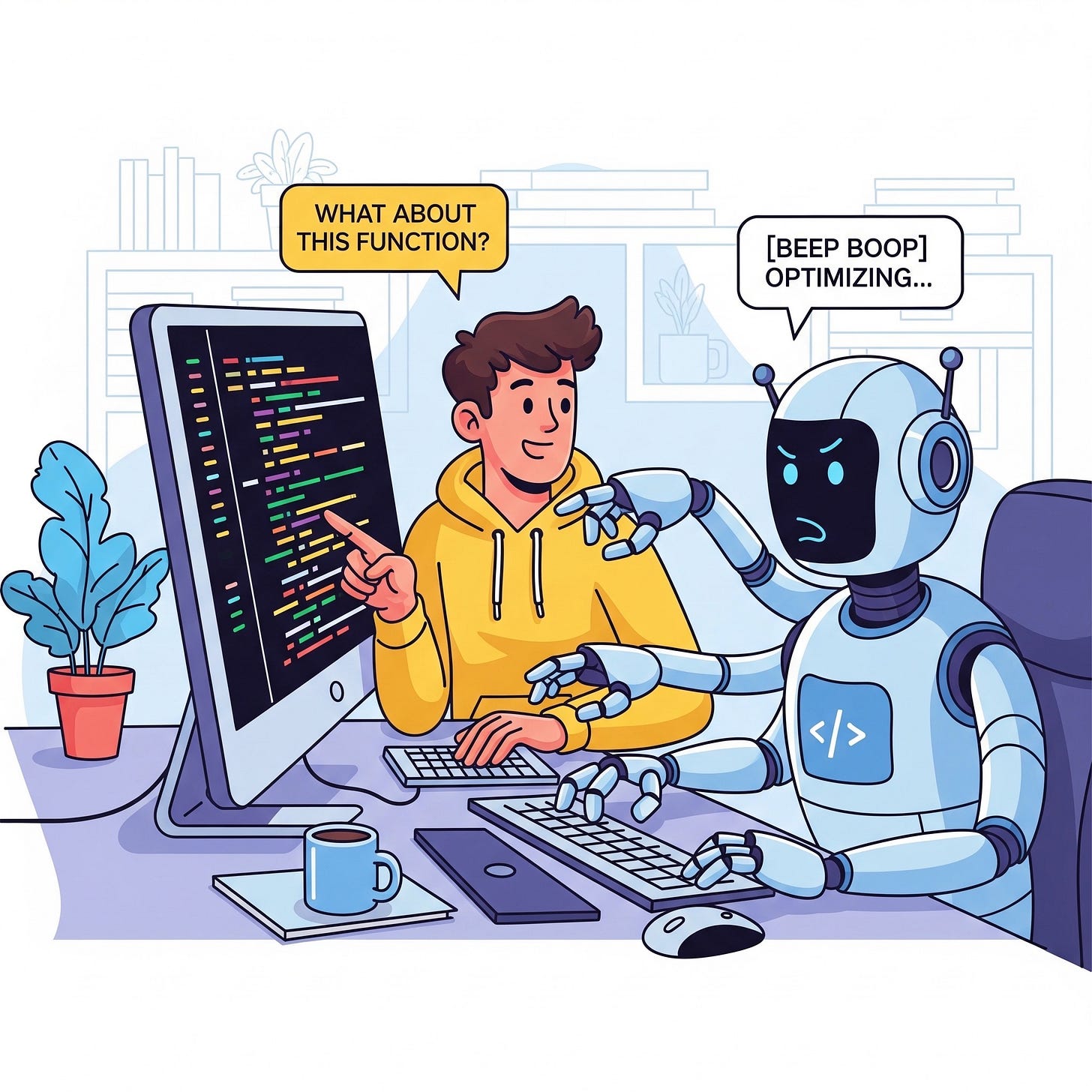
What looked like a massive head start became double the effort. The debugging alone took more time than writing the code manually from the beginning.
Sound familiar? If you’re a developer, you’ve probably lived this nightmare. If you’re a manager or founder, you might be wondering why your “AI-accelerated” development timelines keep exploding.
The Hidden Costs of AI-Generated Code
The problem isn’t that AI can’t code—it absolutely can. The problem is that we’re measuring the wrong thing. We’re counting lines of code generated, not lines of code that survive to production.
Here’s what actually happens in the AI coding workflow:
Phase 1: The Honeymoon
AI churns out impressive-looking code in minutes. Functions appear fully formed, complete with comments and seemingly logical structure. Dopamine hits. You feel like a 10x developer.
Phase 2: The Integration Hell
You try to integrate the AI-generated code with your existing system. Nothing works as expected. Edge cases weren’t considered. The code assumes perfect inputs and ideal conditions that don’t exist in the real world.
Phase 3: The Debug Marathon
You start debugging. But here’s the cruel irony: debugging code you didn’t write is exponentially harder than debugging your own code. You don’t understand the AI’s reasoning, its assumptions, or why it made certain choices. Every bug fix becomes an archaeological expedition.
Phase 4: The Rewrite
Eventually, you realize it would be faster to rewrite the problematic sections yourself. You understand the requirements better, you know the codebase, and you can optimize for maintainability—something AI consistently fails to do.
The Accountability Problem
This brings us to a deeper issue that goes beyond mere productivity: accountability.
In traditional software development, there’s a clear chain of responsibility. The developer who writes the code owns it. They understand its assumptions, limitations, and potential failure modes. When something breaks at 3 AM, they know where to look first.
But what happens when AI generates the code?
We’re creating a dangerous gray area where nobody truly owns the outcome. The AI generated it, so it’s not “your” bug. But you integrated it, so it’s not entirely the AI’s fault either. This diffusion of responsibility is a recipe for fragile, unmaintainable systems.
The Production Reality Check
Here’s what I’ve learned from watching teams try to scale AI-assisted development: production doesn’t care about your coding velocity if the code doesn’t work.
Quality trumps quantity, every single time.
The clients calling at midnight about a critical bug aren’t interested in hearing that “the AI wrote that part.” They want it fixed, and they want it fixed by someone who understands the system deeply enough to prevent similar issues in the future.
A Better Framework: AI as the Capable Intern
I’m not anti-AI. The technology is genuinely impressive and will only get better. But I think we need a healthier mental model for how to use it.
Treat AI like a talented but inexperienced intern:
• It’s fast and eager: Can generate boilerplate, explore multiple approaches, and handle repetitive tasks efficiently
• It lacks context: Doesn’t understand your business logic, existing architecture decisions, or team coding standards
• It needs supervision: Every output requires review, testing, and often significant modification
• It’s not production-ready: You wouldn’t ship an intern’s first draft without extensive review—same principle applies
The Human-AI Balance That Actually Works
The most successful AI-assisted development I’ve seen follows this pattern:
1. Human-Led Architecture
The human developer designs the system architecture, defines interfaces, and establishes the overall approach. AI can suggest patterns, but humans make the final decisions based on non-functional requirements the AI can’t understand.
2. AI-Assisted Implementation
Use AI to generate initial implementations of well-defined functions, create test cases, and handle boilerplate code. This is where AI shines—when the requirements are clear and the scope is limited.
3. Human Review and Refinement
Every AI-generated piece goes through thorough human review. Not just “does it run?” but “is it maintainable?”, “does it handle edge cases?”, and “does it align with our architectural principles?”
4. Human-Owned Testing
Write your own tests, even if AI helps generate test cases. You need to understand what scenarios you’re testing and why. This is where you catch the subtle bugs that will haunt you later.
5. Human Accountability
The human developer signs off on the final code. They own it, understand it, and can defend the implementation choices when questions arise.
The Skills That Matter More Than Ever
This framework means certain human skills become more valuable, not less:
System Design: AI can’t architect complex systems or make nuanced trade-offs between competing requirements.
Code Review: The ability to quickly identify problematic patterns, security issues, and maintainability problems becomes critical.
Debugging: When AI-generated code fails, human debugging skills are what save the project.
Business Context: Understanding why you’re building something is more important than how fast you can generate the initial code.
Quality Judgment: Knowing when “working” isn’t good enough—when performance, security, or maintainability concerns should override speed.
The Long-Term View
Will AI eventually reach true coding autonomy? Maybe. But we’re not there yet, and we might not be for quite some time.
Current AI models are sophisticated pattern matching systems. They’re trained on existing code, which means they excel at reproducing common patterns but struggle with novel problems, complex business logic, and the kind of creative problem-solving that defines great software engineering.
Even if AI capabilities improve dramatically, the accountability problem remains. Software systems are too critical to our infrastructure, economy, and daily lives to operate without clear human ownership and understanding.
The Bottom Line
The developers who thrive in the AI era won’t be those who can prompt-engineer the fastest code generation. They’ll be the ones who can:
• Quickly evaluate AI-generated code for quality and correctness
• Seamlessly integrate AI assistance into a human-driven development process
• Maintain deep system understanding even when AI handles implementation details
• Take full ownership of the final product, regardless of how much AI contributed
Because when the system crashes in production, the client isn’t calling the AI—they’re calling you.
The future of software development isn’t about replacing human developers with AI. It’s about augmenting human capabilities while preserving the critical thinking, accountability, and craftsmanship that make software systems reliable.
AI can make us faster, but only humans can make us responsible.
What’s your experience with AI-assisted coding? Have you found the balance between AI efficiency and human accountability, or are you still navigating the debugging marathons? I’d love to hear your thoughts in the comments.
Originally published on Substack