🔍 AI-Ready Engineer Day 2 — How Large Language Models (LLMs) Actually Work
Welcome back to #AIReady — a 30-day AI Engineering series for Data Analysts and Engineers
If you’ve ever wondered how a language model like GPT or Claude works, but didn’t want to drown in research papers — this one’s for you.
Let’s break it down, simply.
🧠 Step-by-Step: How LLMs Work
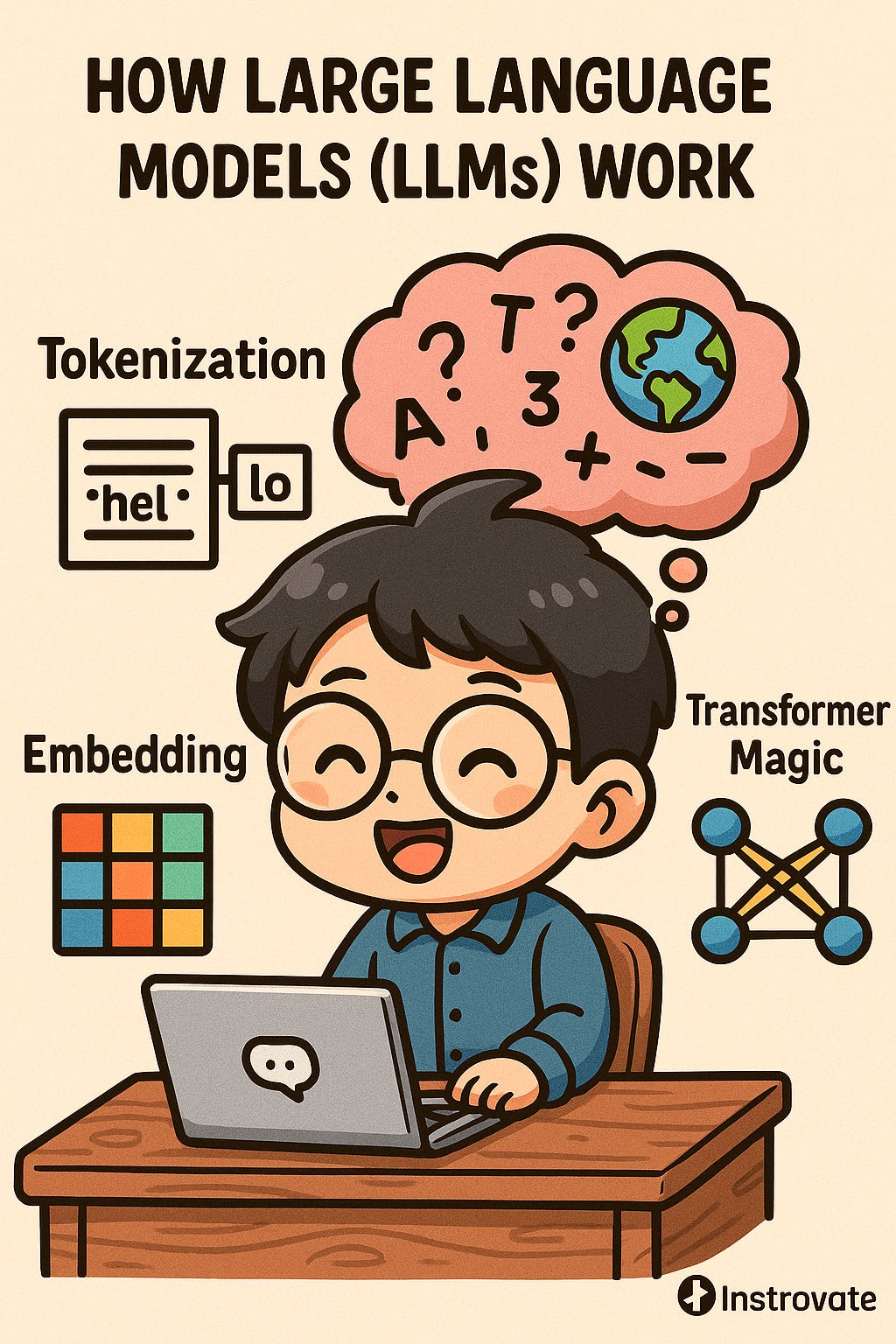
Tokenization
Everything starts by splitting your input (“query”) into chunks called tokens — parts of words like['hel', 'lo']or full words like'banana'.Embedding
Each token is converted into a vector — a list of numbers that captures its meaning in multi-dimensional space.Transformer Magic
LLMs use something called a Transformer architecture — a layered neural network with components like:Self-Attention: Helps the model understand which words matter most
Positional Encoding: Keeps track of word order
Feedforward Layers: For learning deeper patterns
Training
The model reads huge amounts of text and learns to predict the next word.
Example: Given “India won the”, it learns to say “match” instead of “banana.”Fine-Tuning & Alignment
After pretraining, models are aligned to behave safely and helpfully using:Specific datasets
Human feedback (RLHF)
Guardrails for safety
Generation
When you prompt the model, it calculates probabilities and picks the most likely next token — again and again — until your response is formed.
💡 TL;DR (Too Long? Read this)
LLMs are giant pattern predictors trained on internet text. They don’t think — they predict what comes next based on training.
They don’t know “truth,” but they know what looks like a good answer.
🔄 Real-World Relevance
As a Data Engineer or Analyst:
You don’t need to build a model like GPT.
But you do need to understand what it expects — tokens, embeddings, prompt structure — so you can use it well in RAG apps, copilots, and automations.
See you tomorrow for Day 3:
“What Is RAG (Retrieval-Augmented Generation) & Why It’s a Game-Changer”
🧠 Subscribe to follow along
All 30 posts will be bite-sized, visual, and code-friendly.
Originally published on Substack